




Please note: this article discusses suicide. If you are thinking about suicide, are worried about a friend or loved one, or would like emotional support, the Lifeline network is available 24/7 across the United States. The number to call is: 800-273-8255.
1.
Life has its seasons. At thirty-seven years old, I’m in what you might call my “American capitalist” phase. I live in New Jersey but work for a large media company in New York, a second act career after nearly ten years as a teacher. Every day, I go down into the termite tunnels of the PATH train and chug under the Hudson alongside other long-sufferers of the commuter class. We’re a democratic bunch: bankers, software engineers, bricklayers. The whole mixed bag. Our democracy isn’t vocal or obvious. What unites us is the long-suffering, pretty much. Train delays. Track work. We jostle one another, mostly don’t talk, avoid eye contact.

At 33rd, we are disgorged and carom up to the street. I like to walk west along 34th, where the sidewalks are wider. Some days there are protestors or doomsayers proclaiming various horrible endings, religious, political, climatic. One gentleman in particular has a penchant for oversized signage, held aloft. He parts the crowds under the shadow of a search term. Buy crypto. Google it.
Further west I arrive at a glass tower. This one still has the whiff of an architectural rendering. A large mall occupies its base. I take two escalators and walk past stores like Louis Vuitton, Rolex, and Genesis — the latter being a South Korean luxury car maker, with whole-ass cars on the second floor. I scan my badge at the corporate lobby entrance and am whisked up by elevator for a series of meetings, emails, and pitch decks — a mélange of what is considered, institutionally speaking, “creative” work. From my desk I look down on a massive 150-foot tall sculpture called the Vessel, comprising 154 intricately interconnected flights of stairs. You used to be able to climb each flight to the top. But the Vessel is empty now, barred and guarded. It was closed soon after opening because too many people were committing suicide by leaping off it.
After work, after the mirror-image commute home, my daughters, five and three, greet me at the door of our third-floor pre-war walkup. Dinner is usually ready, or almost ready, when I arrive. My wife cooks most days. Maybe it’s a retrograde way to divide the labors of parenthood, but it works for us. After dinner, we all play video games or stuffed animals together, then start on the blessed path to sleep. There’s a Jenga tower quality to this part of the day, a feeling, hard to shake, that the mishandling of even one brick — teeth brushing, potty, PJs, story books — could lead to the destruction of the whole enterprise. But we get there in the end, singing hymns in the dark until the girls are asleep.
At which point my wife and I have two hours, tops, before we collapse into bed. The act of reading, once a great shared joy, seems closed to us now. We nod off after only a few pages, disappointed in the weakness of our flesh. An episode or two of a good show is some substitutive consolation. But the greater consolation is oblivion: the dreamless, self-less sleep known by parents of young children everywhere. These days, this oblivion takes me almost every night without fail — until, still exhausted, the giggles of two little girls wake me, the clock reads 5:30am, and I come back to the world to do it all over again.
Months, years of this with minor variations.
2.
How does this sketch of my life strike you?
Does it seem glum? Privileged? Self-aggrandizing? Self-pitying? Dull?
For me, lately, I am struck by the fact that its fundamental contours are indistinguishable from those of my grandfather’s, who took the Long Island Rail Road every day into Manhattan after the war to his office at the Bell telephone company. He lived under the same dictates. Make money. Provide for your family. Climb the ladder. Seen from that angle, I’m only a latecomer in a long, long line, taking my place in the melancholic, rat-race story shared by millions across the generations, and which, despite many recent innovations, has not disappeared yet. As a quintessential diagnosis of the American condition, “lives of quiet desperation” has been a hot-take since Walden Pond, 1854, after all.
Or maybe that has it backwards. Maybe there’s something enlivening or even admirable about this story, of which I am a small paragraph or mere sentence. It’s the human epic we are all invited to take part in: the vitalizing struggle to make something of one’s self, to make a better life. Consider it an outworking of “the universal eligibility to be noble” voiced by Augie Marsh, that prototypical American, a subspecies of our great collective vocation to keep things going onward and upward in perpetuity.
Or maybe this is all too overheated for your tastes. Maybe you’re like me, who, years ago, when I saw a performance artist dressed like an Orthodox Jew diving into an inflatable kiddie pool and screaming, “I’m falling into shit!” over and over in various registers of distress, thought yes.
Maybe that’s it. Life as a series of descents into shit. Train bullshit. Work bullshit. Money bullshit. Kid bullshit. The same bullshit everybody has to navigate, and then you die. Which, while bleak, at least has some humor, albeit of the gallows pole, about it.
And yet.
3.
I am grateful for my life. I can’t escape the feeling.
Which is kind of a marvel to me, because there was a good stretch back there, say from thirteen to seventeen, when I thought about killing myself more or less constantly. It was a painful time. I had moved from the Philippines, where I was born, to a small town in Pennsylvania, where I most definitely did not want to be. It was hard for all the reasons you can imagine it being hard. And it was also perfectly mundane. The bottom line was I had the unshakeable feeling I would never be happy again.
I would’ve been a wrist-cutter, which makes me cringe now. At the time, there was some thing poignant about the thought of wearing all that blood down my arms. The blood held a straightforward metaphoric power. Its visibility drew me: a physical manifestation of the anguish I felt, of inside pain turned outside. You’d think that logic would’ve led me to something less drastic, like simply cutting myself. But I’d never heard of that then, and so never considered it.
What I had heard of was suicide. Around that time a friend of a friend hung himself in the mild Pennsylvania woods behind his house. Afterward my friend, the one left behind, told me he spent an evening looking at the rifle in his room, and imagining firing it into his mouth. We became a depressed little pair. We kept each other circling the suicide drain, arms linked, dragging ourselves down. Each of us disappointing the other with how little we had to give, how needy we were. I was a bad friend to him. Too wrapped up in my own circumstantial sadness. But in the end neither of us ended up killing ourselves, so maybe that strange embrace counted for something.
There were other compounding factors. It was the early, wild days of the internet, and the horrors of the world could intrude easily at any moment. Horrible images of gore on otherwise innocuous message boards would load line by line then suddenly all at once. Tiny, grainy videos of beheadings were intentionally misnamed and swapped on Napster. Low-res digital ephemera was everywhere, of people dying, of human suffering, of cruelty to animals. In today’s internet, these are still just a click away, and there was a sense then, just as there is now, that you could run across them in the normal course of business, like being mugged on the way to the corner store. And I had a hunger to see these things, feeling as if the secret shape of the world was contained therein. They were evidence. They corresponded with my own sense of the way things were.
Because I had my own memories, too, which dogged me: of the street kids my age, dirtied and in rags, who were constant companions in Manila, where I grew up, their upturned hands at the car windows, outside the storefronts, down the block, and whose situation seemed nonsensical and unjust; of the toddler I saw once, a baby, really, on a garbage heap, something the color of pea-soup oozing from his anus, crying and crying and no one coming to comfort him; of the story my mother told me about a friend of the family, whose father was a human rights lawyer in the Marcos era, and who was chopped up for his noble pains and put into a bag for his daughter, our friend, to discover. And so on. This was what was more true to life, I felt, not the perfectly lovely suburban home I’d moved to in perfectly lovely small-town Pennsylvania.
By some transmogrification, then, I came to associate suicide with a repudiation of human suffering writ large. I had a sneaking suspicion we should admire them — those few who, in my telling of it, at least, could never get accustomed to these things, who found that the only decent thing to do in the face of the overwhelming pain of the world was to turn away, permanently. It was easy for this to slip into disdain for myself and for the rest of the, er, living. Because one way or another we went on — a fact that condemned us.
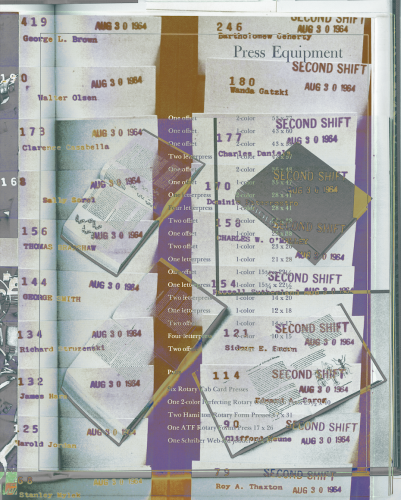
James Welling, Notation 2_11H, 2015-16. Dye Sublimation Print, 20 x 16 in.
Anyway, you get the idea. Whether or not all this was justified, whether or not at twelve or thirteen or sixteen I had any right to feel this way, or knew anything at all about the way of the world, the wound of it felt real enough to me. And I can’t help but have compassion on that self-involved boy, who spent so many nights looking up at the spackled ceiling above his bed in silent pain and thinking too much about turning his back on it, who felt that the only tenable solution to the human situation was an immediate exit through the house of death.
Looking back, I wonder how close I was to actually going through with it. Not close, I think. The ideation was strong, and I spent a lot of time looking into that void, and thinking about what it would mean. But life, blessedly, rolls on. Things happen. I am swept on by circumstance. I have college to attend, girls to meet, books to read, new music, new movies to bowl me over, new friends. And in snatches at first, and then for longer periods, and then as a more or less stable baseline, I find myself enjoying some measure of happiness.
Even so, suicide is a kind of shadow. It is a challenge, repudiation, temptation, and puzzle all in one. In the years since, the shadow has receded. But I’ve remained attuned to it, and though suicide has stayed more or less at arm’s length in the intervening years, arriving via the generally remote forms of celebrity news, literature, memories, occasional periods of depression, or very distant relatives, it still never fails to get my spectral antennae twitching.
4.
Then she took her life during covid. And all these things come rushing back.
Her name was Ashley. We’d both moved to New York around the same time. We were both around the same age. We both had two kids. And if we weren’t fast friends, we were certainly friendly, and we worshiped together at the same small scrappy church in the West Village and saw each other at the same parties and loved many of the same things.
And now she is gone, and it really hurts.
5.
At church this past Advent we prayed the bidding prayer, which includes this passage:
Lastly, let us remember before God all those who rejoice with us, but upon another shore, and in a greater light, that multitude which no man can number, whose hope was in the Word made flesh, and with whom in the Lord Jesus we are one for evermore.
After the service a friend told me she’d been thinking of Ashley during that prayer, and something broke in both of us at the same time as she said it, and we were crying together, hard ugly crying, in the cold stairwell outside the women’s bathroom.
And I have cried most Sundays since, thinking about Ashley. Nothing that dramatic. Just a few silent tears in my pew. It’s a new thing. Even in those depressed adolescent days I wasn’t much of a crier. But I’ve cried more in the last six months than I have in a long time. It’s strange.
I cry at the children gathered at the front of the church, arrayed for prayer before they head down to Sunday school, and at the few faithful congregants who outstretch their hands toward them, praying with their eyes closed, praying earnestly for these our little ones. And I hope to God the impossible thing, that the shadow of death would never fall across them. And I think of Ashley’s two sweet boys.
I cry thinking of all this small congregation has endured: suicides, stillborns, cancers, job loss, manic episodes, heartbreak, depression, death. It’s not the fact of this suffering that makes me cry so much as it is those who’ve survived it, who are still here, and who suffer, sometimes without apparent reason, sometimes without explanation, but more often than not on purpose for the ones they love.
At the final hymn, I cry at the sweeping sound of the choir during the descant, bursting to life behind us from the upper balcony, when suddenly this congregation’s plodding voice is taken up and sent sailing into the stratosphere, and my poor voice, too, is welcome, and gathered with the others to be part of something so beautiful.
And I cry at certain lines from Gerard Manley Hopkins, which had gone dry for me for years, but which I return to now like a deer at a salt lick:
Give beauty back, beauty, beauty,
beauty, back to God, beauty’s
self and beauty’s giver.
See; not a hair is, not an eyelash, not
the least lash lost; every hair
Is, hair of the head, numbered.
And:
… the thing we freely forfeit is kept
with fonder a care,
Fonder a care kept than we could have
kept it, kept
Far with fonder a care (and we, we
should have lost it) finer, fonder
A care kept.
I collect these things that make me cry, and carry them with me against everything contrary. I receive the tears they give as mercies, parched as I am. And looking around the sanctuary, the office, the PATH train, the living room, it is a grace to know I’m not the only one.
6.
So I am returned to my life. Picture us there at the dinner table. It’s only a few days ago. My youngest daughter is refusing, again, to eat anything we put before her. She climbs up and down out of her high chair, whines, is unpleasant and rude. My wife and I have our hands full. We can barely talk, we can barely eat trying to deal with her. Meanwhile my other daughter has somehow magicked the cinnamon shaker to the table. She pats a huge cloud onto her plate, and is suddenly squealing. She’s gotten some in her eye and it burns.
“It’s always something,” my wife says, beyond exasperated now, sweeping her up to wash out her eyes in the sink.
It’s always something. But it’s better than nothing. My God, it’s so much better than nothing.







Thank you, Josh. I relate to so much of this, and I miss Ashley all the time.
Josh, you are a master with words. Thanks for sharing this as only you can.
My eyes fill with tears as I ponder again the pain you experienced moving back to the States and the impact it had on your life. I’m encouraged that the Lord sustained you through it and that you’ve grown to be a good and kind man who loves Jesus.