




Does a missed baseball pop fly show the working of grace? It does. I will explain.
One late Saturday afternoon during a Virginia summer in the 1960’s, as the sun was beginning to set, my father and I were playing catch in our front yard. The hot, humid day was starting to cool. I was 12 years old and a good-field, no-hit shortstop on my Little League team. Our catch included grounders and pop-ups that my father would throw to me. As twilight came on, my father and I kept saying, “One more, one more,” to prolong our enjoyable pastime. He threw a pop-fly. I settled under it to make the catch. In the gathering darkness, I missed it, and the baseball hit me squarely in my mouth.
Stunned, my tongue immediately went to my upper gum. I realized instantly that one of my front teeth was gone. I ran screaming into our house. Not long before, I had seen another boy who had lost one of his permanent teeth; he had a false tooth that he would play with. For some reason, I found this revolting and formed a belief that this would be one of the worst things that could happen to someone. As I stood over a sink in our basement, with blood pouring out, I kept crying over and over, “I don’t want a false tooth!” My nightmare as a 12-year old had happened.
What does this have to do with grace? For starters, providential things began to occur right away. For some reason that he could never explain, my father saw my front tooth, completely intact and lying on the sidewalk after I ran into the house, picked it up, and put it in his pocket. As he and my mother tried to deal with a hysterical child, they realized that I needed to see a dentist. But it was a Saturday night, and our regular dentist’s office was closed. My father was a YMCA executive, and in desperation he called one of the members of his Y’s board of directors who happened to be a dentist. This wonderful man (improbably but appropriately named Dr. Goode) said that he would open his office and told us to meet him there. His calm, confident demeanor that night reassured me and began to give me confidence. Learning that my father had the missing tooth in his pocket, he did what amounted to a tooth transplant — i.e., he fashioned a plate with a hook on the end, cleaned the tooth, reinserted it into my gum, and put the plate in the roof of my mouth to hold it. He said that I would have to use the plate for some time until the tooth took hold again. I would not for now need the nightmarish false tooth! However, he said at some point — and it could be years — the body would reject the tooth, and I would need some type of bridge. Given the shock that I had sustained, he advised that I rest in bed for a day or two.
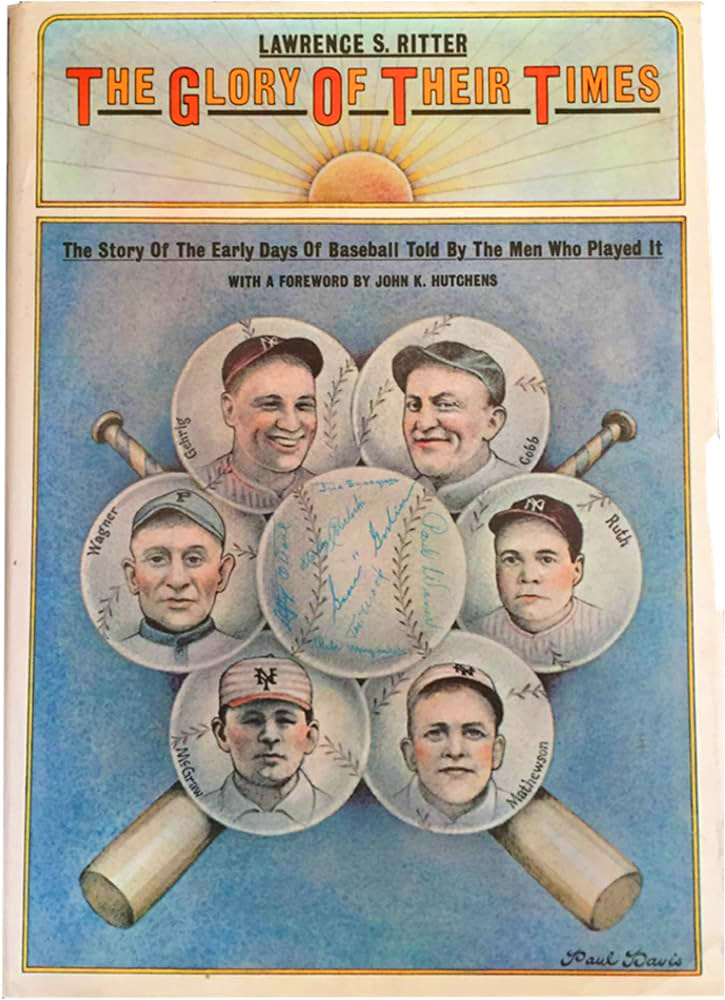 Grace was not done yet. When my father came home from work the following Monday, he brought me a present. Knowing my love of baseball, he bought a book about baseball just out: The Glory of Their Times, by Lawrence Ritter. It turned out that this was not just any baseball book and certainly not the typical boys’ sports offering. Ritter, an economist and professor at NYU’s business school, had compiled an oral history of the early days of baseball by traveling the country and recording the recollections of players from the early 20th century.
Each chapter focused on a single player who told his story in his own words. The chapters began with excerpts from works of literature, poetry, and other apt material that Ritter used to frame what the former players told him. The very first chapter, for example, on Rube Marquard, who ran away from home to pursue his baseball career, quoted a passage from Jack London’s The Apostate. The players’ stories not only covered their careers and incidents from their playing days, but also provided a rich portrait of America as its century dawned. Ritter included numerous evocative photos from that time. The players, now older men, had wise and insightful observations about life. While they typically had little formal education and often came from hardscrabble backgrounds, they were surprisingly articulate and even literate. The book’s title itself was thought-provoking; it came from Ecclesiasticus 44:7. As Ritter said in his preface, the book was about the early days of baseball in the same way that Moby Dick was about whaling.
I devoured that book. It remains, in my opinion, the best book on baseball ever written. At age 12, it opened a world distant yet somehow familiar. Now an older man myself, about the age of the players in the book, I can see that it awakened my life-long interests in American history and literature. While I was a dutiful Episcopal lad whose parents made sure I attended church regularly, the quotation from Ecclesiasticus showed me how the Bible could speak to us and illuminate life today — in a way that no sermon or Sunday School lesson ever had. And, of course, it fed my interest in baseball. In retirement, I have been writing about baseball and given presentations at the Hall of Fame in Cooperstown on baseball and American culture.
So yes, a missed pop fly did lead to grace — revealed in the instincts of a loving father, the kindness and generosity of a doctor, and a gift that kindled a lifetime of enriching interests. Sometimes the things we fear the most do happen. But that is not the end; there is One who is more. In those panic-stricken and dark moments, grace mysteriously goes to work.





[…] is a good example of sports testimony. “So yes, a missed pop fly did lead to grace — revealed in the instincts of a loving […]