You may recall the rise of words like “storytelling,” “craftsmanship,” and even “creator” in the 2010s. Already, certain corners of culture were pushing back on the digital sphere and trying to remind us that doing things and making things with our hands were an inextricable part of being human. In a recent interview I did with Christian apologist and C. S. Lewis scholar, Louis Markos, we talked a lot about scripture as metanarrative and the important role storytelling plays in guiding us to truth. But unfortunately, these are not the only reasons these words came to dominate our vocabulary. In the early 2000s, the internet and social media made everyone a narrator. If you were online, you were a content creator by default, and thus, the creator economy was born.
In 2025, Forbes reported the creator economy is worth $250 billion dollars globally with over 200 million creators who range from full-time digital entrepreneurs to part-time hobbyists. Regardless of whether you “create” digitally, there’s no doubt you’ve been influenced by one of the ideas bolstering the creator economy: the self is a story to curate, a brand to communicate, and a life to produce.
There is a certain way to frame our identities as “creators” theologically that is accurate and even helpful. It’s the way I originally learned it in college (coincidentally in the early 2010s of course): We create because we were first created. We are all mini creators, reflecting the creativity of our maker. This is all based rightfully so on being made in the image of God (Gen 1:27).
Yet nowadays there is an unspoken pressure to create that feels less like it’s from a celebration of God’s handiwork and more like it bubbles forth from the desperation of our own. For instance, as a longtime Instagram addict, I know that when I open the app, I feel this urge to say or post something — anything — not because my livelihood depends on it, but because Instagram runs on recognition: likes, comments, DMs that deliver dopamine hits and a micro-validations to all who participate. I can’t imagine how much greater this pressure is if you are a full-time influencer or depend on social media for a living. Influencers themselves are beginning to talk and write about the irony of “building your own brand,” which often comes at the cost of giving up one’s self and individuality to the whims of the algorithm, the needs of the brands who employ you, and the demands of the audience you post for. In her book, If You Don’t Like This, I Will Die, Lee Tilghman recounts influencing in this way:
I was a prop — a disposable, soulless, increasingly emaciated mannequin used by companies to sell more stuff. We all were — all the billions of us who thought we were using Instagram when really it was the other way around. I post a photo wearing a matching tank-top-and-leggings set. Someone sees that and buys the same set and posts a photo of themselves in it. Someone else sees that and buys it and posts a photo of themselves in it. Someone else sees that and buys it and posts a photo of themselves in it. Someone else sees that and buys it and posts a photo of themselves in it. Don’t forget to hashtag. Don’t forget to tag. Short captions drive more engagement. Long captions drive more engagement. Commenting on comments drives more engagement. Driving more engagement is lame. Posting to the grid is lame. Posting to the grid is cool. Post the thirst trap. Slide into the DMs. Deep like accidentally. Deep like intentionally.[1]
While we assume the call to be our own creators would cultivate individuality, at least online it seems to result in a lack of originality and creativity. The influencer “self” is reliant on the many intricate pushes and pulls of a digital ecosystem in the same way that our actual selves are shaped by family, friends, and societal relationships.
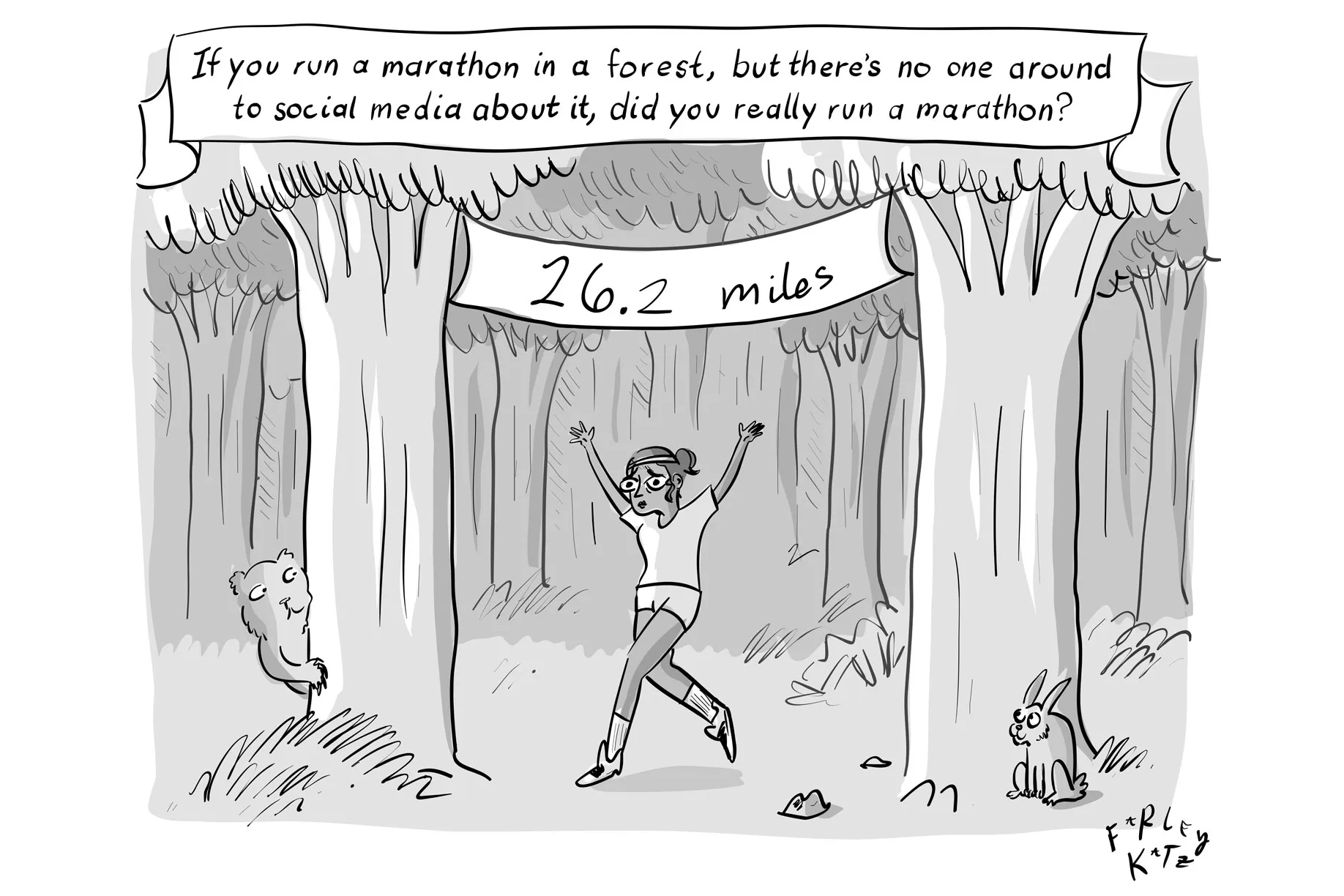
The insistence in modern parlance is that we are capital “C” Creators with all the independence, power, and choice we could ever want — if only we’re willing to muster it up. Yet what we see online and in real life is not proof of the human ability to create but instead our deeply innate reliance on something or someone for our worth or our mattering. Try as we might to appear independent and autonomous, the reality is that we are dependent creatures. We not only crave the approval of others, but we also need relationship and belonging. And even more fundamentally, we need to be told who we are.
Robert Kolb and Charles Arand put it this way in their book, The Genius of Luther’s Theology:
Creatures cannot, by the very definition of what it means to be a creature, comprehend and understand everything about their Creator, and because their relationship with their Creator stands at the heart of their existence, they cannot grasp everything about themselves. Lacking the ability to step outside of themselves, human beings take on a sense of self-exalted importance or find themselves struggling with a sense of insignificance and helplessness within the universe.[2]
Contrary to modern (and postmodern) tactics, the only way to truly understand our anthropology and get any sense of ourselves as individuals is to begin from a theological view. Otherwise, we put the cart before the horse, the creature before the creator.
“Know that the Lord, he is God! It is he who made us, and we are his,” says Psalm 100:3. Just like in Psalm 139, the starting point for knowing oneself in this verse is not to look inward but instead to look outward. To start with the foundational reality that we are made by God himself. Therefore, we are not only creatures, but we also belong to a Creator.
Now this could very well be bad news depending on who our Creator is. This is why in places like Psalm 100 the Psalmist proclaims for us to know God as God and ends with the reminder of who God is for us: “For the Lord is good; his steadfast love endures forever, and his faithfulness to all generations” (Ps 100:5). To know God is to know not only that we are his but that he is good.
This idea is reiterated in Martin Luther’s explanation of the first article of the Apostles’ Creed from his Small Catechism. Many may roll their eyes at this (because I’ve often said similar things), but when I first became a Lutheran, I was perplexed by the Lutheran emphasis on Luther’s Small Catechism. There are many scholars, like John Pless, who spend most of their time writing about the importance of this little book that was originally intended for the use of families and children. But the more time I’ve spent reading and rereading it, the more I understand the fascination. Here, Luther has distilled years of his occasional theology into a concise summary that also illuminates the very building blocks of the faith: the 10 commandments, the Apostles’ Creed, and the Lord’s Prayer. His explanations are simple to understand and yet profound, including this first article explanation:
“I believe in God, the Father almighty, maker of heaven and earth.”
What does this mean?
Answer: I believe that God has created me and all that exists; that he has given me and still sustains my body and soul, all my limbs and senses, my reason and all the faculties of my mind, together with food and clothing, house and home, family and property; that he provides me daily and abundantly with all the necessities of life, protects me from all danger, and preserves me from all evil. All this he does out of his pure, fatherly, and divine goodness and mercy, without any merit or worthiness on my part. For all of this I am bound to thank, praise, serve, and obey him. This is most certainly true.
As I mentioned, much can (and has) been extrapolated from these words. But I would like to briefly highlight two things in particular that stand out to me as foundational building blocks to human identity. Not only does this description give us a thorough overview of who God is specifically as our creator, we learn that because of who he is, we are limited and dependent creatures.
God has created both life as well as provision for that life. He cares deeply about what he has made, and he desires to see it flourish, which is why he protects us from harm. This means he is not just our creator but also a good father. Our dependence on him is relational without being transactional. To know God as a good Father and us as his children (through faith in Christ) is to be restored to right relationship and our intended design. “Simply put,” says Kolb and Arand, “to be righteous is to be the human person God envisioned when he created us … Who I am is determined in large part by how I live with God and my fellow human creatures”[3]
And yet relationships by definition place limits upon us. Modern Americans tend to think about freedom as total and complete independence from any obligation or responsibility. But scripture, the creed, and Luther’s summation all make it clear that this is not what is meant by Christian freedom. As Ryan Couch explains, “Christian freedom isn’t about autonomy from others — it’s about being liberated by Christ to love and serve others without fear.” Limitations, then, are not inhuman but part and parcel of how God created us to operate. Only through limitation can we recognize first our need for God for both our salvation as well as our very existence. And only through admitting our limitations are we ironically freed to stop our navel-gazing and turn outward to those God has placed around us, in true love.
In Christ, the new man or woman is free not from obligation, and certainly not from God, but from the fears of condemnation, not measuring up, finding your worth inside yourself, and being the master of your own fate. As the Apostle Paul reminds us, “For freedom Christ has set us free; stand firm therefore, and do not submit again to a yoke of slavery … only do not use your freedom as an opportunity for the flesh, but through love serve one another.” (Gal 5:1, 13b).
Rather than the Nietzschean vision of the Übermensch (an escape or defeat of our humanity and the burdens that come along with it), God gives us a vision of freedom tethered to his never-ending grace and provision — provisions for body, soul, limb, senses, reason, etc.; grace which negates the shame and guilt of the past, the needs of the present, and the worries of the future. “Although the world may seek honor in power and riches, the fact of the matter is that there is no higher title than to be called a creature of God.”[4]
To be a creature may seem undignified, perhaps even inhuman. But to recognize by faith that we are each a creature tenderly cared for and a child loved infinitely by their almighty father is nothing but good news for us. It means that our fleeing, our discontent, our burdens, and yes, even our sins, are not the identity markers by which we are known. It means we are neither responsible for creating the truest versions of ourselves nor destined to the condemnation of such a task. Instead, our limits and dependence allow us to be the creatures God intended for us to be: his children who know themselves to be fully his.
Kelsi Klembara is the online content manager and podcaster for 1517. She also writes in her Substack, The In-Between.
[1] To be transparent, I have not read Lee’s book but have followed her influencer journey via Instagram. I took this quote from a longer reference cited here. And btw, the title of her book could be a whole post on where the quest for inner justification leads us!
[2] The Genius of Luther’s Theology, pg. 24, Kindle ed.
[3] The Genius of Luther’s Theology, pg. 26, Kindle ed.
[4] The Genius of Luther’s Theology, pg. 38, Kindle ed.