




Identity is everything and it is everywhere. It’s in our politics. In our work. In our bedrooms. In our consumerism. In our brand loyalties. In our food (“You are not what you eat, you are what you want to eat.” -James K.A. Smith). At a birthday party for a friend’s daughter the other day, one of the guests — a girl no older than seven or eight — was wearing a pink tie-died shirt that read, in some sort of bubbly font, “I am the author of my own story.”
Perhaps that shirt will be more prophetic than aesthetic, but consider me skeptical. I can barely author this here article, let alone my life story and identity.
But that is what is being asked — demanded — of each of us today in the late, modern, secular West: to be the sole proprietor of our individual identities. To be the author of my story. Sisyphus looks at our load and shakes his head, thankful for his by-comparison-much-lighter toil. The earth a beach ball compared to the granite boulder of identity we try to roll up the mountain of existence every single day.
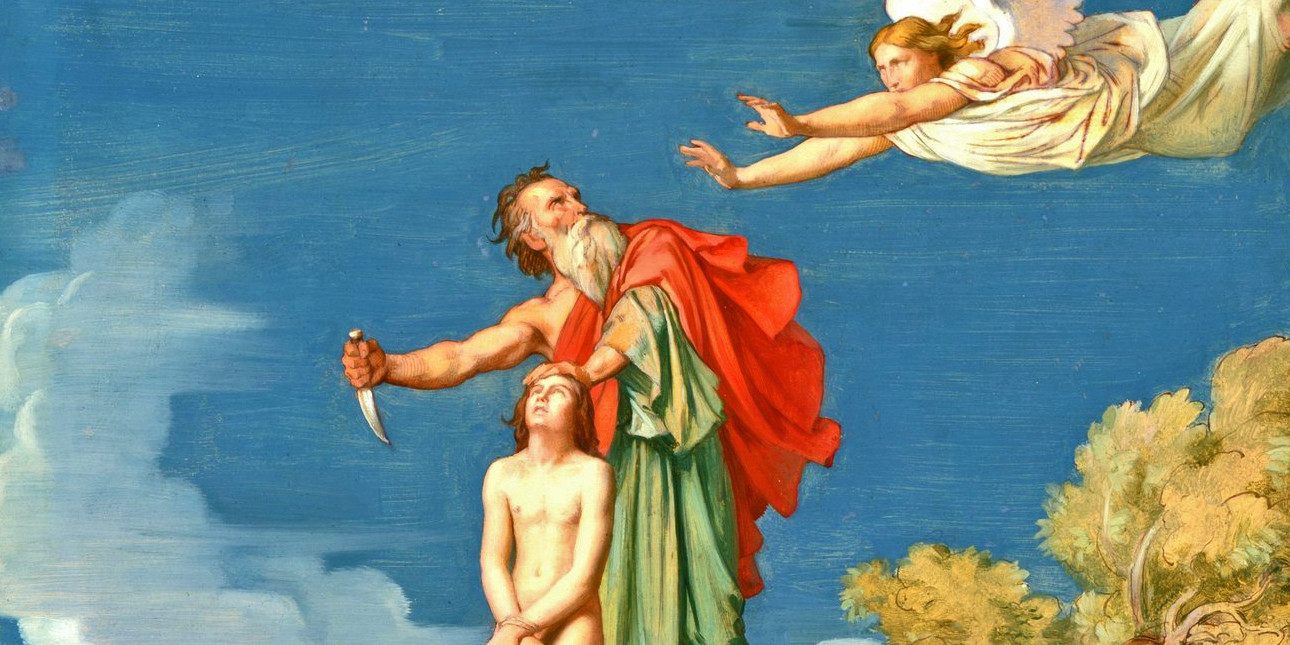
I was thinking about this in light of the account of Abraham and Isaac from Genesis 22:1-14. The brief summary: God calls Abraham to sacrifice his only son, Isaac—Abraham’s only child, who happens to be the answer to God’s covenant promise with Abraham to make him a great nation—at the top of Mt. Moriah.
Here we see the patriarch of the Jewish and Christian faiths being called to do the unimaginable. To do the one thing that, seemingly, would undue the promise God has made to him. Abraham’s entire identity was built around the covenant God had made with him. What’s more, in his culture, a man’s self-worth was largely determined by how many sons one had. And yet here he was, being called by God to give it all away.
Walking up that mountain, with the coals in his hand and the wood on his son’s back, was the exact opposite of authoring his own story. Abraham trusted the story his God was writing. Even if it made no sense. Even if it would break his heart. But he trusted because God called him by name. Abraham knew the Author of this story. He knew he could be trusted.
In our imagination, Isaac is a child in this story. But he was likely a young adult. At the top of the mountain, he needs to bring his trust to the table, too. Isaac gave up authorship of his own story, identity, and very life by giving himself up. Which is actually a pretty good definition of faith. Isaac and Abraham were willing to give up everything because they trusted the God who called them.
Their trust is well-placed. God showed up. He provided a sacrifice. Isaac lived. And the story ultimately finds its conclusion in Jesus, who “endured the cross” for the “joy that was set before him” (Hebrews 12:2). Jesus chose the cross. He climbed the hill.
This means that all who want to find life — real, lasting identity — must give up life to find it. Jesus calls us to bear our crosses (Mk 8:34-35). To follow him regardless of the ask. To die to self and live to and for him.
As our pastor said as he preached on this passage, there are many different deaths we can die. What is Jesus asking me to give up to follow him? What is he asking you? What is the Giver Of Life calling you to give up? These are the things usually terrify us at the thought of relinquishing. No, not that, we say. Anything but that.
William Shakespeare’s “Sonnet 29” is a helpful reflection at this point. The author finds himself in a state of woe, disgrace, and even envy about the ability of others to author a more desirable life story.
When, in disgrace with fortune and men’s eyes,
I all alone beweep my outcast state,
And trouble deaf heaven with my bootless cries,
And look upon myself and curse my fate,
Wishing me like to one more rich in hope,
Featured like him, like him with friends possessed,
Desiring this man’s art and that man’s scope,
With what I most enjoy contented least;
Yet in these thoughts myself almost despising,
Haply I think on thee, and then my state,
(Like to the lark at break of day arising
From sullen earth) sings hymns at heaven’s gate;
For thy sweet love remembered such wealth brings
That then I scorn to change my state with kings.
The text in Genesis 22 does not give us details about the inner thoughts of Abraham as he climbed that mountain. It does not seem that he entertained these kinds of laments. He does not appear to curse his fate and beweep his “outcast state.”
I know, however, that I would have been wishing for a different storyline. Because I do this now. I consider some of the crosses I’m being called to bear and I get tired just looking at them. I would not have written these into my life story, thank you very much. And I forget how solid and trustworthy God’s promises are. I forget how good God is. I forget what joy there is to be found in the cruciform life. I forget that if I obey God, he’ll work it out for good and provide all that I need. I forget that I’m, actually, a lousy author of my own story.
Until, and only by the grace of the Lord, “Haply I think on thee.” Jesus’s “sweet love remembered” brings me back to reality. I realize how rich in his grace I am—and not because of the royalties from my previously published works. Why would I want to “change my state with kings”? Why would I want to be anywhere else except where he’s called me to go?
There’s another William that can help us put a bow on this. In William Butler Yeats’s “The Song of Wandering Aengus,” Yeats receives a calling similar to Abraham’s. One magical night, “someone called me by name,” he writes, and he would follow that calling the rest of his life, even if the following felt more like wandering. Wandering through “hollow lands and hilly lands” until eventually he’d
“… walk among long dappled grass,
And pluck till time and times are done
The silver apples of the moon,
The golden apples of the sun.”
There is joy on the other side of sacrifice. There is life in death. There is glory in resurrection. I cannot name myself or my identity. But I can hear. And I can follow. Because the One who calls is faithful to be there for the duration of the journey (1 Thes 5:24). And he will be there when the journey ends and really, finally, begins.
Trevor Sides lives in Fort Collins, Colorado with his wife, Lindsey, their three adopted kids, and two cats. An avid taker of naps and teller of Dad Jokes, he writes at the confluence of adoption, poetry, and pop culture at trevorsides.com and trevorsides.substack.com.








This is the only poem I have memorized. This was so good.
This is a convicting reminder and a balm for the modern soul. Thank you, Mr. Sides.