




A couple times in recent years I have commented that maybe we don’t really own our many devices (phones, watches, computers, TVs, thermostats, cars). We think we own them, but actually we rent them. We rent them from some corporation somewhere that has their fingers on and in them via internet connections, frequent “updates,” and other forms of required maintenance and interaction on our part.
Lo and behold, the remarkable piece by Terry Godier titled “The Last Quiet Thing.” That “last quiet thing” would be Godier’s Casio wristwatch. He begins his essay with a picture of said humble wristwatch and these words:
This watch cost twelve dollars. It weighs twenty-one grams. It has an alarm that sounds like a microwave in another room. It has told time the same way since 1989. It doesn’t know my heart rate. It has no opinions about whether I’ve stood up enough today. It will never need a firmware update. When the battery dies in seven years, I’ll press in a new one with a paperclip. That will be the entirety of my obligation to it.
His simple wristwatch (like my simple 2010 Honda Fit) predates the present age in which such devices are, depending upon your point of view, much more capable and helpful, or much more demanding and exhausting.
“Sometime in the last twenty years,” continues Godier, “our possessions came alive. Not all at once. Not dramatically. One by one, the objects in our lives opened their eyes, found our faces, and began to need us.”
Your thermostat has opinions now. Your television requires a login. Your car updates itself overnight, and sometimes when you start it in the morning, the interface has rearranged itself, as if someone broke in and reorganized your dashboard while you slept. Your earbuds won’t play music until they’ve updated their firmware. Your refrigerator wants to be on your Wi-Fi.
None of this is broken. This is the product functioning as designed.
For most of human history, you bought a thing, and it was yours, and it was finished. Nothing you own is finished. Everything exists in a state of permanent incompletion, permanently needing. Your phone needs updates, needs charging, needs storage cleared, needs passwords rotated.
Your apps need permissions reviewed, terms accepted, preferences re-configured after every update.
Your subscriptions need evaluating, need renewing, need canceling, need justifying to yourself every month when the charge appears. The purchase isn’t the end of anything. It’s the first day of a relationship you didn’t agree to, with no clean way out.
You can see, I imagine, where this is going. You may love all this stuff (or not). It does make some things possible from which I, for one, derive benefit and enjoyment. And yet … it is relentless, “a to-do list that writes itself.” We have no real alternative, save becoming an off-the-grid hermit. It is also a form of bondage. If you read all of Godier’s piece, he comes to the point where you expect him to tell you some way to manage, to simplify your life and make it all better. He doesn’t do that. Instead, he says that if you are frazzled, confused, overwhelmed, and exhausted by it all, know at least this, “It’s not your fault.”
On reading this, my mind went to the New Testament’s letter to the Hebrews. Well, some of us are weird that way.
One of the principal themes of the letter to the Hebrews is that Christ’s work of salvation on our behalf is not something that ever needs, nor requires, a redo, refreshment, or updates. This, for the author of Hebrews, is in contrast to priestly rites of the old order, which demand constant effort, attention and performance.
Every priest stands day after day at his service, offering again and again the same sacrifices that can never take away sin. But when Christ had offered for all time a single sacrifice for sins, he sat down at the right hand of God … For by a single offering he has perfected for all time those who are sanctified. (Heb 10:11–12).
Get it? The work of forgiveness and freedom has been done once and for all. Those last three words hold a double meaning. Christ’s work has been done — period, full stop. It need not be repeated. It is finished. Complete. “He sat down.” And second, it is for all people that this grace is accomplished and offered in Christ’s death and resurrection.
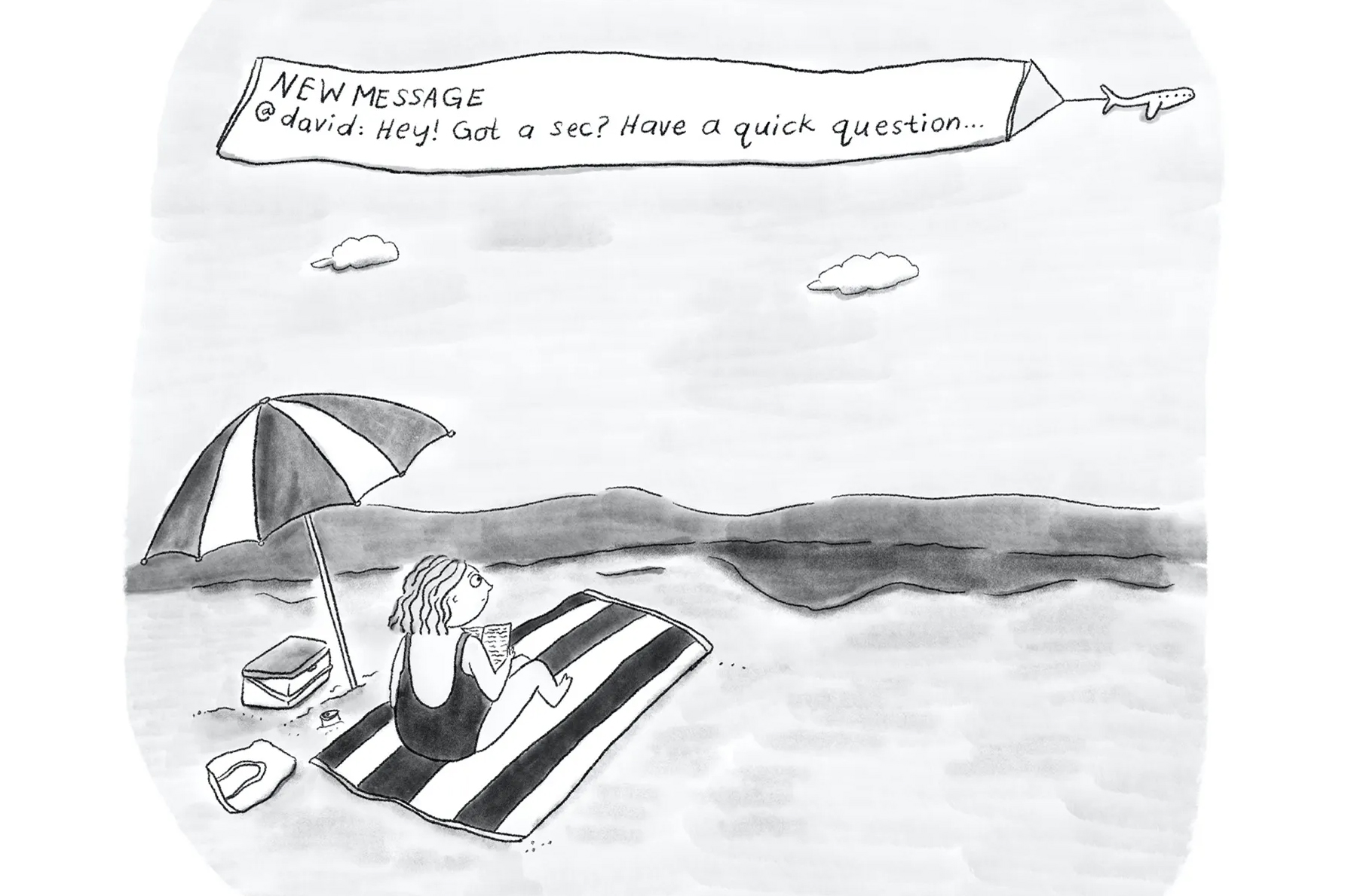
The work of tech now is never done, never finished, never complete, always requiring — demanding — more of us, from us. It’s never enough! Which takes us again to a basic contrast between law and grace.
In that sense, tech functions in a way similar to what theologians and scripture term “Law.” The Law (Ten Commandments and all the rest) are good stuff. However, they can never accomplish what they command. Law can’t save us. Only grace does that. Only the finished work of Christ can offer us true rest. Law isn’t just found in religion. There are lots of secular forms of law, as in “You must have the perfect family,” “You must have the perfect body,” “You (or your kids) must get into the right college.” The grammar of law is “if/then.” If you do this, you will get that. But it’s all on you. The grammar of the gospel is different. It is the language of promise, as in, “I am with you always.” “I love you.” “I died for you.”
Grace and promise lead to “rest in the Lord.” I used to know an older, African-American man who was often to be found on a bench in a nearby park. I’d say, “Hey, what’s up?” He’d answer, “Just resting in the Lord, in what Jesus done for me.”
Our technology has become Law-like. It requires of us always more, constant attention, and “updating.” I put quotes around “update,” because I think it is a term deliberately chosen to suggest improving, getting better, climbing higher. We are keeping up to date! God help us if we don’t keep up!
This is the false promise of the Law (do this, do enough of this and you’ll be saved/loved/okay/at peace). Now the law comes at us again in the disguise of modern technology. Get this device, this app, this hack and climb the ladder to perfection, peace, abundant life. It’s a false promise because we never arrive, only needing to go faster, harder. We become like the old order priests of Hebrews performing the same sacrificial rites day after day, even though it never really works, never frees people from the grip of sin and death.
Perhaps the most needed thing for us striving, updating, never-enough, 21st-century humans is the rest that comes from knowing that Christ has done for us, once and for all, that we cannot do for ourselves. I go to church not to check off my week’s to-do list of the things I must do to get on God’s (or other people’s) good side. I go to church to hear the good news of God’s work which has been done on my/our behalf, once and for all.
We need, imho, just this: rest, resting in the Lord, resting in the work Christ has done on our behalf. “Just resting in the Lord, resting in what Jesus done for me.”
The way tech has and is developing, probably with good intentions (and profit motive), Christ’s promised rest is needed more than ever. Godier’s Casio watch is not the last quiet thing. There is another quiet thing: our souls and hearts quieted by the promise of the gospel and by dwelling, being still, in the presence of the God who is God.







Hik Tony – I’m just finishing a Bible study on Hebrews at my church and am passing on your fantastic article to the Bible study members. Thank you!!!
What a blessing this article is to my soul. Thank you for the time, and willingness to write a Jesus-centric response to our complicated relationship w / tech. Luditism isn’t the answer; rest in Christ alone is!
Great article! Unique that you tied in a very interesting tech critique to the Gospel message. Great ‘daily bread’ material!
Amen Tony, great article