




Welcome to the fourth edition of Mockingbird’s preacher interview series! Over the past few months, we’ve been interviewing some of our favorite veteran ministers from around the country to find out more about what is really working in Christianity today and how to do church well. (See also eps. 1, 2, and 3.) Our fourth interview is with longtime Mockingbird contributor, author, Episcopal priest, and disco enthusiast, John Zahl.
M: Hey John! Thanks so much for doing this. One of the things we’re trying to do here is to counter the long-running cultural narrative of inevitable religious decline by highlighting some of the great things that are happening in the church today.
JZ: Oh yeah. There are lots of good things happening. There’s even good stuff going on in the English church right now. I just saw an article in The Times called, “Full-fat faith: the young Christian converts filling our churches.” The first paragraph says, “Few would have predicted a comeback for Christianity, but a backlash against secularism looks less surprising set against the backdrop of global turmoil and a search for lost meaning and connection.”
M: Wow. I mean, I guess that makes sense. When your life is in turmoil …
JZ: I know. I was thinking my brother Simeon lives in England, and it’s not in great shape. The reality is that there has been a lot of economic decline, and the pressures on things like the National Health System have just exponentially increased. Simeon says it feels like a lot of the systems are sort of falling apart. So, England is going through a bit of a rough patch, and wouldn’t you know? Christianity is surging. There has suddenly been this wonderful revival vibe in the UK.
M: Well, I guess we ought to get down to some specifics. How would you describe the congregation where you currently work?
JZ: I work at St. Matthew’s Episcopal Church in Bedford, New York, which is in Northern Westchester, a sort of suburb of New York City. Westchester County is the first county north of the Bronx, and it’s relatively quiet, what people here almost consider to be like a country setting — like an English country setting is sort of how people think of it. But the reality is, it’s 40 miles from New York City, and everybody here has pretty much lived and/or worked in New York City. It’s an old Episcopal church. The parish was founded in 1800 by John Jay and his family, so it’s got all kinds of storied American roots. But it also means it’s pretty old by American standards, going on 225 years, which is certainly enough time for a church to die. And we’re not dead! In fact, we’re bucking most of the regional trends.
You may have heard people talk about how hard-going it is in the Northeast with the influence of secularism and the decline of the church. So I’m really in what is considered one of the two ground zeros in the U.S. for church extinction — the Northeast and then the Pacific Northwest. And again, there are exceptions everywhere. Like us.
Our church is a relatively traditional church. We are trying to keep alive the old classic version of Episcopal Church worship out of the Book of Common Prayer, which is what St. Matthew’s has really always done. I think a lot of people start with the premise that their church is needing to be repackaged because the culture has changed so much. And that’s true of lots of parishes, I guess. But the assumption that the old ways are broken and can no longer connect with people — I reject that premise, and we seem to either be proving that it’s not true or doing something impossible, because we have managed to grow and have an ongoing vital ministry. The quote I like comes from Gustav Mahler, who said, “Tradition is not the worship of ashes, but the preservation of fire.”
M: I like that.
JZ: In flavor, our church is somewhat formal. Most of the men wear blazers, and I’d say 50% of them wear ties. Most of the women wear dresses or semi-formal attire. But we’re not fussy at all. We welcome anybody. I often say to people, if you adhere to the general trend clothing wise, you’ll probably feel more comfortable here than if you roll in in jeans and a t-shirt — but that’s not to say there’s anything wrong with that. Millions of churches do that. We’re just not that type. And the sort of logic, at least for justifying that kind of formality on spiritual terms, is that when you worship God you sort of bring your best. It’s basically a display of reverence and deference. So in some ways, though it’s a little counterintuitive, we dress up out of humility.
M: What about smells and bells? Is there any of that in your church?
JZ: No. The category we fit under within the world of Anglicanism would be called “Classic Low Church.” So we’re not High Church in the sense that we don’t have any incense or “smells and bells.” We don’t sing the Eucharist. And we don’t have communion every week. In our primary 10 a.m. service, we alternate between morning prayer and communion every other week. But sometimes people think Low Church means “no church” and it doesn’t. Low Church is a very specific style, a collection of liturgy and hymns and things like that. So we are really Classic Low Church, and I would define that ethos — what it means to do that in worship — as tasteful understatement. We have very few frills.
M: Sounds like a nice church.
JZ: Yeah, it is. On any given Sunday, we have around 200 people coming through church, although we technically have 400 families on the books. It fluctuates.
M: What types of services do you have?
JZ: Our 8 a.m. is a short Holy Eucharist Rite I service with no choir or hymns. But at our main 10:00 services, we actually use three different liturgies over the course of four Sundays every month. That’s partly because we alternate between communion services and morning prayer services every other week. St. Matthew’s is actually one of only two churches in the Episcopal Diocese of New York, out of 180, who held on to doing morning prayer on Sunday mornings.
Here’s the rationale for multiple liturgies: for one, that’s the way St. Matthew’s has done it for a long time. I inherited that. But also, we have a really wonderful prayer book, and I like to use as much of the good stuff as I can. So basically, we try to create what we call prayer book literacy in the life of our congregation. We do not print out our liturgy — another move that’s very atypical of most churches that are trying to buck trends and grow. We want people to learn how to use the Book of Common Prayer, and we want them to appreciate its breadth.
I will say, that doesn’t mean that we’re not critical of portions of the book. The goal is not simply to use the whole book. The goal is to use the good parts.
M: Right. It’s like with the hymnal. I mean, there may be 800+ hymns in the hymnal, but they can’t all be good, let alone familiar to people in the pews.
JZ: I’m so glad you mentioned that, because that’s another key piece for us. I am holding right here our master list of hymns. These are the only hymns we sing at St. Matthew’s right here. It’s about 100–120 hymns that we pull from, and we only ever sing those hymns. And that’s because the others, we think, are either overly obscure or overly weird in their vibe, and people come to church and love to sing, and they love the classics. Again, if we’re trying to keep a classic version of things alive, part of that is keeping classic hymnody alive, especially if we’re also not using guitars or bringing in other instrumentation. If we’re keeping the organ alive, we’re using classic hymns.
And we always do very familiar hymns at the end, so people feel like, Oh, wow! I’ve heard “Come, Thou Fount” or “Amazing Grace” before. I just hired a new director of music, and I had to say to the organist, “Can you play ‘Amazing Grace’ without cringing? Because if you can’t, you’re not right for our congregation, because you don’t really understand what we’re doing.”
M: Is there a service that has been particularly successful for attracting newcomers or caters more to families?
JZ: The 10:00 service is our main service, our big show. That’s where we have a large percentage of young families as well as a lot of our old guard. Our 8:00 service attracts exactly the same people that go to every 8:00 service, right? Mostly older, longtime Episcopalians. Or people who golf. The joke is that people created the 8:00 service so that Episcopalians wouldn’t miss their tee time. It’s not a large service, but we still give it the full attention. So both clergy attend both Sunday morning services, even though it’s usually the same preacher at both. And then only one of us typically does our much smaller 5:00 evening prayer service. But, to answer your question, the majority of our newcomers come to the 10. We also, by the way, have an educational slot in between the two services at 9 a.m., and we’ll have classes in the fall and during Lent.
At St. Matthews, we pride ourselves on being efficient. We don’t rush, but none of our services are longer than an hour. That is also an important piece of church growth — we really respect people’s time. We thank them for taking the time to commit to coming to church on a Sunday morning, and we don’t take that lightly. The last thing we want is for them to feel like they’re being held hostage.
M: So if a new person comes and they’re not an Episcopalian, how do you make sure that they can figure out what’s going on in the service and don’t feel totally lost?
JZ: The reality is we’re not that great on this. We really appeal to certain folks. But we make sure if you are arriving at St. Matthew’s that you’re greeted with a smile and welcomed. We have wonderful ushers, and they’ll help you find a place to sit, get you a bulletin, and answer any questions. Our bulletin is an order of service. That means it lists all the things that happen in our service with page numbers in either the Book of Common Prayer or in the hymnal. And here’s the basic premise for that: We treat people like they’re not stupid. It drives me up the wall when churches act like adults who walk into church can’t read and can’t figure anything out without literally being held by the hand in this pedantic manner that kills the verticality of worship.
We give you a bulletin and we give you all the answers to where we are in the service so that you can track the service and find the pages you need. We want you to learn. Again, we’re trying to teach people to become comfortable with the prayer book, and the way you do that is by providing people with page numbers and then allowing them to find them. If they come two to three weeks in a row, they will quickly learn.
We also make sure the person up front, the priest leading worship, models the use of those books. But basically, we try to really convey warmth without being fussy. If you don’t know your page numbers, somebody will either help you or they’ll let you figure it out. But nobody’s going to give you a dirty look. It’s the same if you bring a child to church. We make sure that people feel welcome to bring their children to church, and if the child freaks out, we let the parents decide what they want to do.
I find that if people have had an experience of God in church, and specifically I mean if the church service has spoken to them, has spoken into their real life, then all that stuff about the Prayer Book doesn’t create a hindrance to their returning. It may actually be the opposite. One thing I believe people want is for church to feel like church. And it’s something you can learn how to participate in.
M: What are your offerings for children and youth?
JZ: We have a great nursery for kids up to age five. And then what we do with other kids and youth — ages fifth grade and under — is on Sunday mornings, they get dropped off by their parents on the way into church at a separate children’s chapel, a gorgeous old stone chapel where they have their own service and liturgy they go through. Their service is about 20 minutes, which is a good length for them. You’ll notice we believe that the most effective long-term church model is that short services make longtime members. After their 20-minute service, they roll into 40 minutes of Sunday School. But one Sunday a month, the third Sunday, they come into church and join their parents for communion. Children like communion anyway, and we have a lot of young families. That’s one of the areas where we’ve really grown. We were really blessed during the pandemic that a ton of young families moved to our area.
But again, what I think people need and want from church, whether they’ve been coming forever or are brand new, is they’re hoping that just maybe they will actually have an encounter with the Living God, that God will in some way actually speak to them about whatever it is that’s really on their mind or heart. And so, if that happens, and if it doesn’t take too long, and if there’s a sense of reverence and a sense of something other than what they experience anywhere else, then it can be incredibly powerful and keep them coming back.
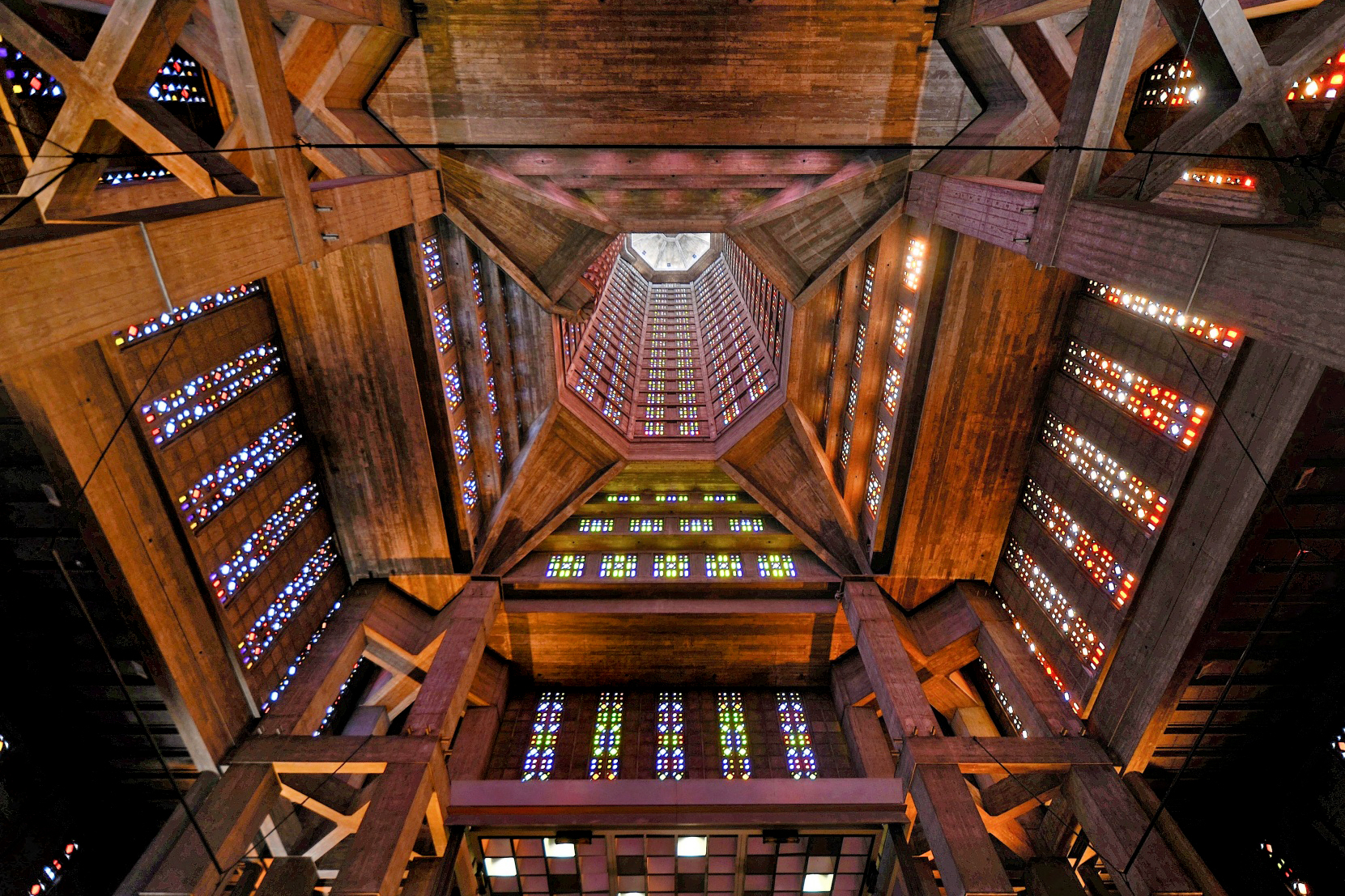
Le Havre (Seine-Maritime) – Eglise Saint-Joseph – Tour lanterne
https://fr.wikipedia.org/wiki/%C3%89glise_Saint-Joseph_du_Havre
M: Exactly. Church should be something different, not just some vaguely theological version of what they can get elsewhere.
JZ: Yeah. And it’s really important, again, that church have verticality in worship, at least in our tradition. That’s something we’re good at. And that means we’re not overly folksy. So when I’m leading the service from the front, I give a warm welcome, but I actually wait and do that during the announcements instead of at the beginning of the service, and then I keep the announcements as short as possible. It drives me up the wall when clergy are too folksy, because it just turns the service into a town meeting. We are here to go up and outside of ourselves. And so I stand very reverently, with a warm but not overly effusive smile, trying to convey the warmth of God — but we are here to connect with God — and so at the beginning of the service I just say, “Please stand for our opening hymn, number …” and that’s all I say until I welcome everyone during the announcements.
I try never to break the verticality of worship with my own stuff. If I make a mistake, I don’t go “hahaha” so that everybody laughs to make me feel okay, and we kill the verticality of our worship. When somebody makes a mistake, we continue right on. I hate when people kill the worship out of their own insecurity and discomfort. I’m eager to maintain a sense that we are going up and out when we get together.
Another thing you should know about our parish — we draw a very hard line on this, and I really believe in it, especially if one is interested in church growth — is no politics from the pulpit. It’s that simple. We preach existentially to the individual as they stand before God in the midst of life, as a human being. We do not focus on their corporate identity as American citizens. We do not in any way mimic some post on a Facebook feed that they’re reading right before or right after church. We consciously avoid politics, and that’s something that in this day and age very few churches actually do. A lot of clergy seem to think that you can’t be faithful to scripture without going there, but I have no trouble not going there and feeling like I’m being faithful to scripture — if one takes the tack I’ve just described, which is understanding the preaching enterprise to be about that existential encounter with the Living God.
M: I think that’s wise.
JZ: I will just add: Yes, we keep politics out of the pulpit, but that doesn’t mean that we don’t acknowledge events going on in the world. We believe the place to do that, the way to do that in church, is in prayer. So we will pray without taking sides. We pray every Sunday for peace in Israel and Palestine. We pray for peace between Russia and Ukraine. We’re taking the Christian approach, which is praying for peace. Or we pray for all those impacted by a hurricane. But we don’t just dive into the news. The test for every preacher is to not do it, because it’s very hard — it always feels like the latest thing has to be addressed. A preacher has to work hard not to go there.
But people love to come to church and be able to have an hour to pray about the things they’re worried about without having to be lectured to or spoken to about politics.
M: So what is the most important thing that people hear from the pulpit?
JZ: In Mockingbird circles, we talk about how we want to make sure we “preach the gospel,” right? But I don’t usually use those terms, because people who don’t know what that means don’t know what that means. People who do know what that means are few and far between, and so it tends to become an insider’s baseball code. So the word I use, which is distinctly Christian and something people won’t encounter anywhere else, is grace, the grace of God in Christ. I talk about grace all the time. People in my church would all say, “John’s always beating the drum on God’s grace.” That’s a big umbrella term that captures a multitude of different topics, but generally speaking, that’s my accessible way of talking about what it means to be a gospel parish.
We believe in a God who, in Jesus, has forgiveness of sins and mercy for the sinner, compassion for all who are weary and heavy laden. It also means we’re always doubling down on trying to connect with people in the place where they’re vulnerable — the place where they’re hurting, the place where they’re stressed out, the place where there’s anxiety. That’s the area of their psyche that we are targeting.
M: So if you had some advice on preaching, would it be to start with trying to meet people where they are vulnerable and then bring in that message of God’s grace?
JZ: I’ve been doing this seventeen years as an ordained priest, and my own thinking is more and more that I don’t want to be overly pedagogical. What I find is that most new folks who come into church understanding justification by faith, the centrality of preaching of the gospel, the forgiveness of sins, absolution, and all these wonderful themes that are at the bedrock and core of our faith — tend to be too theological, and they basically think that if I’ve preached the forgiveness of sins, then I preached a good sermon. Because doctrinally it was sound. But I would say it’s possible to preach a bad sermon with good doctrine.
What I’m interested in at this stage of the game is connecting biblical truths that are grace-centered — not just any biblical truths, but the grace-centered biblical truths — with a person’s life. So I mine scripture for material that will speak directly to people about who they are and who God is. I believe in the law/gospel paradigm, and it has hugely shaped my preaching as a sort of Luthero-Anglican, but I try to talk about law and gospel in layman’s terms. So if I’m approaching a passage and preparing a sermon, I ask two primary questions of the text: “What do we learn about ourselves?” and “What do we learn about God?” And actually, what we learn about ourselves is that we’re sinners, right? So it’s some form of law convicting us. And what do we learn about God? It’s always grace in Jesus Christ, and it’s a surprise every time. So it’s grace for the person who’s just learned of themselves as sinners. That’s my way of preaching law and gospel, starting with ourselves then getting to God.
I want to tell people that the Bible understands that this is actually what’s going on in life. So I’m more and more trying to be a philosopher who talks about what life is like based on my understanding and the illumination of scripture. I’ll say something like: “Sometimes people think that life is a bit like riding in a car, and I agree, but it’s not like riding on the open road. It’s more like you’re in a Target parking lot, and you have to back out of your parking spot, and you’re looking behind you, and a cart could come from any angle, and an old woman or a child could come from any angle, not to mention another car. Fender benders happen all the time, and as you are backing out, that first five seconds of just beginning to pull out where you feel like anything could go down and you have no confidence that you’re not about to get into an accident and possibly even hurt somebody — well, that’s what life is like, you know?” I’ll say things like that to try to get the message of grace to resonate with people.

M: In the past, you’ve written beautifully about your experience in 12-Step programs, so I’d like to talk briefly about the 12 Steps in relation to Christianity. To some extent, 12-Step theology seems very much in line with law and gospel thinking, in the sense that on our own we are powerless to recover from ails us, to fulfill the law, to become what we long to become.
JZ: Sure. The First Step starts with us, not with God, right? It diagnoses a problem and reveals a real plight.
M: Exactly. So here’s my question: Even though the 12 Steps begin from that place of powerlessness, there’s still a lot of expectations about things you have to do—
JZ: You’re talking about the working of the Steps?
M: Right. Working the Steps, showing up to meetings, doing inventory, doing outreach, making amends, and just trying to do God’s will … but it all comes about through this spiritual awakening. So how do you reconcile your low anthropology Christian theology with the 12-Step theology?
JZ: Well, as you may know, I wrote a book answering this question that’s pretty in-depth. The general answer that I give is that nobody works the Steps unless they’ve tried not working them. And so the motivation is not a “should.” It’s an “I have to.” In other words, desperation is the source of inspiration as opposed to good decision making. It’s fear of more bad decision making that makes people do what they should do, and I think that’s really where the 12 Steps are coming from. So while it can appear to be like, “Oh, you have to do these things, and it’s up to you to do them,” the reality is, people don’t do them. They don’t come to AA until they’ve tried not coming to AA — and failed at it. It’s the same with the Steps. They don’t work the Steps until they’ve tried not working the Steps, and they only work them to the extent that they feel they have to.
You know how sometimes ADHD people will say, “I’m grateful for deadlines because without them I’d never get anything done”? Well, basically, the Steps are like deadlines for people with ADHD. You have to do them or you will fail. There is always the imminent looming threat of relapse — and that is really what motivates a person, as opposed to virtue.
M: And then I guess the gratitude and good works just come naturally over time out of being sober and experiencing the bounty of life that you had been missing for so long.
JZ: Certainly. There’s a line in AA: We start by going to meetings because we have to — they start as a necessity, then they become a habit, and then they could become a joy. And I think it’s that way with the 12 Steps too, which is basically we start to turn to them more quickly because we’ve experienced what it’s like to not turn to them and not trust them, which is really about turning to God. Remember, it’s not the Steps that get a person sober, it’s God. And the Steps are the way that we connect with God.
Sometimes I think in AA it’s portrayed as though if you work the Steps right then you’ll get sober, and the reality is that you can’t work the Steps right unless God enables you to work the Steps right. God’s the one who enables you to do the Steps.
M: Yeah. Like, the reason I actually found the program and made it to a meeting was because God helped me get there, right?
JZ: Exactly. If we only did the things we need to do out of virtue, a lot of us would never do anything virtuous. Honestly — I have to put together a high chair for my wife and my baby. My wife has mentioned it several times, and so I will end up doing it the last day before I need to do it, and it’s not because I am suddenly the ultimate dad. It’s because I don’t want to experience the consequences of having not done it having said I would. You know what I mean? I think that’s how most people actually operate: We choose what is least painful. That’s what people do. We choose the opposite of pain, for the most part. That usually explains our decisions, even our good decisions. Even our good decisions are usually motivated by the pain that’s caused by not choosing otherwise.
M: Okay, last question for you: as a church that preaches grace, how do you deal with difficult people?
JZ: God, that’s tough. Generally speaking, I try to give people the benefit of the doubt. I try to be a person who is willing to take criticism on board and to try my best to please a person initially. With really difficult people, that doesn’t work. But reasonable Christian people who have a fair issue deserve that charitable approach from me, and that usually is enough to resolve things, and to not only resolve an issue but strengthen my connection to those people — and to strengthen the church. But with the really difficult people, it’s a different matter.
We have certain things in place to keep really troubled people from getting a foothold in ministries. One of the things that often happens in smaller parishes is that difficult people can get into roles of leadership very easily. And so if somebody new comes to me and says, “Hey, I led Bible studies for six years in my former parish, and I’m a lifelong Episcopalian. When can I start leading a Bible study here?” I will say, “Wow! I am so glad you found us, and it sounds like you have been giving so much of yourself to the church over the years, which, gosh, we’re so grateful for. Why don’t you initially just pull up a pew and enjoy the relief of not having to be in leadership and learn how we typically do things at St. Matthew’s and pray about how you can serve, and then come back to me in six months, and we can discuss.”
And if the person actually is a narcissistic personality, that will not work for them. They will not get a foothold, and they will either get pissed or usually they’ll just walk. So you can have systems set up where you keep many unhealthy personalities from being able to get into leadership. But the reality is that some of them will get into leadership. You will have people who vote against you on vestry. You will have people coming at you. A few things that help: 1.) Therapy. 2.) Remembering that ultimately it’s not your church, it’s God’s church. And 3.) having a healthy understanding of yourself in relation to your professional role. Like, you don’t want to overly identify yourself with the office of rector. So, while I am the rector, John Zahl is more than the rector and only is called to be the rector when I’m on duty.
It’s a very hard thing to learn how to not overly identify with your role when somebody’s critical of your church. You’ll take it like they’re being critical of you, and that’s very tough. I was struggling recently with a criticism. Somebody basically created an issue. And I’m now having to deal with it and praying for the courage to have a heart-to-heart with that person — which I’m able to do, partly because God gives me courage to face my fears and reminds me that if I avoid them they get worse, not better. So I pray for God to give me the courage to face my fears. That’s part of being a Christian for me. That’s what sanctification looks like in my life.
But then I was thinking, gosh, this person’s raised all these issues … it tapped into fears for me. It was like a resentment I started to get where I realized it affected my ambition, it affected my self-esteem, it affected my security. I was like, “Oh, no! What if I lose my job?” You start to get all worried, and that’s a resentment that I learned how to address thanks to AA and the 12 Steps and doing inventory. And then I prayed and got a word from God and also exercised. You know the line “move the muscle, change the thought”? Well, I go for a walk in the woods, I pray about the issue, and then God says: “John, you’ve forgotten. Ultimately, you don’t have to worry because I’ve got you, first of all. Because this is my church, not your church. And what you need to do is cling to me, because you’re thinking that the only answer to this person’s criticism is going to be to do something or function in some way that you’re never going to be able to …” At the end of the day, cling to Christ, not to doing a good job. Which is the gospel.
M: John, this has been really fun. Thanks so much, man.








“At the end of the day, cling to Christ, not to doing a good job. ….” Amen!!!!!!!!!!!!!!!!!!
My first encounter with Mockingbird. I’m excited to find you!
I want to be your curate.
Wow, I want to attend this church (sigh, I live in SE PA)
Thanks for this, wonderful. An odd thing is how many clergy seem to think their job is to interrupt or distract from “verticality in worship,” making themselves or other people the focus. God help us!