The Christian church often reflects its surrounding culture, for good and for ill. This is one of the consequences of its members being made up of, as the hymn “Amazing Grace” puts it, wretches. So it’s probably not a surprise that the body of Christ has fallen prey to rampant ideologies of individualism and full human autonomy — to the point that it has either excised appendages or passively allowed segments of the body of Christ to wither. Some of this is due to the ever-present powers and principalities laying siege, and some is due to the passive inaction of the church against those insidious elements of culture that seek to slowly dismantle the body. The attack on the body of Christ is nothing new, it is just the shape of the attack that has changed. The gracious and magisterial work of God in transforming this Frankenstein’s monster of a global church into the very resurrected body of Christ is kind of the big picture of the whole gospel story. Hans Urs von Balthasar spoke incisively of this truth in a prologue to the first volume of Communio: International Catholic Review:
Christian community is established in the Eucharist, which presupposes the descent into hell (mine and yours). No flight into an abstract unity is permitted there. It demands the courage to penetrate into another’s best defended fortress and, in the knowledge that it is, fundamentally, already conquered and surrendered, to contact its very center. That may provoke the other to the most savage resistance, and this must be endured … Communion is established on Good Friday, after the cry of dereliction, and before the tomb is burst open; in the wordless silence, beyond speech, of being together in the alone.[1]
Elsewhere[2] Balthasar described the bonding of the communio sanctorum (or “communion of the holy”) within the Eucharist as “the blood circulating in the Body of the cosmic Christ.” Few people recite the Apostles’ Creed or speak a theological conception of the communion of saints with, at the very least, a healthy dose of hope (cheap or otherwise) and an idiot smile playing upon their lips. Very little at the outset of discussing this lesser contemplated article of the creed screams fear or horror or darkness. Yet there is not a dotted “i” or crossed “t” within the faith that doesn’t on further inspection elicit the standing ovation of one’s neck hairs.
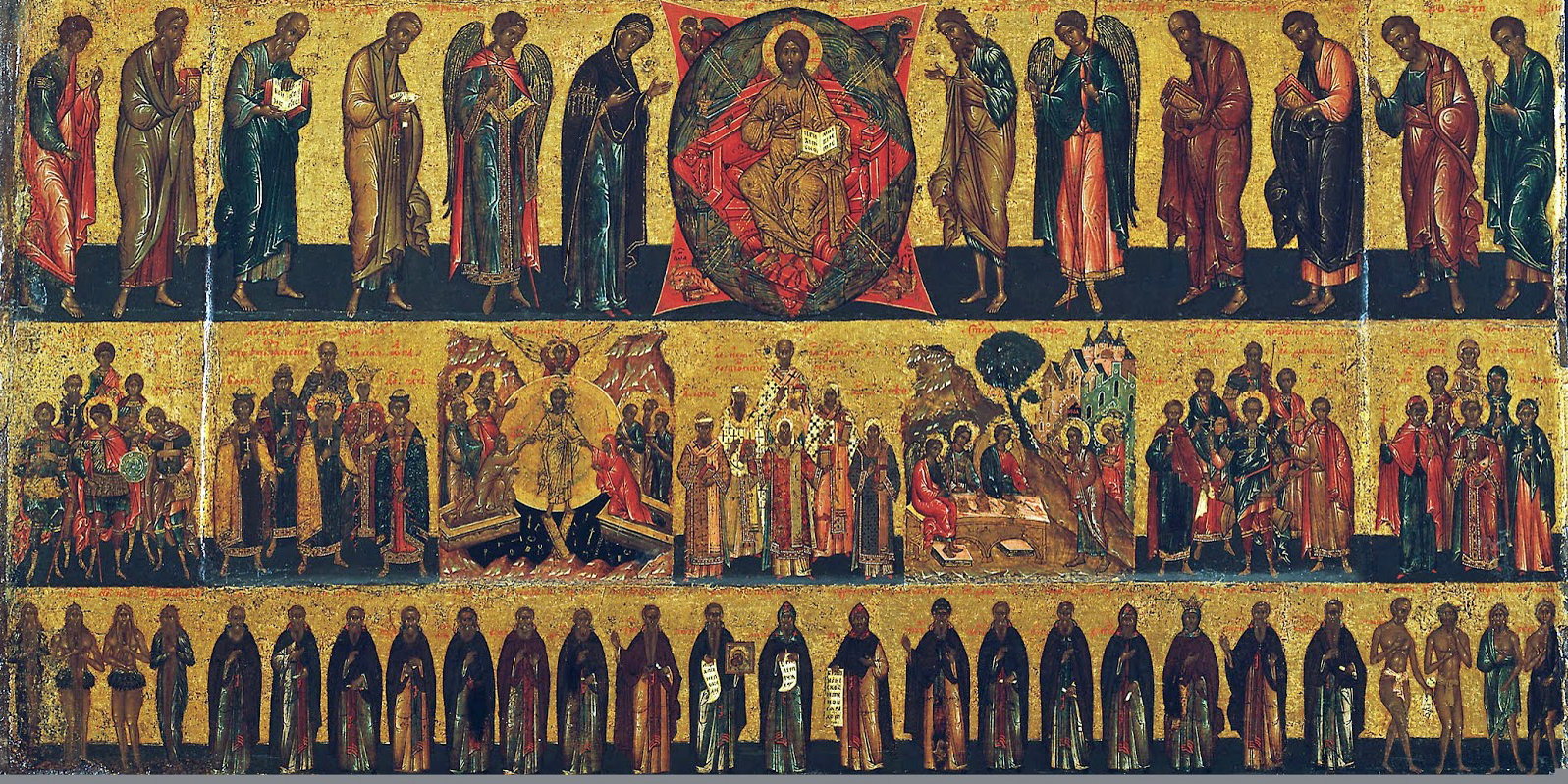
The communion of the saints presupposes a cosmic lifeblood which flowed from the cross and soaked into the same ground as Abel’s and continues to run through time and place. It makes that which is alive commune with the dead, and the dead come back to life within the wily winds of the Spirit. To be alive in the world and yet connected and (often) owing to the fellow denizens decomposing six feet under should give all of us a pause. Or perhaps we should look at it from a different angle. Perhaps our connection to the dead is a grounding force by which we are forced in our every act of love, sacrifice, mercy, and good work to remember that we are but dust. Meanwhile the dead are connected to the living as a mark of Christ’s promise to gather his sheep in the great hereafter.
Beyond the simple mingling of death and life alluded to within this communion, there are still more practical horrors to portend. If we meditate on the communio sanctorum as the “body of Christ,” then what of those passive aggressive actions of believers which cause the body to wither — like Billy Halleck in Thinner, the utter trainwrecks of history which lead to the pruning of body parts like Conrad Veidt’s hands in The Hands of Orlac, or Ken Sparten’s appendages in Scream and Scream Again. For us to think that the Spirit isn’t wily enough to dismember the dying segments of Christ’s body so that it may heal, we would have to be blind to the so-called “hard teachings” of Christ.
We may look upon something like the disembodied hand of 1946’s The Beast with Five Fingers with horror simply because its detached existence presumes an incompleteness. We look for the body and head and other appendages, but none are there. This is the same grotesquerie with which we should view our atomized individualism that pervades our society today. Each of us, consciously or unconsciously, looks at ourselves as a self-sufficient body when in fact we are a distal or proximal phalanx cutting ourselves off from the community that grounds and sanctifies us. To think otherwise is true horror.
In his recent Red Hand Files, musician-turned-amateur-theologian Nick Cave was told by someone to check his privilege, and he recenters the question in the proper light:
“Check your privilege,” you say. I close my eyes, lean back, and do precisely that. I reflect on how music, which started as a hobby, became my calling — my avocation turned vocation — as love and need became intertwined, and how profound a privilege it was to be in this position. I think about all of it, my job, my friends, my family, and how it all could have been so different had fortune not been on my side — extraordinary luck, cosmic happenstance perhaps, the kindness and generosity of the world. I take none of this for granted, Sammie, and in the back of the cab my heart flows with gratitude.[3]
Cave gets it. He understands that tapestry of the communion of saints and how it pulls back the curtain on the mysteriousness of God’s orchestration and labor. It’s something that he profoundly uses us in the lives of others and others in our lives. Whether the actions are for good or ill, it makes no difference to God who can minister to the warp and woof of the cosmic fabric. The horror of existing within the life of a living, breathing, self-made phalanx is the inability to see that our existence — where we are, who we are, what we are doing, the privileges that all of us attend to, etc. — is indebted to the body we have severed ourselves from; in the words of Cave “the kindness and generosity of the world.”
It seems that beneath the atomized individualism of our world is the fear of depending on something other than ourselves. We rail against the idea that the faith of a baby’s parents can nurture the child into the kingdom of heaven, or that the Bible allows for the mysterious work of the Spirit in the life of an unbeliever through the faith of their spouse, or more pointedly that merely gathering together in an ecclesial community can carry those whose faith may be dwindling or near extinction. It doesn’t seem like these good things would cause such angst and rebellion in and of themselves, but, perhaps, it is the other side of the coin: that the parents, the spouse, the church community could end up damning us. This seems to be more reasonable as a fear, and to avoid this, we shuck all of it including the good parts that are so buoyant and full of grace. Yet it is exactly this that we are called to by the communion of the saints. For better or worse, through sickness and health, etc. We belong to the body and that body belongs to us. Otherwise it is mere travesty and grotesquerie that will likely lead to us being gouged out and pitched away.
The fear inherent in this article of the creed can subside when we see the body not as some hand-stitched incarnation of Frankenstein’s monster, but as the beautiful and perfect body of Christ.
[1] Hans Urs von Balthasar, “Communio: A Program”
[2] Balthasar, Heart of the World, pg. 212.
[3] Cave, Nick. 2025. “ISSUE #338 / OCTOBER 2025.” The Red Hand Files. https://www.theredhandfiles.com/day-omnichord-privelege/.