




The play of shadows. That is an early memory of church. Cast by lights high above, they would interplay between and under the pews at my first church. That was Byne Baptist Church in Albany, Georgia.
Actually, 50 years ago it was Byne Memorial Baptist Church.[1] And 50 years ago it was located in downtown Albany — in buildings, now mostly demolished, I still remember well — and not in a gargantuan brick structure north of town.
As so often, church began with an invitation — an acquaintance invited Mom to Byne — specifically to the all-important Sunday school class. Pretty soon Byne was a fixture.
I was baptized there in the baptismal pool behind and above the choir. I must have been six years old. Stepping out onto the pedestal for little kids, the pastor — following the Southern Baptist understanding of millennia’s worth of traditions — immersed me “in the name of the Father, and of the Son, and of the Holy Spirit.” Time has blurred these memories. I do recall the sense of seriousness, of commitment.
Some of my psyche’s deepest tracks were laid down at Byne. Hymns. Bible stories. The need to be “saved” (or else). The sense of mission. The importance of a godly life. Being “called” to do amazing things for God and his world. The centrality of sin and the Fall and how all our righteousness is “as filthy rags.” And, what I didn’t see as paradoxical until later, the simultaneous stress on free will, of decision.[2]
Most of these I have, over the decades, drastically rethought and reworked. Much ended up in a baggage compartment I keep locked tight. Yet there was much good, as well:
Every teacher of the law who has become a disciple in the kingdom of heaven is like the owner of a house who brings out of his storeroom new treasures as well as old. (Matt. 13:52)
I did my first school years in a public school. Starting in fourth grade, we joined the growing Christian school movement. By the time I was in sixth grade, Byne had its own school. I did sixth and seventh grades there.[3]
***
Sometime that last year, our time at Byne would end.[4] That sad happening, so common among churches, befell Byne: a church split.
Schism — rupture in a communion — has featured among Christians since the beginning.[5] The Reformation, with its emphasis on an individual’s understanding of scripture, accelerated it. Christ’s hope, that Christians might be “one” like he and the Father, is as yet unfulfilled.[6]
Just as any particular divorce is a composite of the typical reasons and the specific causes for the break, so too a church split. I recall a “moral failure” on one leader’s part. Having myself failed enough — morally and otherwise — I do not judge. And I am saddened that, even at this distance, shame seems to seep in.[7]
In retrospect, this was the precipitating cause of the split rather than the deeper explanation. The Charismatic movement was billowing through the South. A fresh voice of the Spirit was overturning the traditions of men. New ways of “singing and making melody” — praise and worship music versus dusty hymns — were bursting out. My parents and their friends hungered for these things. I recall, too, the belief that our “side” was more serious, more committed, possessed of deeper spiritual knowledge.
I am hazy on the chronology of all this but not on how I felt — anxiety and a sense of loss, mingled with curiosity and anticipation.
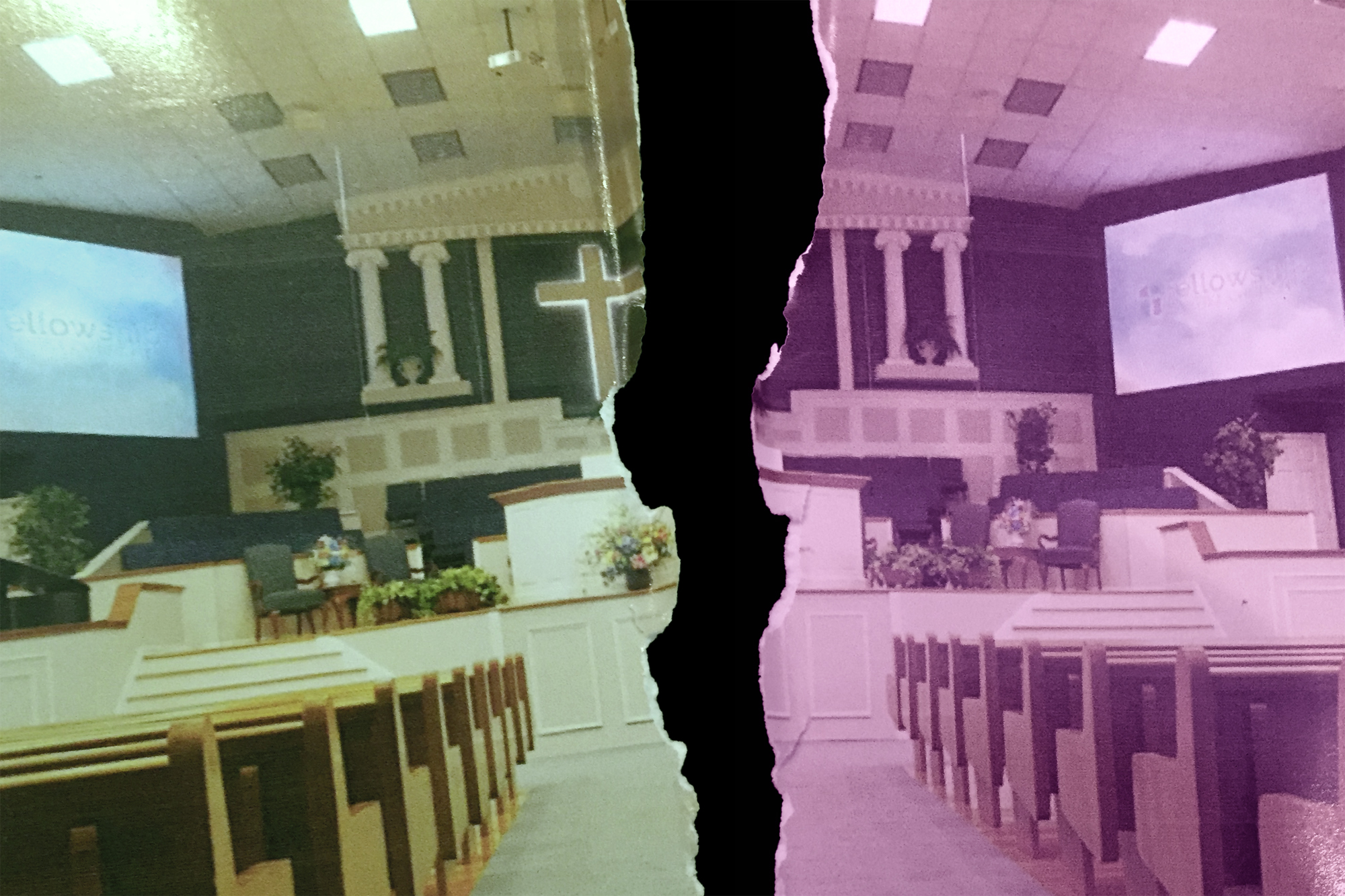
And so it was that Lifegate Church was formed. Lifegate was my church in youth and young adulthood. Except during college, this close-knit community — really, an extended family — was my spiritual home until I left Albany for grad school.
Many lovely things happened at Lifegate. We followed Christ in what was, for our culture, a radical way. A number of families homeschooled, unusual back then. We were, I suppose, “Bapticostals.” We held traditional views about scripture, salvation, baptism, and ethics. Yet, intense praise and worship, prayers for healing, speaking in tongues, the weekly hope for a fresh word from God — these marked us in varying intensities.
We also held home groups. We hosted “Matthew parties.” We had a lovely youth group. We had itinerant ministers giving us the Good Word. We were politically engaged. [I recall Pat Robertson on a bus at the Albany Mall (ca. 1988). I recall David Barton at Sunday lunch (ca. not sure).] We were ardent pro-lifers. Yet we also wanted to heal Albany’s racial divide — quite remarkable in hindsight.
But Lifegate struggled from the get-go. We had rejected a denominational hierarchy yet soon hungered for an organizational “covering.” We had spurned investment in mere bricks and mortar yet discovered that renting was hard. We had transcended “programs” yet learned that young parents needed those. We had surpassed “committees” yet still had to make decisions. And we had our own conflicts.
Lifegate just never found its footing. People would come; they would leave; they might come back. Stasis was actually a fairly healthy community. Yet, it never achieved escape velocity, never actually left the ground.
More than anything, Lifegate lacked consistent leadership. My first real pastor — a young man from Texas whom I consider a mentor — was at Lifegate. Yet, he was there just a few years. We also had flash-in-the-pan types come through (from Texas, also). Arrogant and immature, they left division in their dust.
A core group of men (of course!) — like a presbytery — gave ongoing leadership. I love them. Yet, to speak in their idiom: They didn’t get it done.
***
When you leave a place, you retain a picture of the people and relationships as you knew them. Yet, those go on, they evolve. My parents — founding members — actually left Lifegate for another small charismatic church. And so, people that in my mind’s eye should be together, are not.
I left Albany when I was nearly 30. Lifegate would endure another 20 years or so. Whether it flourished in those decades is not for me to say. I tried to keep up. Yet politics, a pandemic, my father’s passing, and sheer distance means those connections are largely defunct.
The church closed in 2023.
I’m grateful for my decade and a half or so at Lifegate. “Fundamentalist” might be a fair descriptor, true. Yet, genuine, lived-out love also characterized it. “Christian nationalist” might also be fair. But that too came from conviction that a godly nation alone can prosper. These hold, I suspect, for most Christians hoovered up under the sociopolitical tag White Evangelical.
Lifegate exposed me to different points of view, different ways of being a Christian. Granted, some of these were strange, some downright wrong. Yet, there was a flexibility, an embryonic tolerance. That led, at seminary, to an ecumenicalism and then, years later, to a generous pluralism. I doubt Byne could have given me that head start.
Anthropologists have a notion apropos a church break-up. It’s called schismogenesis. Each side defines itself as much in opposition to the other as it does in terms of what it’s actually for. It sets up a self-reinforcing, perpetual motion machine of divisiveness (see also: our national politics). If Byne was stuck in the past, Lifegate was the future. A photographic negative of the stale deadness that came before.
I don’t know if the stayers at Byne actually thought much about us leavers. We certainly thought about them. A particular position (scriptural, theological, or ethical) was often couched in terms of Exodus. We’d left the old behind and were on to the Promised Land.
Lifegate never reached that locale. Maybe the joy was always destined to be in the journey. Perhaps the peregrinations were the point.
I wonder about counterfactuals, ways things might have been: Byne, I understand, never fully recovered from the break. Its ultimate potential was thus attenuated. So, would the “net result” of Christian impact in Albany have been greater without that split? Probably so. Yet, what about the manifold — and for a place like Albany, truly fresh — insights, experiences, ways of being, and expressions of Christianity that came through Lifegate? They marked me for sure.
Online, I find no trace of that 40-year-old schism. No doubt, the Southern policy to hush up unpleasant things underwrites this. And, no doubt, the event and its aftermath feature larger in my memory than in historical fact. But it happened. Wheat and weeds were sown. I want to identify, to classify, to sort. Yet, at this distance, only God can do that.
[1] In 1910 a mother and daughter made a significant contribution (greater than half a million dollars in today’s money) toward a church building and dedicated it to their late husband and father — a Mr. G. M. Byne.
[2] I would understand later that the first stress owed much to Saint Augustine, the latter much to Jacobus Arminius.
[3] So that would have been through the 1984 / 1985 school year; I would have turned thirteen that January.
[4] Not only did we leave Byne for church, but we also left the school. We joined the very, very new — and to my paternal grandmother, horrifying — homeschooling movement. So I switched church and school about the same time. A big year for me.
[5] Witness the conflict between Paul and Peter in Galatians, as well as that between Paul and Barnabas in Acts.
[6] “My prayer is not for them alone. I pray also for those who will believe in me through their message, that all of them may be one, Father, just as you are in me and I am in you. May they also be in us so that the world may believe that you have sent me…” John 17:20, 21 (NIV)
[7] I recall “our side” forgiving the leader and seeking reconciliation, while the “other side” did not. That is good. People mess up — leaders mess up. We should forgive, make amends, reconcile.








“Perhaps the peregrinations were the point.” Thank you for a new word! When I looked it up, this is the definition I found: “Peregrinations are long, often slow or winding journeys, travels, or wanderings, frequently made on foot or to foreign places.” Man can I identify, and the catalyst for the wandering over 45 years was church, and all too often it was a split.
Your story is different than mine, but still very much the same. Raised Roman Catholic, rejected that in my teens and towards the end of college “got saved” (that makes me laugh now). I have come to regard what happened to me, was me, finally being able to hear the knock on my door, think the Eagles song “Desperado”, and really hearing the Gospel in it. In hindsight, I’ve recognized the signs that He was there knocking all along. The peregrinations (in my case…saying this so as not to try and introduce a new point of orthodoxy!), were similar to God’s motivation for sending Avram to a land He would show Him.
I’ve discovered a Hebrew phrase from Avram’s story; “Lekh Lekha (לך־לך), found in Genesis 12:1, is a Hebrew phrase translated as “go forth,” “go to yourself,” or “go for your own benefit”. It is a divine command to Abraham to leave his home for a new land, symbolizing a spiritual journey, self-discovery, and total trust in God, representing a “descent for the purpose of ascent”.
Even though in 1978 I had no idea about any of this, I left for college 4 states from my home town, became immersed in a completely different culture, and well, the “descent for the purpose of ascent” was on. I’ve lived in 13 different places since then. Sometimes the geographic change was less than 10 miles, but it’s amazing how much even a move like that changes what you see, where you drive, who you interact with, like everything, it changes everything. The ten miles was to ensure as much as possible little to no interaction between my family and others from a church we’d left under very difficult circumstances, and it worked.
But the disorientation, developing knew patterns and habits, the peregrinations if you will, I recognize now are a pattern God does use for some people, not all, and good God not only for the “remnant”. If anyone happens to reads this (at all) and you’re thinking you’re part of a remnant, please stop! I needed to learn dependence, and I still am…always will be.
It was at times very hard, heart breaking, and involved twists ands turns I would gladly undo if I could, because I recognize much more clearly my own culpability in the consequences I created. But thank God, He was managing the impact of my culpability, just as He said He would in Exodus 34:6-7. The word most often translated visit, I think is better translated “pays attention to, and intervenes”.
I write to those experiencing the same, “descent for the purpose of ascent”. I thought I was alone in that for very long, that there was something about me God didn’t like, and that I was unique in that kind of experience in a very negative way, which is a favorite trick of the adversary to keep us isolated.
Thank you Mockingbird for continuing to post some of the most relevant and impactful reading relative to our journey with the Lord. God bless you all!
As someone whose childhood church also went through a major schism, I resonate a lot with what you have written. I am learning to treasure the good – to be grateful for what I received – and to extend grace for everything else. Usually in these situations, there is not one holy side and one wretched side, but a whole bunch of sinners trying and failing to live in harmony. Where unity does exist in the church, it is a miracle of God and proof of the Spirit at work. I think that’s the right way to look at it.