




Living life in the analog world has meant experiencing much of life through cultural lenses: magazines, newspapers, broadcast television — none of these are surviving a direct-demand response via technology to our desires, wherever we are. The same is true of our buildings — movie theaters, museums, churches, shopping malls, town halls, even classrooms are now losing their social necessity.
Churchill was actually wrong when he said “We shape our buildings; thereafter they shape us” at a speech on October 28, 1943, arguing for the traditional rebuilding of the House of Commons after it was destroyed by bombing during World War II. The culture of Britain had shaped the building, and the radical cultural revisions Britain experienced after World War II — including firing Churchill — were not shaped by the fully traditional rebuild of the House of Commons.
Aesthetics in buildings changed after World War II, and modern architecture became the default style of most of our public places. Cultural changes created those changes — designers simply responded to them.
In the midst of the greatest cultural upheaval since the Industrial Revolution — the Internet Explosion — our culture is radically changing as it did then. Part of that are the convulsive changes organized religion is facing — because the humans are changing, what we create changes. The last decade has seen this change in a brutal social dynamic that is causing record levels of human isolation, addiction, and suicide; and in northeast America, new lows in participation in organized religion and in the use of the buildings of organized religion.
I design sacred spaces. And I am a human who goes to church every week. At one of those weekly gatherings, Rector Luk de Volder had to voice what is both obvious and hard to fathom:
One of the things our culture has lost, it certainly seems a distant memory, is the gift of forgiveness or mercy. Our digital lives don’t know mercy. Anything you search, post, or watch online is forever carved in the memory of the web. God may wash away our sins, but online, nothing will be wiped out. No forgiveness, no mercy. The internet remembers forever and brings back memories, even the ones you hoped to forget.
Those words cut to the devotion to the beauty we feel in our sacred spaces — the places we make that nurture the places we do not. Hearing the presence of God in our day-to-day is harder in traditional spaces amid the disheartening diminishing mercy in our day-to-day lives.
And our buildings reflect that humanity. The overwhelming majority of us knows that there is something far, far, more important than our day-to-day. Organized religion is the assembly of rituals and icons to reflect and elicit that human reality. But our analog organizations are often not so much the extension of us now as they are of the lives we once had — the lives now fully upended by the technological revolution of our culture.
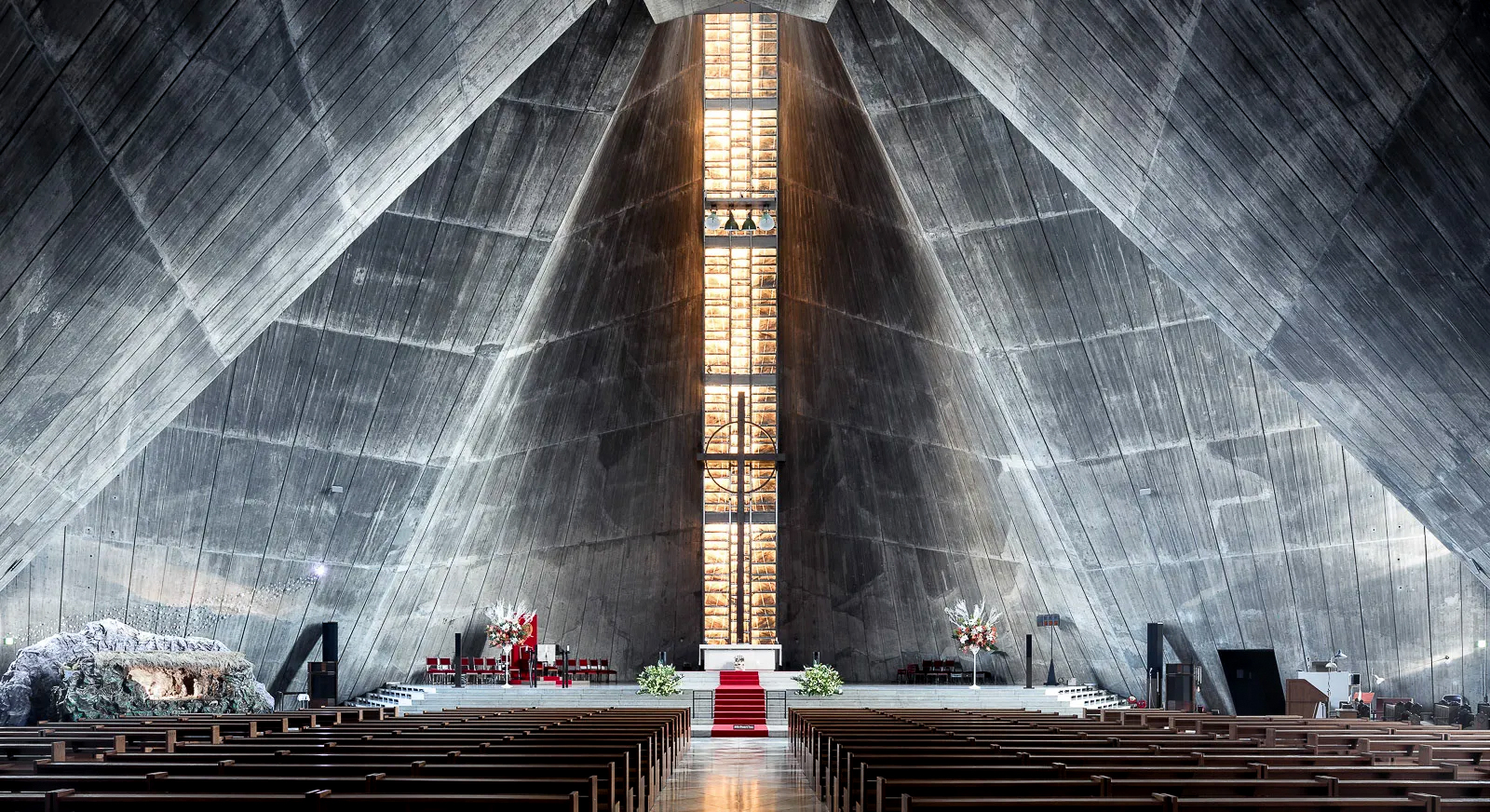
How do designers respond? Well, education is at the forefront of addressing change in our lives: All our human reactions are analyzed, organized, and projected in how we educate ourselves. I teach architectural design at the University of Hartford. As a designer of sacred space, I received two unsolicited cries out in the wilderness from two remote schools of architecture about how design reflects changing perceptions. Both are grappling with the changes in our culture that are affecting how design reflects the perception of the sacred.
Aurora Thompson, a senior at the Interior Architecture and Design program at Western Michigan University, wrote to me. “I am studying generational divides within worship environments and exploring how to design spaces that foster connection, inclusivity, and spiritual growth across all generations.”
Cormac Fitzgerald, a thesis student in architecture at SUNY Alfred is trying to define the “use of multiculturalist practices to enhance interreligious facilities … in response to the abundance of immigration to the US and the influx of new, unfamiliar traditions, with the goal of contributing towards an accepting and holistic society.”
All good. But to me there is more. The “more” is actually the fundamental reality of God that defies all understanding but is as real as “generational divides” and “multiculturalist practices” — places we can try and maybe succeed at understanding our focused impacts. Beauty (and God for that matter) is something we stumble into. It is not something we create, for we have already been created by it. Our lives are, in fact, steeped in beauty beyond our understanding. Hearing what beckons us beyond ourselves — despite ourselves — is given to us by the God who “gives all things their beauty: that he restores fair form to what has lost its shape, that he makes the beautiful more beautiful, and what is more beautiful he makes most beautiful” (Bonaventure Hex. I, 34).
I have come to realize the futility of trying to justify beauty and instead listen to the truth revealed in all of us in the things I help create. Late in life, for the first time, that truth was voiced by a great thought leader in architecture who has now passed. He was a designer too — not specifically of sacred space but in direct connection to the sacred in each of us. Not the intellectually convenient rationalizing of spirituality in a psychiatric syndrome but as a direct connection to God.
He was the author of A Pattern Language — Christopher Alexander, the creator of a program called Building Beauty where I also teach. His widow shared with me the article “Making the Garden” published by First Things in February 2016. At the time, it was a revelation to the world — a voice in a secular, rational, atheist world of academics.
Unlike almost all other publishing architects, Alexander clearly understood the state of decline in the relevance of religion:
There can be little doubt that the idea of God, as brought forth from the nineteenth and twentieth centuries, has slowly become tired … to such an extent that it has difficulty fitting into everyday twenty-first-century discourse. As it stands, it is almost embarrassing to many people, in many walks of life.

His early training revealed that “in an epoch when God was not acknowledged, it became virtually impossible for people to build the kinds of buildings where God appears.” He saw a different way: “I did maintain an inner knowing that the best way to produce good architecture must somehow be linked to God — indeed, that valuable architecture was always about God.”
Alexander justified this conclusion by stating that “there are two approaches to the reality of God. One is faith; the other is reason. Faith works easily when it is present, but it is luck, or one’s early history in family life, or a blinding insight of some kind, that determines whether one has faith. Reason is much harder. One cannot easily approach the reality of God by means of reason. Yet in twentieth- and twenty-first-century discourse, reason is almost the only way we have of explaining a difficult thing so that another can participate.”
Like myself, Alexander concluded, “I could no longer really avoid the topic of God.”
But more than broad oaths of devotion and insight, Alexander offers an insight that is both rare and a more radical basis for architecture than any of his other well-known aesthetic insights. For him, his theories and practices add up to one point:
The tangible substance of architecture, the fact that in good architecture, every tiny piece is (by definition) suffused with God, either more or less, gives the concept of God a meaning essentially translated from the beauty of what may be seen in such a place, and so allows it to disclose God with unique clarity … If we pay attention to the beauty of those places that are suffused with God in each part, then we can conceive of God in a down-to-earth way … the path of architecture thus leads inexorably towards a renewed understanding of God.
And mercy — in grace.








Lovely! I hope to meet you soon. I have a project in the Hudson Valley and I studied and taught with Chris at U.C. Berkeley.
Wonderful to meet you, Do!
Kathryn Langstaff, Autopoiesis, LLC
THANKYOU: would love to hear the “Autopoiesis” story