




I first came across the phrase, “Remember, everyone you meet is fighting a great battle,” on the back of a business card of an acquaintance, an attorney. Not the usual business card fare, certainly, but all the more welcome for that.
It’s unclear where or with whom the phrase originated.[1] It seems to have been written originally by a Rev. John Watson, who published it under the pseudonym of Ian Maclaren in 1897 in a British Weekly Christmas message. Originally worded, “Be pitiful , for every man is fighting a hard battle,” Watson’s 1908 biographer restates “his famous motto” as “Be kind, for everyone is fighting a hard battle.”
I suppose the admonition to “be kind” can sound like “law,” that is, an exhortation, even if a gentle one. But it’s the other part that veers toward “gospel.” “Remember, everyone you meet is fighting a great battle.” As every pastor knows, behind the general outward appearance of put-togetherness, there is always some suffering, sadness, as well as burdens being borne. I have even incorporated the phrase into two paintings, one of which was purchased by a woman who struggles with bipolar illness, another to a couple whose adult son took his own life.
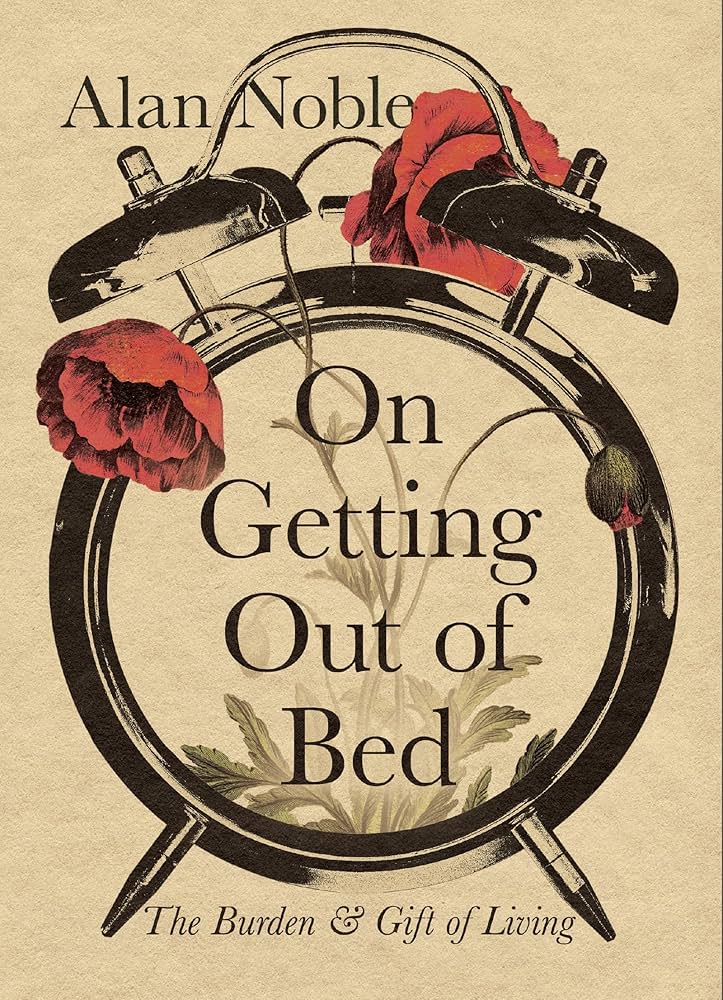
I recently began reading a newish book by O. Alan Noble, On Getting Out of Bed in the Morning: The Burden and Gift of Life. Noble tells us that he grew up around a great deal of tragedy and trauma, but he thought that this experience and these people were outliers. Most people, he imagined, have it together and lead pleasant and safe lives. He thought he too, despite a difficult background, could enjoy a normal, pleasant life if he played by the rules. Noble writes:
It’s hard not to think like this, even when you grow up around tragedy and trauma, as I did. It’s hard not to think like this because almost no one wants to tell you otherwise. There’s a kind of unspoken conspiracy to ignore how difficult life is, or to reframe it as something romantic — a heroic challenge to overcome on our way to the good life.
In this conspiracy we each try to hide our scars, even from those closest to us and sometimes even from ourselves. Almost every cultural institution, church, government or corporation promises you a good life if you will just do what they ask. Make the right choices. Marry the right person. Go to the right church. Get the right education. Work the right job. Buy the right products. And you’ll be fine.
That would be the “law,” in both its secular and religious forms. And Noble is certainly right that almost every institution — including most churches — do promise a good life as a result of doing what they say you should. It’s up to you. It’s on you. Suck it up. Try Harder.
We love that stuff, and particularly at this time of the year, January. A poster in my gym urges, “A New Year: A New You.” Only $595 for seven sessions of personal training. A friend’s rejoinder to the “New Year: New You” cliche, is “I like the me I have managed with a lot of therapy, hard work and God’s grace to become. I don’t want to be a ‘new me.’” Thanks all the same.”
Noble rings a few more changes on this theme, including noting the downside corollary which is, if you don’t have a safe and pleasant life, it’s your own damn fault. Then he confesses:
I believed all this, and I was wrong. The people close to me weren’t anomalies, they were the norm. While not everyone will experience the kinds of trauma they did, suffering — even profound mental affliction and personal tragedy — is a normal part of human life . . . Once I grew closer to other adults, people who seemed ‘to have their lives together,’ that’s what I discovered. Life is far more difficult than we let on. [Emphasis added]
Hence, my recall of the phrase, “Remember everyone you meet is fighting a great battle,” as I read Noble’s book.
Years ago, I came upon a piece by a psychiatric nurse titled “Wrestling with Our Inner Angels/Demons,” in which she shared the wisdom of Beverly, a woman she knew who experienced a mental illness. I was so struck by Beverly’s wisdom for dealing with pain and anguish that I wrote in a journal I kept at the time. Because Noble is right, “Life is far more difficult than we let on,” Beverly’s advice for seasons of mental or spiritual affliction and personal tragedy ring true.
She suggests, “When you are in pain, you must, one, wait for the relief which always comes by God’s grace.” My comment here: as one who has known dark times, there is that nothing harder to believe when deeply depressed than “it will end,” but also nothing is more important or true.
“Two, function as well as you can with as little self-pity and self-hatred as possible.” My comment: I like the two-sidedness of this. In distress, you can go to self-pity, moaning about your plight and casting about for someone or something to blame for it all. But, strangely, that can exist right alongside what might seem self-pity’s opposite, self-hatred. In fact, while possibly opposites, the two are highly compatible and equally defeating. As Beverly counsels, both require resistance.
“Three, still ‘be kind to all you meet’ as much as you can, take it one day at a time; treat yourself and others as lovingly as possible;”
“Four, when you have failed” (at any or every part of number three), “accept God’s and others, and your own, forgiveness as soon as possible; then with His help, ‘Take up your bed and walk.’” Partly that is an admonition to insofar as you are able to get on with it, as in Churchill’s phrase, “When you find yourself going through hell, keep moving,” but also a reminder that walking almost always helps. Salvitor Ambulando. We are saved by walking.
Perhaps this all seems a bit on the downer, even pathetic side. I don’t think it is. What is pathetic is pretending, as Noble suggests, that life isn’t more difficult than we let on.
It’s automatically saying when someone asks “How are you?” “Fine, just fine.” You know what “fine” means, don’t you? “Feelings Inside Not Expressed.” Sometimes it’s the best we can do. And sometimes it’s what the situation calls for.
But here, let’s be honest. Life is more difficult than we let on. That doesn’t mean going around sad and morose all the time, just honest. Honesty from Yeshua: “In the world you will have tribulation, but be of good cheer, for I have overcome the world.” (Jn 16:33)
Noble concludes the foreword to On Getting Out of Bed with these words:
If you take away one truth, the one thing in this book I know with certainty, let it be this: your life is a good gift from a loving God, even when subjectively it doesn’t feel good or like a gift, and even when you doubt God is loving. Please: get out of bed anyway.
[1] False attributions abound nowadays, with Plato and Philo being the most common. In 1922, a Jack O’ London’s weekly footnote wonders where the quote came from. Then in 1923, an introduction to the works of Oscar Wilde offers a version of the quote, but the author also doesn’t know where it came from! Some have attributed it to Henry James who is said to have answered the question “What’s important in life” by saying, “Three things in human life are important: the first is to be kind; the second is to be kind; and the third is to be kind because everyone you meet is fighting a great battle.” While James did offer the three-fold admonition to “be kind,” there’s no evidence that he added the phrase in question.







Thank you. I needed to read this today.
Thanks Tony. In terms of the ‘great battle’ that we all face, I was reminded of the verse early on in Ecclesiastes (1:13b), “What a heavy burden God has laid on mankind”. Life isn’t easy as the Preacher in Ecclesiastes sets out clearly. Thank you for reminding us – and what that means for responding to others and ourselves.