




As seasons go, November in New England is neither here nor there. Trees strain to hold on to their October colors, but they’re thinning at the crowns. The morning is chilly enough for me to dig out gloves for my youngest, which he’ll likely leave behind on a warm playground this afternoon. His brother already knew to wear an extra layer today — I catch a glimpse of him out the window as he rides off toward the high school — and I think of their sister bundling up, too, in her dorm room hundreds of miles to the west.
Autumn is ripe for mental time travel. Our phones’ photo reels remind us that On This Day, the same jacket was worn by a different kid, and we see both at the same time: their past, present, and future selves folding in on themselves and producing a feeling we can’t quite pin down.
***
There’s a video clip I show in my lectures when I teach about emotion. It’s a local news report covering a surprise military reunion — the ones where the soldier comes home unexpectedly, there are gasps, and hugs and tears ensue. What’s unique about this particular clip is that the returning soldier has two daughters, both unaware that he’s about to show up at their school assembly. When he steps out on stage, the kindergartener leaps up from her spot on the floor. Her eyes are wide as she runs to him, she’s beaming, and my students have no problem volunteering responses when I ask them to identify her emotion. She’s happy. Excited. Overjoyed. But then the camera pans to her fifth-grade sister, who’s reacting very differently to the sight of their dad. She stays seated, covers her face, and sobs. And now, the trickier question: what is she feeling? And why is her reaction so different from her sister’s?
Part of the reason is that the older sister is a more seasoned mental time traveler. Constructivist theories of emotion[1] propose that our emotions are generated — constructed — by a dynamic mix of present and past ingredients: sensory data from both inside and outside our body, memories of relevant experiences, and our pre-existing emotion categories come together to produce something we may identify as “happiness.” And because we become better mental time travelers with age, the younger sister is likely attending to nothing else but the present moment: her heart is beating faster and her dad is standing in front of her. Meanwhile, her older sister also sees their dad, also feels the quickening in her chest. But she may also be remembering how much she’s missed him, thinking through the steps he had to take to get here, or even wondering how long they’ll have together before he needs to leave again. Past, future, delight, and sorrow converge in the moment to construct something far more textured than happiness, so of course she’s still sobbing as she eventually makes her way to the stage.
Kodak introduced the Carousel Model 550 slide projector in 1961.[2] The major upgrade was the invention of a circular slide tray, which, in contrast to the straight tray of its predecessor, the Cavalcade 540, allowed users to advance their slides both backwards and forwards; and in doing so, made mental time travel a collective family room activity.

1961 advertisement for the Kodak Carousel
“Carousel” may have been a deliberate nod. Ancient Chinese zoetropes were called revolving or trotting horse lanterns (走馬燈 /zou ma deng) in reference to their silhouettes of officers on horseback, projected onto a rotating paper lantern — a reel of battle highlights on heat-propelled loop.[3] These days, zou ma deng has taken on an additional idiomatic function. In both Chinese and Japanese (soumatou そうまとう), “revolving horse lantern phenomena” refer to aspects of the near-death experience: the flashes we get of our timelines, tangled and unspooled — now, and at the hour of our death.
Modern animation — Pixar, in particular — leverages mental time travel to similar effect. Ratatouille’s food critic is moved from stoicism to shock then rapture by a gustatory sensation that transports him back to his childhood kitchen. Marlin, having finally found Nemo, gets a glimpse of his son both as he is and as he was the day he first saw him. And when Inside Out culminates with a family yearning for their old home, the emotion that’s generated is a glowing yin-yang sphere of joy and sadness.
Or consider the Kodak Carousel itself. A 2007 Mad Men episode imagines its initial ad campaign, in which Don Draper pitches it as — yes — a time machine. He demonstrates by projecting slides from a family album in zou ma deng fashion, traveling back and forth on the timeline. Images from a wedding and pregnancy are flashed in between pictures of their kids who are preschoolers, then newborns, then preschoolers again. What the Kodak execs don’t know, and the reason Don’s voice catches in his throat midway through his pitch, is that the photos he’s showing are of his own family — now fraying — in happier times. Consider the Carousel: “It goes backwards, forwards, and takes us to a place where we ache to go again.”
All of us — parents on the first day of school, daughters of returning soldiers, 1960s ad men — struggle to label the emotion we’re experiencing in these moments, because it’s not just happiness or sadness or even a combination of both. What mental time travel stirs into motion is longing.
***
But a longing for what, exactly? More than a millennium before modern psychology, Augustine devotes Books 10–12 of his Confessions to time, memory, and mental time travel. “Coexisting somehow in the soul” — somehow! — are “a time present of things past; a time present of things present; and a time present of things future” (Book 11; 20.26). We hear a whisper of wonder in his somehow, and it may be only partly referring to unknown neural mechanisms. Augustine’s broader grapplings in these sections are those of a timebound creature longing to relate to One who exists outside it. Even as memory is the faculty allowing an embodied self to seek God — “How then shall I find you, if I do not remember you?” (Book 10:17.26) — what follows is a realization of the great gulf between the temporal and the eternal. For Augustine,
“It is memory that brings the desired object before the mind’s eye in its appropriate manner, making what is absent, present; the will unites the soul with the thing that it desires, but lacks, or possesses only imperfectly.”[4]
Memory, too, is the thing that accentuates what Augustine desires but lacks, notably by projecting the slides of Augustine’s old self into the here and now:
“In my memory … there still live images of such things as my former habits implanted there. When I am awake they assail me but lacking in strength; in sleep they assail me not only so as to arouse pleasure, but even consent and something very like the deed itself” (Book 10, 30.41).
What Augustine’s unquiet heart possesses only imperfectly in the moment is an overarching order — an ordo — and as such, “he desires nothing less than a share of eternity now.”
In this way, Augustine lays out the role of mental time travel in fostering a longing for the eternal. Centuries later, C. S. Lewis leans into the longing itself. He lands on the German sehnsucht as a label to describe “the old stab, the old bittersweet”[5] he first recalls encountering when he was six years old. Sehnsucht seeps through Lewis’ work even when it’s not named explicitly. And when he isn’t writing about his own experiences with the emotion, his characters speak about theirs:
“It was when I was happiest that I longed the most … Do you remember? The colour and the smell, and looking across at the Grey Mountain in the distance? And because it was so beautiful, it set me longing … Somewhere else there must be more of it.”[6]
Psyche says this to her sister Orual, who has come to comfort her on the eve of her execution but instead finds herself on the receiving end of comfort that Psyche has herself received — from what? Or worse, from Whom? Here, again, we have two sisters: one focused on the present moment and the other looking both backward and forward, producing an emotional state that defies easy categorization.
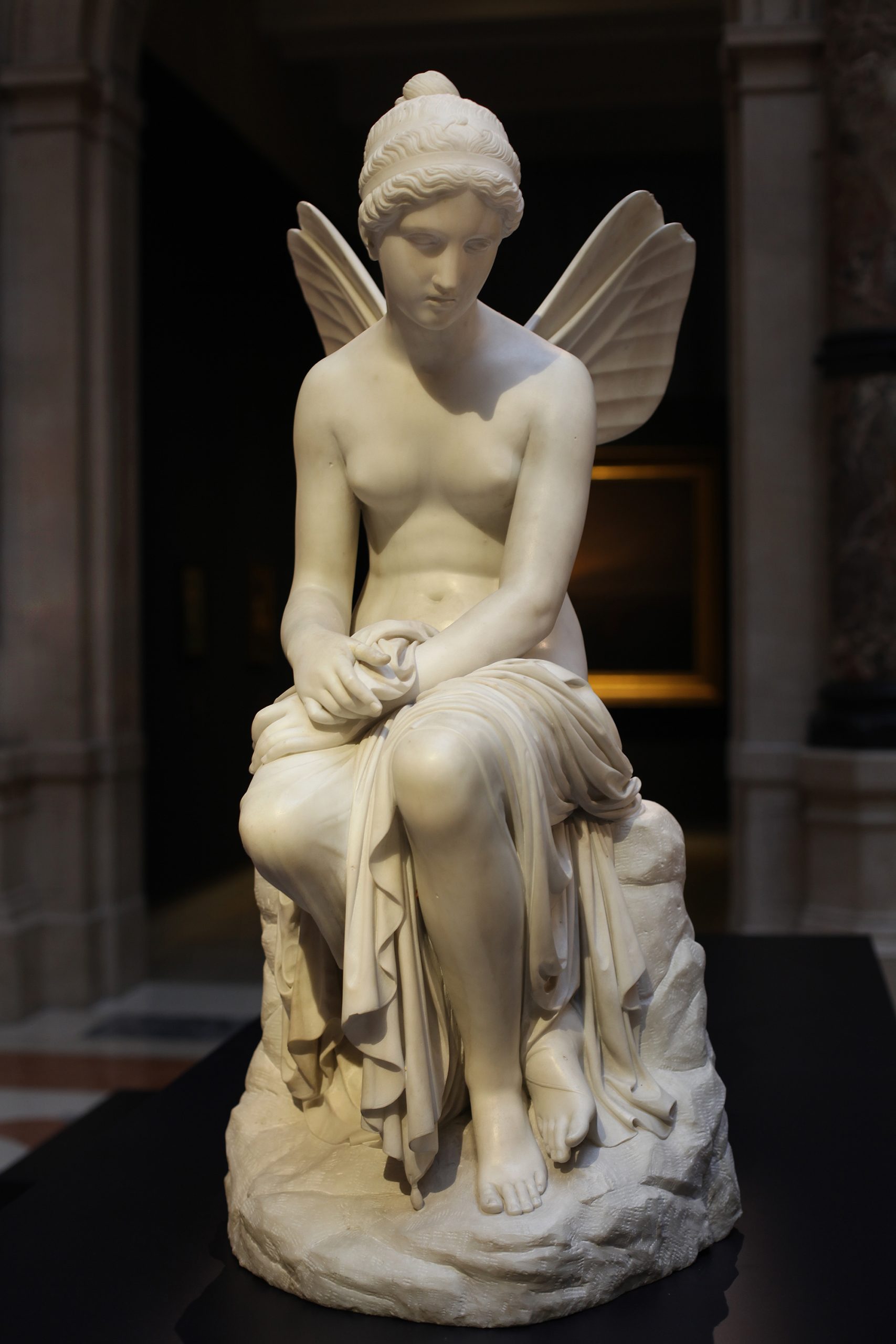
Psyche Abandoned, Pietro Tenerani (Torano, Carrara 1789 – Roma 1869)
Psychologists studying sehnsucht — centuries after Augustine, decades after Lewis — identify many of these same features: a mix of positive and negative emotions, long-held utopian longings, and of course, mental time travel.[7] In their subjects’ moments of sehnsucht, they find “memories of past peak experiences (e.g., falling in love for the first time) may fuse with the desire to re-experience them, while knowing that this is impossible in the present as well as in the future.”[8]
The impossible element is a reunion between past, present, and future selves: for our children to be both present and absent, to both grow and stay the same. Don Draper sells the Carousel as a nostalgia machine — something that would allow us to travel “around and around and back home again, to a place where we know we are loved.” What ultimately distinguishes Lewis and Augustine’s longing from Draper’s is that rather than a circular tray, they saw a straight line to its fulfillment. For Augustine, this line passed through, and only through, the verax mediator: his hope of overcoming present time warped toward his past self lay in Christ — “by staking his claim upon the total effectiveness of divine initiative.”[9] Likewise, for Lewis, sehnsucht wasn’t a carousel of nostalgia but rather a signpost to a day when he would finally emerge from
“the tyranny, the unilinear poverty, of time, to ride it, not to be ridden by it, and so to cure that always aching wound.”[10]
Psyche’s longing, as it turns out, wasn’t a revolving horse phenomenon or a story told to comfort herself at her final bedtime. It was the title page of a book that would go on forever, “in which every chapter is better than the one before.”[11]
***
Autumn is a collision of beginnings and endings, with leaves donning new colors to celebrate their last days. Is it any surprise that one of Lewis’ earliest encounters with sehnsucht came through the mere idea of autumn? What is surprising is that as often as he writes about sehnsucht, the term itself appears relatively infrequently in his writing. More often, he refers to the longing as Joy — so often, in fact, that it’s hard to discern where one emotion ends and where the other begins.
[1] Barrett, L. F. (2014). The conceptual act theory: A précis. Emotion Review, 6(4), 292–297.
[2] https://resources.kodak.com/support/pdf/en/manuals/slideProj/history.pdf
[3] I am indebted to a Japanese-speaking friend for making this connection.
[4] Hochschild, P. E. (2012). Memory in Augustine’s theological anthropology. Oxford University Press.
[5] C. S. Lewis, Surprised by Joy: The Shape of My Early Life. (Houghton Mifflin Harcourt, 1956).
[6] C. S. Lewis, Till We Have Faces: A Myth Retold. (1st Mariner books ed. Houghton Mifflin Harcourt, 2012)
[7] Scheibe, S., Freund, A. M., & Baltes, P. B. (2007). Toward a developmental psychology of Sehnsucht (life longings): The optimal (utopian) life. Developmental Psychology, 43(3), 778.
[8] Ibid, 781
[9] Hochschild, P. E. (2012), p. 151
[10] C.S. Lewis, Reflections on the Psalms. (New York: Harcourt Brace & Co., 1955), p. 137
[11] C.S. Lewis, The Last Battle (New York: HarperTrophy, 1994), 211.








[…] 1. Stephen Chen: Autumn and the Emotion of Time Travel […]