





The Inconceivability of a Post-Christendom Society
I took a semester off my junior year of college to live and work in Hamburg, Germany. Many things surprised me: how many döner kebabs people ate, how much Tom Jones music they listened to, and … how empty the churches were. I knew Germany was less religious than the United States, but nothing could have prepared my heart for the utter lack of religious participation by people in society.
Growing up in late-twentieth-century America, I could not have imagined a Western society in which the church was not central to daily life. Almost everyone I knew belonged to some kind of church; everyone from politicians wooing voters to stars accepting Hollywood awards acknowledged God, and church buildings occupied a prominent place in nearly every city and small town in the country. When I looked at Germany, when I saw pictures of German towns adorned with steeples, when I read plenty of German theologians, I figured Christendom was alive and well there. I had heard it was more secular than the US, and so I prepared for a few more “Christmas and Easter” Christians. But I assumed that the church in Germany would still form the backbone of society, the nexus through which the civilization filtered its aspirations and mores for life together.
I was wrong. Sitting in massive cathedrals that were essentially empty rocked my world, because it revealed to me that a society could exist without a church. To be clear, on future trips to Germany, I have discovered ways in which the church there is alive, vital, and a source of renewal. Furthermore, Hamburg, Germany, is more secular than other parts of Germany, and I realize that piety includes more than worship attendance. But as a whole, the trip opened my eyes to what a post-Christendom society looks like: the vestiges of Christian culture have faded into the background, becoming historical artifacts to be admired or judged rather than living signposts to a deeper reality.
I have generally preached from this mindset: namely, that our society is becoming post-Christendom. The church increasingly takes its place at the margins of relevance. I find this does not always resonate with my congregation members, because for many of them, a post-Christendom society is an inconceivable reality. They lament dwindling attendance at churches, sure, but they struggle to see the extent to which the American Christian church, their denomination, and their congregation are simply irrelevant to the lives of others. I am always struck by how many of my older congregation members want to know what our denomination says about X, Y, or Z social topic, because it does not occur to me that people would actually care about this. But they grew up in the mid-twentieth century, when Christendom, carried forth by the mainline denominations, formed the backbone of civil society.
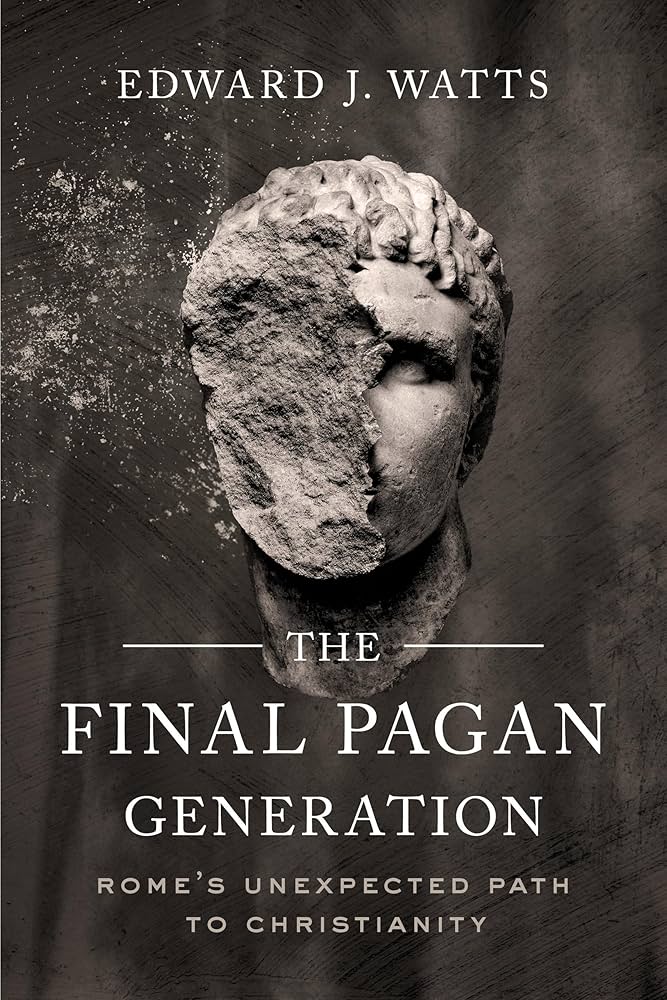
This echoes what happened to elites in the fourth century who were blind to the rise of Christianity. In his book The Final Pagan Generation, Edward Watts argues that elites in Roman society during this time period, even if they were Christian, could not conceive of a Roman Empire that had shed its moorings in pagan spirituality and culture. They could not see that they would be the “final generation” of people living during the time in which paganism served as the dominant cultural force.
The Roman elites of the 300s lived in a world in which most of their friends and daily life continued in a pagan milieu, in spite of Constantine’s conversion. Sure, the emperor was closing temples, but these were decrepit ones, eyesores that everyone agreed needed to be taken down. Sure, the emperor might not worship Zeus, but the altar of the goddess Victory still framed the Roman senate. Because many of the elites’ peers were still pagan and their world played by pagan rules, the rise of Christians in the general populace didn’t impact them. Their home, their friends, their temples, and the workplaces still functioned by the same rules; and the rules that did change did so slowly over time, giving plenty of time for readjustment.
Watts drives home the point that they couldn’t see the massive culture shift taking place. This is like the person today who laments that their grandchild or child plays in soccer tournaments on Sundays but doesn’t realize the deeper problem: their grandchild or child grows up in a world in which children don’t know the stories of the Bible, don’t pray, and don’t have friends who are Christians.
It leaves me with a challenging question: How do we help people see that the culture has shifted away from the church — without simply making them sad or mad about it? For me, I probably spent a good five years grieving what I had seen in Germany. It ultimately would shape a deep sense of calling to form communities in which the gospel resonates with people still longing for forgiveness, purpose, belonging, and hope. While I lament the rise of secularism, I believe that modern secular society fails to deliver the fundamental goods of society and that the gospel will prevail. But arriving at a point of purpose only came about after many sad and mad moments. How do we help lifelong Christians do more than acknowledge or be angry with the cultural shifts? How do we help them adapt to a new way of relating to church and culture, one they frankly might not see within their own spheres of influence. How can we preach the “law” — the truth that the comfortable détente between Christianity and culture of the twentieth century has given way to something else — in such a way that people’s ears can still hear the gospel, that Jesus Christ is alive yesterday, today, tomorrow, and in the church, regardless of how much the culture values it? This task likely requires a ministry of preaching and not just a sermon!
 Demographics Alone Are Not Destiny
Rodney Stark’s The Rise of Christianity (1996) offers a compelling demographic argument for the rise of Christianity: Christians loved more, therefore they were more likely to have babies, survive plagues, and convert people they helped during plagues. The author of The Final Pagan Generation takes a very different approach. Watts acknowledges the growth of Christianity, especially in the lower classes. But the demographics of love thesis doesn’t explain how you get a Christian bishop leading a mob to destroy the massive 550-year-old temple to the god Serapis in Alexandria in 391 AD. The author argues that Christianity may have drawn strength from a theology of love but found a way to play “chess” in the real world through its bishops and monks.
The author argues that up until the mid-fourth century, most of the Christian bishops were people who were drawn from the middle class. While there existed a number of Christians in elite society, they were not interested in these church positions. As members of wealthy families, they had potential for incredible wealth and upward mobility within the imperial system. They also had enormous family and patron obligations to fulfill. The author mentions how many Christian elites who sought positions of Christian leadership were chided by their families for failing to fulfill their commandment to love their mother and father (a millennium before Luther!). Roman society may have been harsh, but there were interlocking bonds of obligation that tied people within and across classes. The combination of benefits and responsibilities made walking away from elite society unattractive.
By the late fourth century, however, an increasing number of Christians from the elites of society entered into church service. However, rather than simply abandon their ties to the world, they would find ways to synthesize their elite upbringing with the new Christian positions. For example, a new type of bishop emerges, a person like St. Ambrose. He was from a wealthy senatorial family, one who could actually pay for the construction of church buildings himself. Of course, he was a devout Nicene Christian, but he was also one who knew the rules of the elite game. In fact, he intervened (in a kind of shady way) to secure the coronation of Emperor Valentinus II. Later he called in this favor to secure certain religious policies that pagan leaders were fighting against. The bishops of the late fourth century began to function like the bishops on a chess board. They didn’t quite move the way other pieces moved but nonetheless were close to the royals and a force to contend with.
Elites also dropped out of society to pursue ascetic life. This may sound like the deepest repudiation of wealth and power, but it did not quite work this way. St. Anthony, the “grandfather” of all monks, walked away from his position in society, defeated demons in the wilderness, and then returned to a position of even greater respect in society. The ascetics from the elite emerged from the desert with spiritual credibility and social connections, a potent combination. Significantly, Athanasius wrote a biography of him, and this served as a blueprint for future elites to see how even the path of asceticism could ultimately lead to a path of influence. Men like Chrysostom read Anthony’s biography and decided to pursue the ascetic lifestyle, only to emerge later as the powerful bishop of Constantinople. The author avoids claiming that these men chose an ascetic pathway because they sought power in a craven way. However, he makes the point that as Christianity grew in size and stature, the leaders of the movement, even monks, became entangled in Roman elite life.
Christian leaders began engaging civic leaders before the fourth century, but by the end of that century, Roman elite society had to contend with bishops and monks from their own ranks. Furthermore, these Christian leaders often had sizable followings. This meant that when Christians turned against the remaining edifices of pagan society, the elites — whether pagan or Christian themselves — had less leverage to stop them. While the demographics provided the power to the engine, it took members of the elite class taking on leadership in the church to steer the imperial machinery against pagan worship and dismantle pagan society.
Which leads me to ask another challenging question. Does the church in the West need people like St. Ambrose? Increasingly, large churches require effective business people to manage their assets, their campuses, and their staffs. Those who preach in these settings often have influence that spills out beyond their congregations. Consider megachurch pastor Rick Warren, who is both a best-selling author and known for praying at the inauguration of Obama. Folks like Warren are essentially bishops, even if their (non)denomination abhors the title. Even traditional mainline bishops often find themselves engaged with political leaders in surprising and influential ways. Consider the Episcopal bishop who called on President Trump to care for the poor. She now has more than 150k followers on Instagram. (Do that many Episcopalians even go to church nationwide??) Does the church need people who understand how one plays the game of wealth, power, and politics so that Christian influence can compete with the other voices in society? Sure, small separatist communities of love worked in the first century, but does our current context not resemble more closely the fourth century? Now, like then, Christianity does have a place at the political table, so do we need people who know their table manners? And what might this look like for us to recruit or develop such leaders?
History of Saints and Sinners
In Hamilton, Aaron Burr muses, “Death doesn’t discriminate between the sinner and the saint.” One might wonder if “God doesn’t discriminate between the sinner and the saint,” at least when it comes to bringing about his purposes in this world. The fourth century closed with pagan worship waning and Christian worship flourishing, something we would consider good. This resulted not simply from angels singing in heaven, but from sinners and saints colliding and cooperating across multiple generations.
Admittedly, I like stories about saints. I like the story that Christianity overtook paganism by love alone. But it does seem like at some point, power was needed, and not simply the power of cheer and goodwill. The great temple of Serapis was a gigantic idol fest, clearly a breaking of the first commandment. Such a thing will not exist in the new creation and should not exist in this creation either. Would any of us argue that God wouldn’t judge such an edifice? But in my imagination, the temple totally emptied out over time, it laid in waste for a generation, and then the Christians came along, sold all the assets, gave them to the poor, and started a monastery out of the area. Alas, the real story is of flesh and blood, of an angry mob deciding it needed to bring down the idols and knowing they had political coverage to do so. Was this God’s judgment, working behind the mask of human anger, political machinations and, yes, love of the Lord? I want to say yes, but this leaves me unsettled.
Given that all the characters of the fourth century were both sinners and saints, we will not see a clear picture of God’s mercy in the heroes or God’s judgment in the villains of the fourth-century church. For example, the violence in Alexandria between pagans and Christians likely goes back to the mid-third century. I am not an expert on inter-religious strife in third-century Egypt, but I suspect the more one studies it, the more it probably begins to look like any other example in history where religion, class, tribe, and access to resources intertwine, breaking out frequently in violence.
Which brings me to my last challenging question: Not so much can we figure out who is good and bad in history, but given the saint and sinner in each of us, is it possible for Christians to seek worldly power and not lose themselves in the game? Can we be fluent in mercy and in power?
Perhaps I could put it more positively, How can the church foster countercultural people who still develop leadership skills? The ascetics who withdrew from elite society, like Anthony or Chrysostom, never fully withdrew from all of their friends or relationships. They ended up forming nodes or small communities through which they encouraged each other. My hunch is that this kind development of a person — one who is savvy to the world, who can fundraise with the wealthy, who can work a room or a community to help pass legislation, yet who is humble of heart and knows the power of prayer and the necessity of grace — probably takes a long time to form, and this person remains grounded in a community of confession, prayer, and scripture!
We can recognize the twentieth century’s church-state-culture relationship that conferred stability and prestige on Christian churches has changed. Perhaps we are not so much the final Christian generation, but the final Christendom generation. That said, this book does not forecast the decline of Christianity as imminent or definite; the author makes no comment on modern religion. However, this book suggests the transition to a new stasis between religion-state-culture likely brings disruptions and likely takes a long time. Even if we are living at a time where Christianity must fail in the West for resurrection to take place, it will happen over many generations, generations in which Christianity still has viability, spiritually and economically, certainly in particular communities. Regardless of what the twenty-second century will look like, how Christian congregations engage within their communities in the twenty-first century will continue to have a significant impact on life! Furthermore, there will be many chapters that include collusion and cooperation between rising forces of secularism and Christianity.
What remains very unsettled is how we move ahead as Christians in this time of flux. My final question then to fellow members of the final Christendom generation is this: In which language do we strive to write the next chapter, Mercy or Power? It is never fully either-or, but at some point, the Christian church of the fourth century discovered that speaking both proves necessary and quite difficult.
Rob Myallis lives with his wife, Emily, and two daughters in Lititz, PA, where they serve together on staff at St. Paul Lutheran. He enjoys assisting with the high school cross country team and helping fellow preachers mine the Greek New Testament for preaching nuggets. Lastly, his claim to fame is knowing Dave Zahl when Dave had braces.
The Final Pagan Generation examines the unexpected rise of Christianity in the Roman Empire during the fourth century. Although Emperor Constantine had converted early in the century, most of the important institutions in society were still led by pagans, and pagan worship dominated civic life. Edward Watts, the author, offers this thesis: The assault on pagan worship and life that bishops and monks led at the end of the century completely caught the elites in society off guard; furthermore, the power accrued to these bishops and monks meant the remaining pagan elites could not thwart the rising power of the maturing Christian church. This book led me to reflect on three matters: how to preach to people who are often unable to conceive of a post-Christendom society; how to develop leaders who are fluent in the language of power; and how God might just work through sinners.








By using coercive power against Roman pagan society, and extending that strategy to maintain dominance in medieval times during the height of European integralism of Church, culture, and government, Christians got the practice in coercion that they later used against each other in the European wars of religion that followed the Reformation. That can’t be right. Maybe the Church lost the way of Jesus Christ long before Constantine baptized the Empire in the name of Christ.
Excellent and thoughtful work as always. In many ways the coasts have been Post-Christian (at least post-Mainline Protestant dominant) for a well over a generation now. This gap has been replaced by dominant a d growing secularism, pockets of big box Evangelical Christianity and an ethnically cultural Catholicism (perhaps stronger in identity than participation) which all finish a distant 2nd behind youth sports.
What is to come in our societal shift is anyone’s guess, but I love the connections you are making to another dominant crumbling empire and our institutions. In New England where I live there are glimmers of hope underneath what feels like more moving parts than one can track effectively, but where there is life and energy, it is because the faithful are putting its message into action and building relationships in the ways Christians have always done to spread the gospel.
Maybe our moment is live in the tension between Rome’s collapse and Christianity’s rise of the same period as we enter our own. Aren’t we standing in both worlds? It is also worth noting that as Western Christianity is searching for any kind of solid footing in this changing landscape our global partners are flourishing as the gospel continues to spread.
All this to say, there is much to learn. Thanks for asking great questions and paying attention. It is one reason (of many) you are a very effective pastor. Thank you for your faithfulness. Blessings friend. G