




Last week, my self-righteous automotive heart was lifted to the seventh heaven by a new road sign.
The state has been working on my town’s main road recently, closing one lane of the two eastbound lanes I drive between my home and my grocery store. You know the drill: when one lane is closed, everyone has to merge into the other single lane, and that merger causes a backup. The question, of course, is when one should start to merge into the open lane, a question that has unexpectedly high stakes.
Judging by the behaviors and attitudes of my fellow drivers, the answer is that one should merge as soon as one knows about the upcoming lane closure. One or two miles in advance, vehicles begin the merging process, leading to one packed lane and one empty lane. This is the considerate merge, unlike those unobservant drivers zipping by in the almost closed lane. Who among us hasn’t completed their merge, sat in traffic, and watched with resentment as those awful “heathen” line cutters whiz by. They should have gotten in line and waited their turn! Now, they’ll skip the line, only to plead for a mercy merge when they finally arrive at the lane closure point. They’re rewarded for their inconsiderate, if not reckless, behavior by a shorter wait time.
The sign that lifted my heart to the seventh heaven was a sign telling drivers “merge point ahead — stay in your lane.” The state — and traffic planners — have taken a side on this issue. What seems like an exercise in consideration and good driving manners actually makes traffic worse. About 40% worse. Perhaps its zipper-merge endorsement in blaze orange road signage will reduce the righteous indignation that clogs our highways?
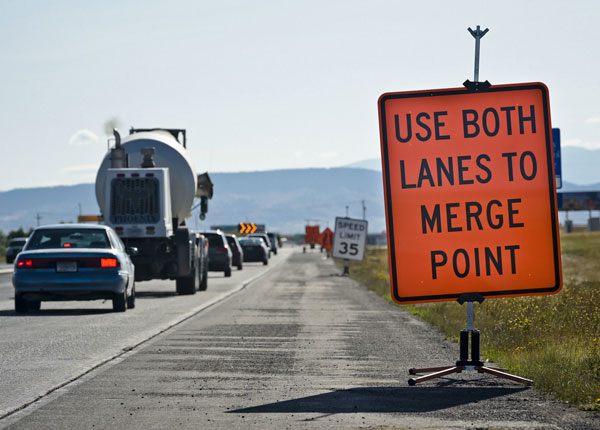
Driving is the ultimate expression of American freedom, but it remains one of the great arenas where the drama of righteousness and condemnation plays itself out. The rules of the road are norms, which is just language for the laws that are universally understood and applied. This, of course, despite the fact that only a fraction of the rules are codified in codes and signs, and the rest are formed by community consensus and folkways.
There are geographic expressions of these norms, for example. The New Jersey driver is justified by their aggression because it is the expectation of the land, just as much as lane splitting by motorcycles is legal and permitted in California. The Pittsburgh left is a sacred tradition in western PA, and its opposite, the Michigan left, is just as sacred around Detroit.
Then there are rules of politeness. The left lane is the fast lane, or the passing lane — though not everyone understands this. My father once took a defensive driving course to get points expunged from his driving record. In that class, he was told that the middle lane is the safest lane to drive in on the freeway. After that lesson, for about a decade, he contently set his cruise control to the speed limit in the middle of a three-lane highway on every family vacation. As we were passed on the left and the right by faster drivers, I tried not to make eye contact out the window in embarrassment.
There is etiquette for honking intensity, etiquette for turn signals, and etiquette for saying “thank you” with hand gestures.
The myriad of driving rules, of course, make driving safe. Not just speed limits and road signs, but the shared understanding of what other cars will and will not do. These are, in theological language, the first use of the law. Without them, the world would spin off its axis into a chaos of twisted metal. But driving makes lawyers of us all. The more rules there are, the more opportunity there is for judgment and self-righteousness on both sides of the dashed white line. That “crazy” driver passing on the right very likely believes you are endangering traffic by going too slowly. Though you believe yourself to be a perfectly safe driver, your spouse sitting next to you may vehemently disagree.
Perhaps the best evidence that our driving is an avenue for righteousness is road rage. I’m reminded of the new research that David Zahl highlighted in the recent weekender, where MRIs show that a brain bent on revenge has similar MRI imaging as a brain addicted to drugs. Those who are wronged behind the wheel demand some satisfaction for their wrath, whether it be a quick tap of the brakes, a slam of the horn, or a hand gesture out the window.
In many ways, driving is a mini parable for life. In the driver’s seat, there’s little difference between righteous anger and self-righteous anger. When we divide drivers into the righteous and unrighteous, the considerate merger and the inconsiderate heathen, all in the name of fairness, we make things worse for everyone.
The solution to road rage is as uncomplicated as it is impossible: loosen your white-knuckled grip on your righteousness. To quote the apostle Paul, “Why not be wronged? Why not be defrauded” (1 Cor 6:7). Better to arrive two minutes late than damage your front-left fender. Better to give other drivers the benefit of the doubt than assuming incompetence or malice. Look past the rules and see the wearied traveler behind the other wheel. As a serene friend of mine once observed, most bad driving could easily be explained away as a result of someone’s urgent need to find a restroom. It’s likely the case that your trip isn’t especially urgent, and the other driver is probably not on a mission to assault your sense of fairness.
So go ahead — let the heathen drivers merge. It’s the humble and gracious thing to do, to say nothing about its impact on your serenity and your spirit.








I have found that waving vigorously and profusely as to imply recognition of the road rager is highly effective – especially at calming my spirit of indignation for being given the bird (most likely for driving in that safest middle lane) 😮
I always feel like my worst self when I’m driving: everyone driving faster than me is a maniac; everyone driving slower than me is a dangerous idiot. I’m really going to try to take this piece to heart. The one place I think has the healthiest driving culture that I’ve experienced is Hawai’i: the spirit of aloha means you don’t aggressively pass people just to get one car ahead, you let people in to merge and turn, and you just generally take it easy on the road. I need more of that in my life.