Welcome back for the final installment of A Midsummer Night’s Scream (on the final day of the summer!). We’re watching Bone Tomahawk and getting wistful as we ponder the doom that encompasses our world and riding out to meet it.
Ian: Maybe the way into this is asking, “What is Bone Tomahawk”?
Blaine: When I saw this in the theater when it came out, the house was filled with a bunch of old timers, clearly thinking they were in for a classic Western. And most of them bowed out around crotch-choppin’ time.
Ian: Ope, we’re getting ahead of ourselves! This film strikes me as a great example of horror’s porousness. The horror of this story unmasks all that has transpired as something other than what we and the characters expected.
Blake: It, like Unforgiven, is also a deconstruction of the Western. It denotes that the typical Cowboy vs. Indian concept is really only the surface level of what was actually going on the whole time in the West.
Caleb: This is even better than I remember. It’s making me want to play Red Dead Redemption 2 again. (Which I’ve 100%ed twice.)
Ian: You heard it here, folks!
Caleb: And it was kind of the perfect movie to end this series on. Arthur’s line, “The more sleepin’ I do, the quicker autumn’ll get here,” feels kind of where we all are: Ready for the harvest. Ready for healing. Ready for celebration for once.
Ian: This movie is not “about” this, but that porous aspect provoked a thought. It really weirds me out when people say they hate horror but they looooove true crime or murder dramas, especially when said dramas are as lurid and/or violent as the most notable offenders in the horror genre. So hear this as a bridge, perhaps, between Blaine’s observation about the old fellers there for a good old-fashioned Western and this unexpected, Nathan-like, “Thou art the man” kind of veil tearing: “Y’all say you don’t like this, but y’all are weird and do like this under a different name. The only people you are fooling are yourselves.”
Caleb: I think that matches my own journey with this movie, since my opinion of it has improved significantly in the seven years since I first saw it. And it has to do with some adjustments of expectations as to what kind of movie this is. It’s far less interested in explaining or demythologizing the terrifying, inscrutable “Troglodytes” and far more interested in watching “four doomed men ride out” — each wrestling with the inevitability of their own demise and doing their best to assure themselves they’ll be okay in the end.
Ian: I like that a lot. You can call the shape of this doom whatever you like, but doom is what’s on offer in any story in this world. And the question then is, how will you live and die with that doom?
Caleb: Yeah, I noticed that with the “Doom of the Noldor” and how that meant a very different thing for different elves — some just, some unjust.
Ian: That’s right, my boy’s reading The Silmarillion!
Caleb: Speaking of elves, the head Troglodyte — Boar Tusks, I think was his credit — looked orcish to me. I wonder how that might’ve changed the feeling if “the enemy” wasn’t just bestial in action but, indeed, in origin. Of course, there is a complicated layer instead — these are humans, perhaps problematically depicted ones too. How far does the bone tomahawk have to cut to separate flesh and blood from power and principality? I’d love to hear your thoughts and feelings about this, Ian.
Ian: I love that other Indians say of them, “Those aren’t Indians.” And it feels like a full circle from The Wailing, actually: our proclivity to look beyond the obvious source of evil for a more hidden threat, when it is, in fact, this obvious evil. Your question, Caleb, forces me to reflect on how I think it’s underappreciated how culture shapes individual subjects, yes, but can only mobilize what it finds in those subjects. That is, Troglodyte society forms monstrous human beings that are human, yes, but behave most inhumanely. But culture cannot make a person do “X” if “X” was not already within them. Which is to say that Native Americans are as flawed and as riven within as other sons and daughters of Adam, and within them is the potential for the despicable things we see in this movie. This is something we were talking about the other day, that even the wronged are guilty of sin. And if you want to call that colonialism then you, friend, are yourself colonized by the Devil. One does not understand the Troglodytes any more than one understands the Devil. There is evil that will not be redeemed, because it will not have it.
Blaine: “You educated him [the horse] in bigotry!” is a fantastic line.
Caleb: Brooder, arguably, is not much different than the Troglodytes. He kills indiscriminately and only actually seems to care about his horse. It’s a subtle cruelty, sure, but he’s still prone to cruelty.
Blaine: Yes. Arthur’s admonition to Brooder about flirtations with Samantha come off as brotherly jest at the start of the film, but the more we see of him throughout, it’s tempting to reevaluate that line as coming from someone who knows of his true character. One thing we haven’t discussed is Bone Tomahawk’s relationship to John Ford’s The Searchers and how it’s situated in the captivity narrative subgenre.
Ian: Yes, that’s a great point.
Caleb: Gosh, I haven’t seen The Searchers in maybe like fifteen years.
Blake: I don’t think I’ve seen it since I was a kid.
I keep going back to your talk about doom and judgment, and our conversation about No Country keeps coming up with that famous line from Tommy Lee about having to put your soul at hazard. You’d have to say, “OK. I’ll be a part of this world.” All of us are doomed people riding out into this world, and in order to take that action, one has to embrace the truth of one’s own judgment and own it and say, “Ok. Here I am, send me.” And that act is even redemptive for a bad hombre such as Brooder. (Can we also note how freaking good Richard Jenkins is as Chicory? He anchors the whole damn movie. It says a lot when you can upstage Kurt Russell, but he does in every scene.)
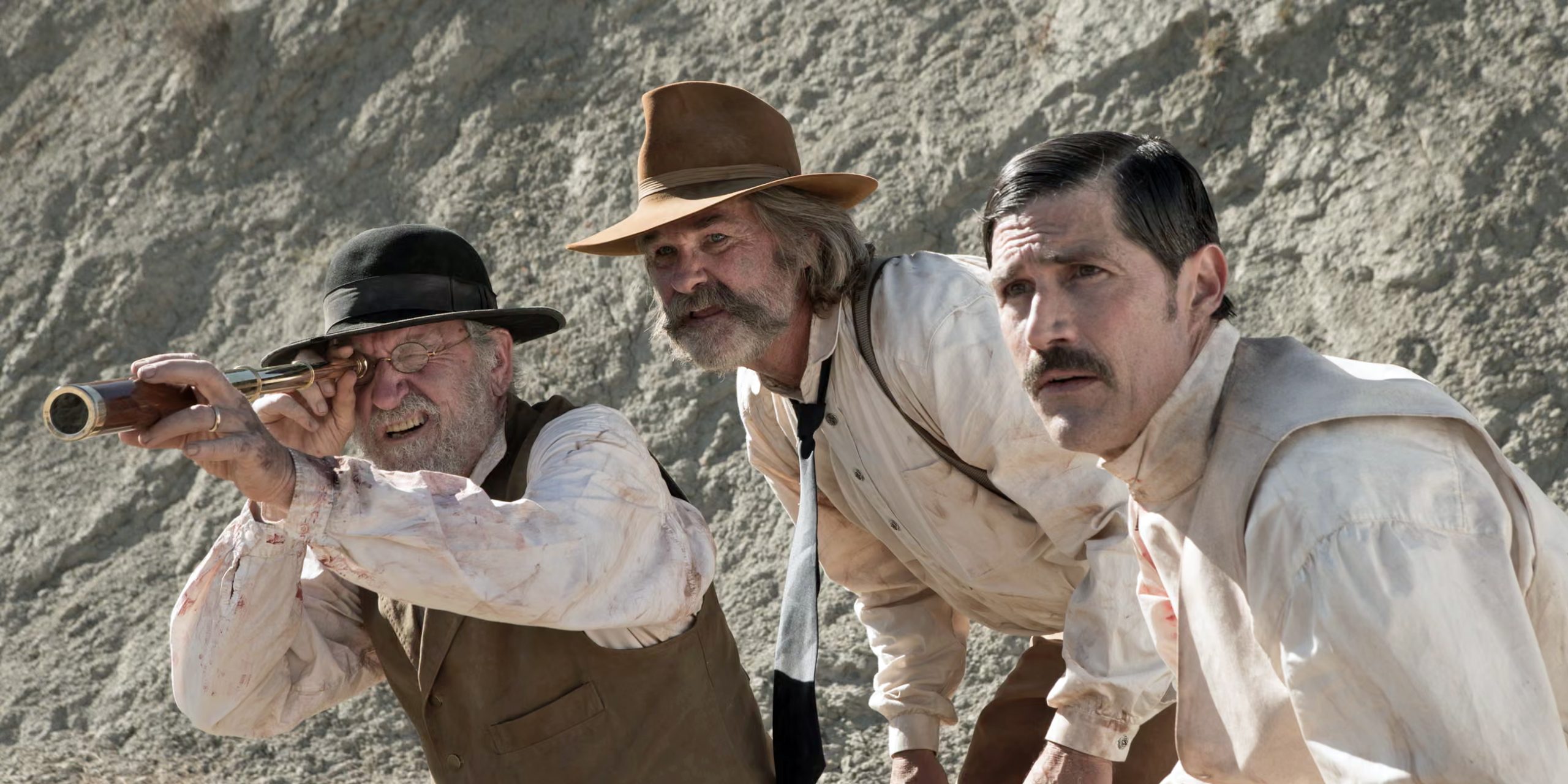
Ian: The heart and the humor are two things that make this not torture-porn. Not the only thing, but they are vital aspects. And I guess that’s one of the things I wanted to ask you boys. Is that scene — you know the one of which I speak — essential? It is one of two death scenes in good films that it is nigh impossible for me to watch.
Caleb: Yeah, I hate that moment. I always wrestle with how cruelty and brutality can be effectively communicated in film without almost driving you to despair. This was one of those moments that felt too terrible to abide. I guess the only redeeming moment was Hunt’s bluffed speech about the cavalry, in which he then poignantly says to Chicory — “That’s what I would’ve wanted to hear.”
Blake: I don’t think it’s “essential,” but I do think it was “necessary” to move the danger past simple captivity stories, simple fears of Indians taking your women and kids. This or something like it had to be done to tow the danger and evil over the line. The Troglodytes aren’t just “savages,” they are “other” (and not in the progressive political sense of the word, but the cosmic horror sense). I wince every time I see it, but I don’t think I would viscerally feel the same fear that our characters feel if that scene had not been included. And, humorously, in a progressive sense, it is this action that makes the Troglodytes more than the classic Western-Indian-as-“savage” trope.
Blaine: I don’t know how to answer if I think it’s essential, but what does strike me is that we always ask that question of that scene, which in my mind, is not the worst in the film — though the goriest for certain.
Ian: Interesting! What is the worst in your book?
Blaine: The scene with the pregnant Troglodyte women as the group exits the cave is the part I think about most after watching it.
Ian: Oof. Yeah.
Blaine: I can think of one way “that” scene could play a useful function in terms of captivity narrative tropes … Captivity narrative Westerns, historically, tend to focus on violence against women as the ultimate form of savagery. Typically, at some point in these films, a character will say, “They may kill her … or WORSE.” So, these films conjure fear, dread, suspense, etc. by inciting us to imagine these atrocities committed against women. And that’s one reason I think the infamous scene here in Bone Tomahawk is so terrifying. It depicts an act of violence against a male character in a way we are not conditioned to expect in this genre framework. (More likely, though, is that it’s just horrifying to think about a person being split in two.)
Caleb: I think Terrifier takes the cake on that.
Blaine: No doubt.
Ian: I think formally, in a sense, yes, but I also think that genre difference makes a substantive difference. Because I hate Terrifier. For me a worse franchise cannot be conceived. And the scene you’re alluding to, Caleb, truly is nasty and horrible, but I don’t think there’s any pretense of it being a serious work of any sort. Terrifier plays to gore-heads who are knowledgeable in the history of slashers and are looking for something yet more over-the-top. I hate this scene in Bone Tomahawk in an entirely different way, precisely because it is played seriously and has a real emotional valence, and its shock is more than simply shock: it is the veil being torn. It is the upheaval of real evil crashing into human beings. This and Quint’s death in Jaws are the two scenes most difficult for me to watch. But I think I am grateful I watch it with my oldest now, because now I fast forward through Quint sliding down to his final confrontation with Bruce. RIP, Quint.
Blaine: I have to say, I’m sad this endeavor is over. It has been a great joy, and though I was hesitant to join at first, I am better for it and grateful to have taken part.
Ian: Well ain’t that about the shape of this story, too? I am bowled over by how sweet a sentiment as that arises off the back of such a film as this. Maybe the real Bone Tomahawk was the friends we brought along for the doomed ride?
Well, friends, thank you for riding out with us to face our doom and die another’s death. Take heart: the cavalry has already come in Christ, and the vile, stupid brutality of our world is not the ultimate victor. And every time we sleep, autumn gets a little closer. We are so glad you joined and finished the summer with us. May the harvest come and healing and celebration with it — as well as more spooky gospel fun!