




When my husband and I moved to Fort Worth in 2014, we had no friends and no washing machine. This led to an unexpectedly deep friendship with my Granny and Papa, which developed while washing our clothes at their house every Sunday afternoon. Papa passed away in 2021, two years after he got to meet our son Charlie, his namesake. Papa was affectionate, funny, clever, and incredibly generous. As far back as I can remember, he obviously enjoyed life. He delighted in simple pleasures like extra-large pieces of chocolate sheet cake and discovering new books at the Little Library down the block. Papa had a successful career as an oil company accountant until he was 55, when he retired early and went to seminary. The following years were filled with teaching Sunday school, caring for elderly family members and neighbors, fishing, and telling his grandchildren the best stories. During our Sunday afternoon laundry visits, we ate dessert and watched classic films. We never watched Harvey together, but people often told Papa that he reminded them of Jimmy Stewart’s character in the film. After watching it, I can see why.
The events in Harvey occur over one day in the life of Elwood P. Dowd, played by Jimmy Stewart. Throughout this unusual day, the audience is led to consider this question: what is normal? Elwood stands out as “abnormal” in comparison to the other characters for two reasons. First, he is disarmingly courteous and treats every new acquaintance with genuine interest. The characters are visibly stunned by his sincerity and positive demeanor when he greets them.
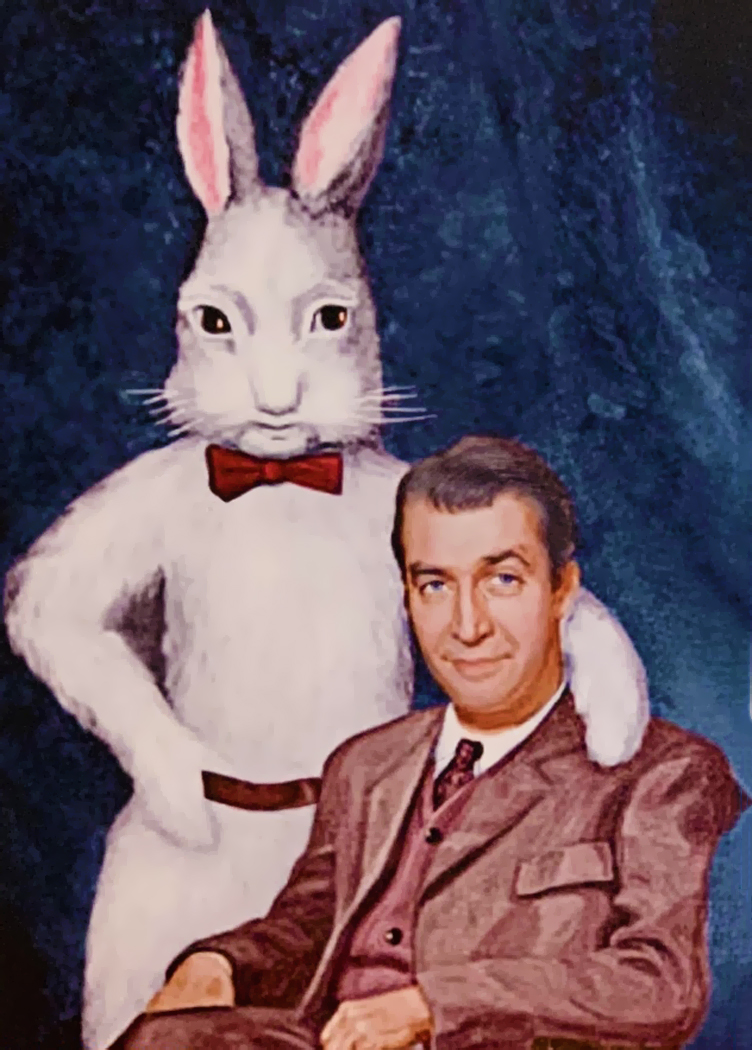 His second oddity is that he introduces everyone he meets to his dear friend — an enormous, invisible white rabbit named Harvey. The other characters in the film are overly concerned with their careers and social standing and are generally shown to be unhappy. They can’t see Harvey and question Elwood’s sanity. Elwood does not fall into the normal social conventions of the town — he is unmarried, unemployed, (potentially insane) and completely content with his life. He and the invisible Harvey spend their days walking around town chatting with friends and family and making new acquaintances.
Elwood met Harvey right after his mother’s funeral. He describes how his life changed after meeting Harvey, saying: “In this world … you can be oh so smart, or oh so pleasant. Well, for years I was smart … I recommend pleasant.”
There are playful hints that Harvey is actually real throughout the film (i.e., doors opening on their own and a hat with rabbit ear-shaped holes). However, the only person other than Elwood who truly sees Harvey is Dr. Chumley, the head psychologist of the hospital where Elwood is admitted. Dr. Chumley is the most miserable, pretentious character in the film. When he is not sitting alone in his office, he is yelling at his staff and chasing after Elwood to bring him in for treatment. Then, he meets Harvey. This no-nonsense man who has established a reputation for “shocking” people back to reality experiences the wonder and irrefutable presence of Harvey and begins to soften. There is a scene where Dr. Chumley lies down on his office couch and confesses his deepest hopes and dreams to Elwood, flipping the role of patient and psychologist.
Those with eyes to see and ears to hear Harvey are not blinded to the realities of the world, but now, they view it all through Harvey. Elwood is aware that his sister commits him to the psychiatric hospital, but instead of being offended, he is impressed — “My sister did that all in one afternoon?!” He accepts that some people believe he is insane and answers their mockery with a smile, as if he is in on the joke. Elwood’s philosophy is “I’ve wrestled with reality for 35 years, Doctor, and I’m happy to state I finally won out over it.” In other words, if a normal, sane life means endless striving, loneliness, and hopelessness, I choose Harvey.
When asked what he and Harvey do all day, Elwood says:
Harvey and I sit in the bars … have a drink or two … play the jukebox. And soon the faces of all the other people, they turn toward mine and they smile … and they come over … and they sit with us… and they drink with us … and they talk to us. They tell about the big terrible things they’ve done and the big wonderful things they’ll do. Their hopes, and their regrets, and their loves, and their hates. All very large, because nobody ever brings anything small into a bar. And then I introduce them to Harvey … and he’s bigger and grander than anything they offer me. And when they leave, they leave impressed.
Elwood’s main objective throughout the film is to invite everyone he meets over for dinner. However, most of the people he encounters already have plans or give vague excuses, even when it is clear he has invited them many times before. The only people who readily accept his invitation are a bar regular with a criminal record, a quiet security guard, and a disagreeable hospital attendant. We never get to see a dinner party scene with this eclectic group, but I believe it would look a little like the Great Banquet described in Luke 14. In it, Jesus tells a parable about a host who has been preparing a great feast, but when it is ready, the guests make excuses and never come. The host then sends his servant out to invite strangers from the streets and alleys until the table is full. I imagine Elwood’s table to be similarly full of misfits and outcasts, with an empty seat reserved for Harvey.
I was reading about the play the film was based on and came across an interview with the playwright, Mary Chase. Chase wrote Harvey during the dark years following World War II. When asked what inspired it, she describes an elderly neighbor who lost her son during the war. Chase wondered what she could ever write that would make this woman laugh again. Then, she says, “One morning I woke up and saw a big white rabbit walking across the room of a sanitarium and I knew that was it” (Interview, 1979). Chase knew that it would take something absurdly pleasant to disrupt the hopelessness around her.
In the world of Dr. Chumley and Elwood P. Dowd, grace comes in the absurd form of a big white rabbit. Harvey walks with Elwood across the floors of sanitariums and dive bars and listens to people’s big things. Harvey leads the psychologist to lie down on the couch and offers him relief. Harvey inspires laughter in the midst of grief. He responds to mockery with courtesy and breaks up fights with a gentle hand.
My Papa didn’t see a big white rabbit, but people certainly thought he was crazy for stepping away from a thirty-year career with no idea what lay ahead. Following the call of grace and serving others will never be viewed as the “smart” choice, but Papa’s life was filled with kindness and gentleness, and he was oh so pleasant.








That was worded perfectly, I miss him all the time still but know that his legacy lives on through me.
What a beautiful legacy! 😍