




Leap of Faith is a new documentary by Nicholas Ma and Morgan Neville. Previously the duo collaborated on Won’t You be My Neighbor?, a celebrated documentary about the life of Fred Rogers, which became the highest-grossing biographical documentary of all time.
Both films are about faith, hope, and ultimately, love.
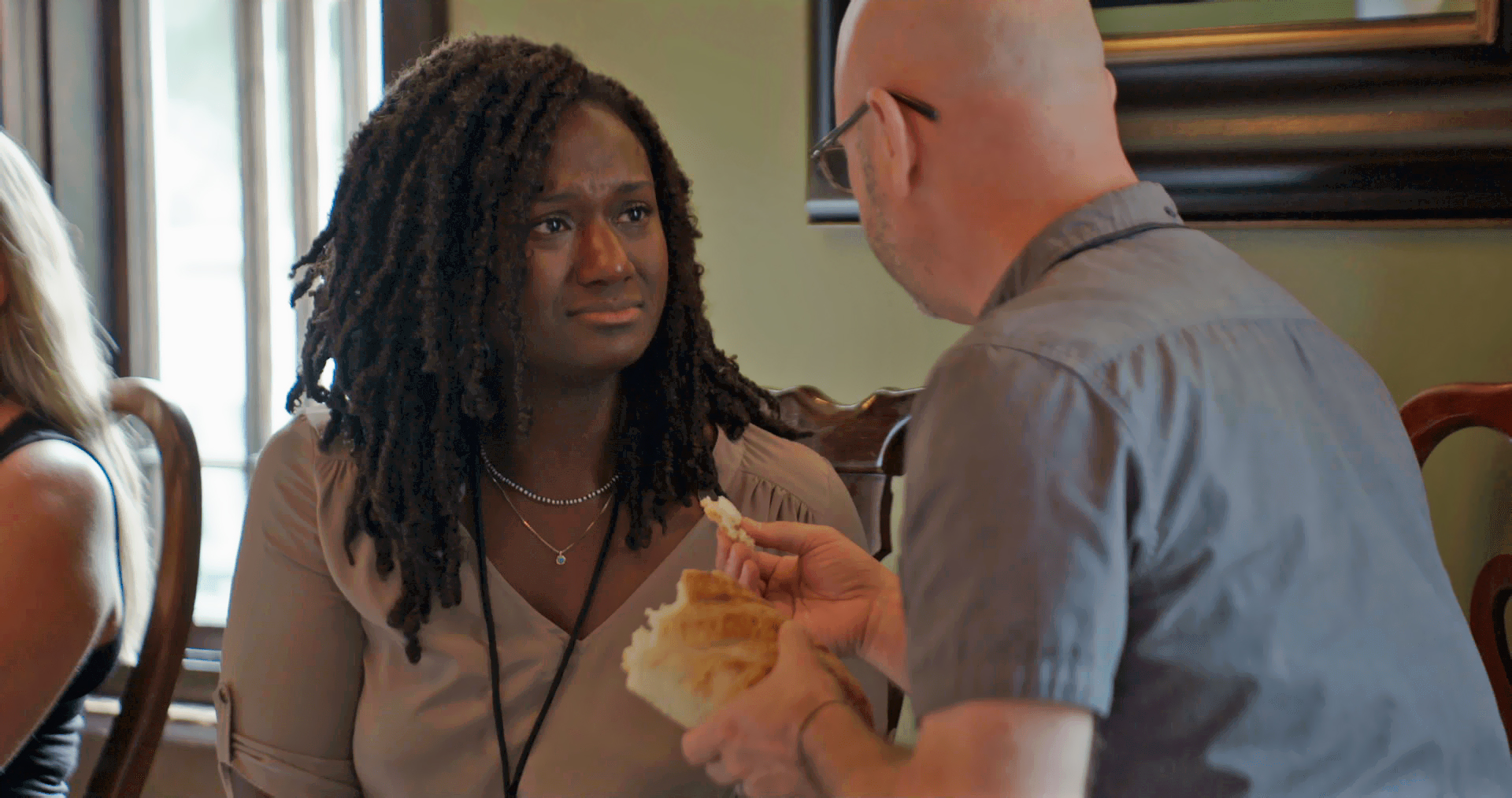
In 2020, Ma approached Michael Gulker of the Colossian Forum, a faith-based organization in Grand Rapids, which works with people to cultivate connection across difference. He wanted to make a film about people who disagree with each other, yet still belong to each other. During a series of boundary-breaking retreats, the filmmakers profiled twelve clergypersons serving a diverse array of congregations from a variety of denominations, representing some of the wealthiest and poorest, the most liberal and most conservative communities across Grand Rapids, which has been said to have more local churches per capita than any other U.S. city. The film takes an emotional, and at times tense, approach to documenting how everyone grappled with some of today’s most contentious issues: immigration, race, gun control, class, abortion, sexuality, racism, and church doctrine. Divisions between them become apparent and test their shared faith as well as the bonds they build over the course of a year.
In a recent interview Morgan Neville, the film’s producer, said, “I want to keep making films that address this rift in kindness and understanding, because it feels like a topic that everyone, regardless of religion or political party, can connect with.”
Leap of Faith shows the beauty that can emerge through intractable conflict, how difficult conversations can be generative beyond expectation, and it reminds communities of faith that they have an important and positive role to play in a time of deep polarization. After election results are tabulated, new bishops are appointed, and court cases are resolved, deep relationships persist. Core commitments to the goodness of the gospel and the power of friendship have enduring power in a world where patience, fortitude, and vulnerability are exceedingly rare. — Meaghan Ritchey
Meaghan Ritchey: At Mockingbird, we investigate grace — and its absence — in everyday life. Where was grace present or absent in the group dynamics of the Colossian Forum cohort?
Nicholas Ma: I think this entire experience was shot through with grace from beginning to end. Our task was to see it and discover it.
In the final lunch that we had, one of the pastors said to me, “Just to be clear, the Spirit has been at work between us all this time. How are you going to show that on film?” And I realized that was the task: to show how grace and the Spirit were at work.
Grace is explicitly mentioned very early on. Joan (the associate pastor at Grand Rapids First United Methodist Church) talks about the unforced rhythms of grace. And it’s worth picking apart that phrase. Unforced is really hard for us right now. We want change to happen quickly. There are reasons for that. Maybe we’re afraid of climate change, or we’re afraid of the direction of this country, or we’re afraid of the direction of Christianity. There’s a sense that, if we don’t change quickly, we will fall into despair.
But of course, rhythm is the counterpoint to that, right? Rhythm is repetition — it comes back. That’s what’s beautiful about a back beat in a song. It’s like, oh, I get it, because I know I’m going to hear it again. When we’re talking about the rhythms of grace, we’re saying that grace will come. It may leave, but it will come back. We can’t force it, but we can have faith that it will come again.
When we thought about making the film, we wanted to express that same idea. How can we show this alternation between moments of intense vulnerability and moments of contemplation? And how do we let that rhythm remind us of these unforced rhythms of grace that operate within our lives?
MR: It was clear from all the pastors in the cohort that the grace that they were modeling to each other was the grace that they had received. Not necessarily from their congregations or from the world, but from God, enabling them to do this vocational work. It was so countercultural to see. The world is so preoccupied with optimization, outcomes, and results.
What was it like for you to be a filmmaker who wanted, by the end of this process, to capture and create an actual film, even if the results of the cohort meetings were so intangible and elusive? Tell me a little bit about that contrast.
NM: I think this film requires so many leaps of faith. And one of those leaps of faith is that the relationships established here would continue to be generative after we finished filming. To say, something will come, something will come. And it has: the durability of these relationships has been startling to me. But I think if we had focused on the outcomes, the durability would be lower, right? Because we’d have reached an end-point, and there would be no need for renewal. It’s like, okay, well, we did it. We’re done. But the relationships here continue and they’re generative.
The relationship between Molly and James has changed the North End pastor group into one that now includes historically black churches. We don’t tell you that at the end of the film, in part because we didn’t know that when we’d finished filming.
I’m so glad that the film ended at a point of unresolve because it completes the story in a way that is challenging but is so much more honest. And as a documentary filmmaker, that’s the North Star — to sort of reach some kind of ecstatic truth that exists above the planned outcome of what you thought the end of the film might be.
We have to remind ourselves that, while we have big decisions like who we’re going to vote for in November, none of those problems disappear in December, and the consequential decisions are the ones that we make every day about how we show up for each other, right?
I think a lot about how different media require different strategies. Books and articles can sustain the kind of analytical approach that films can’t. When films go into that territory, they become instructional. I don’t think it’s their highest calling. Their highest calling is to live within us, to compliment the emotional kaleidoscope that exists within us.
In the context of Won’t You Be My Neighbor?, it’s not so much that we’ve learned critical biographical details about Fred, though that’s part of the movie, but it’s not the goal. The art that I admire most is where you walk away, and you have this feeling that you can’t easily put into words. That’s where art and faith and grace share so much in common. They are so profound and so familiar and deep. We know them when we experience them. And yet they cannot be contained in words.

MR: The Mr. Rogers documentary was about the life of one person. In this film, you traced the lives of over a dozen people. I think you took an equitable approach to representation and really tried to give every person’s views their due time, just as I’m assuming the Colossian Forum seeks to do when they’re moderating all of these conversations.
Was that difficult to do, given your own opinions on some of these theological issues?
NM: It’s hard, right? I mean, it’s interesting how the work behind the camera mirrors the work in front of the camera. From a filmmaking perspective, you have to choose vantage points. But in order to do that, you have to see each of these people as having complex, beautiful, considered worldviews that they’re bringing to the table. So, yes, the group story is what made the film so challenging to make, but without it, the film doesn’t exist. You walk away with zero villains.
MR: And you walk away, I think, rightfully unpersuaded — I mean about certain issues. You’re only persuaded about the deep goodness of holding the tension and remaining in relationship.
NM: You’re not allowed to dislike any of the pastors because of their views, right? You’re not allowed to say, well, I’m going to discard this pastor because of their views.
MR: Because they didn’t do that to each other.
NM: They didn’t do that to each other. And as a filmmaker, it would have been really dishonest to do that to them. You’re asked to say, you be who you are, I’ll be who I am, and we’ll get through this together, right? I think it’s a very simple set of three statements, but we only really believe two of them at the same time. Either I have to change, you have to change, or we’ll go our separate ways.
And the notion that all three could be true at once is beautiful. We’re so convinced that those three things can be true that we say, I don’t want to show you who I am, because then we won’t be able to get through it. Don’t show me who you are, because I don’t want to know, because if I know, then this is going to be over, right?
MR: Given the flurry of issues that divide people — race, abortion, poverty, the role of the government, the validity of the resurrection — I was surprised how often sexuality became the definitive issue. And you talk about that in the film. Why do we keep returning to this?
NM: Michael and I both agreed that we didn’t want to make a film that focused on sexuality and LGBTQ questions. Because it is, unfortunately, the question that so many denominations are divided over: the CRC, the Methodists, the Mennonites, PCUSA and PCA, everywhere. And so maybe our initial unwillingness to talk about it was an unrecognized fear that, if we did talk about it, we couldn’t get through.
And it’s amazing how the pastors did — they tackled the thing that is the hardest for them. Still, the movie is not about resolving questions of LGBTQ inclusion in the church. It’s about talking about the hardest things for pastors to talk about. And it reminds me, what are the hardest questions that I don’t like to talk about with my family, with my friends, with my loved ones? And to say, I have to believe that we can talk about these things. I have to have faith in that.
I should also be very clear: Just because I think it was the hardest issue for them to talk about doesn’t mean I think it’s the most important issue to address. Those are different things.
This movie is for anyone who believes in engaging with people who are different from you. It’s painful, but it’s critical. And it is always scary to me to realize that there are meaningful numbers of people who don’t believe in that.
MR: And it’s so rarely modeled anymore. We are actively entertained by our contentions and our differences — and not as much by our peacemaking. That’s just not the currency.
NM: So I’m the father of a seven month old. And everyone’s like, you must be exhausted. It’s going to be okay. Savor these moments. The days are long, the years are short. All of those clichés are designed to tell you that there is value in this experience, even though it’s hard. Same for when people care for a loved one who’s sick: These moments are hard, but don’t forego the chance to be with someone in their final moments. You will treasure that. You know?
And the same thing is true for this. It’s like, don’t be afraid to walk into rooms where people are different than you. That doesn’t mean every room, that doesn’t mean walk into a room where people have guns pointed at you, right? But there are rooms that we don’t walk into because we’re afraid that it’s going to be too hard. And we can be in those rooms and not sacrifice who we are — and we can learn a little bit more about who someone else is at the same time.
We don’t have enough stories that say, it is hard, but it’s worth it. And it’s beautiful.
MR: Midway through the film, you asked Michael, the director of the Colossian Forum who runs the retreats, a question to hint at some of the tension in his work. You asked him, what do you think you’re doing versus what are you actually doing?
What did you think that you were doing at the inception of this whole process versus what do you think the film is doing having been released?
NM: As a director, you have to come in with a question that’s interesting to you that you think will sustain you over years. The question was Colossians 1:17, “All things hold together in Christ,” and I wanted to know, do they? And Michael said, “Let’s see.”
But that’s a theological question, and at the end of the day, the film is an emotional artifact. And we discovered that as we went along. Because it allows anyone to watch this and say, ah, I know that feeling. And I know this emotional journey, but I’m not always sure that I know the ending. And I’m curious to find out.
Particularly in addressing contentious questions, rendering the film as an emotional artifact rather than a theological or analytical artifact, was the gift that I didn’t know I had been given in making this film.
I worked with an incredible editor, Tamara Maloney, who was our guide and passionate companion in this. And it took long hours with Tamara talking it through to realize, no, that’s the gift — to say, experience this, and see what it does within you. It means that I have rabbis come up to me and say, this is exactly what we need. Conservative Christians come up to me saying, I need to talk to my church about how we integrate love and justice more clearly, love and truth more clearly. People who have been harmed by the church watch this film and say, this allows me to have a relationship with Christianity that I never thought possible. There is a way in which, by creating an authentic emotional artifact, you offer a greater gift.
MR: I’m thinking of the question that you asked of the group: Is vulnerability part of the Christian story? I was thinking, vulnerability is the Christian story. It is Christ crucified. Is there a more vulnerable act?
NM: I think there is one more vulnerable act than Christ crucified. And it was brought up to me by two pastors who are on opposite sides of the theological spectrum. And they both said, it’s the incarnation.
The incarnation as a baby, right? Not as an adult. In the most vulnerable place you can be. A child. That is vulnerability. And what it reminds us is that vulnerability is at the beginning of the story and at the end, and not just at the end.
MR: You see that kind of childlike nature present in the pastors as they’re provoking each other and asking questions. I hope that’s how people can approach this film — not as blank slates, because we necessarily bring the fullness of ourselves to everything — but just as gentle, and teachable, and open to the goodness of the gospel.
NM: It’s why we start the film with a prayer and not with news footage. We could have started this with news footage saying look how divided we are, blah blah blah blah. But think about where that puts you.
But if you start with a prayer, if you start by seeing the interiors of these congregations, you put yourself in that place. You don’t know who these people are, you don’t know what’s going to happen, but you know this is the tenor of what is to come. And regardless of whether you’re a Christian or not, you know what that means. We know what prayer asks of us.
MR: Before we go, is there anything that you’d like for Mockingbird readers to know about the lives of these pastors now? Or is there a story about the film that you’d like to share?
NR: I would say we rushed this film into the world to come in October versus next year. Because it was, for all of us on the filmmaking side, on the Colossian Forum side, a statement of faith before the election. Right? After the election, we’ll know who won and who lost. But before the election is when we need to make these commitments to a world of peacemaking and listening.
Leap of Faith is now playing in select cinemas nationwide. For more information visit www.leapoffaithmovie.com








Would like to know the time of the start of session.
[…] “A Story of Love – Beyond Tolerance” from Mockingbird […]