




When deciding how to arrange one’s day, the time-management guru Oliver Burkeman recommends that you first make a list of all that needs to be accomplished. The purpose of this list is not to overwhelm you, but to focus your attention. But rather than attempting to accomplish all the items on the list at once, Burkeman suggests choosing precisely one thing to do. When that one thing is finished, cross it off and move on. Multitasking, he argues, is a fool’s errand that can drain productivity. With your time divided across several tasks simultaneously — say, between checking your email and writing a report — you find yourself “anxiously switching your attention rapidly between things.” Better to prioritize the “one thing” and accept that failure is inevitable for a fallible human.
Burkeman’s advice is a perfectly sound approach to maximizing one’s productivity in a manner that doesn’t produce burnout and/or failure. And for those of us who work from home, advice of this kind can feel like a lifeline of structure that keeps our days from spiraling into a lifeless void of always and yet never fully working. Sitting down to write this article, I have self-consciously chosen to ignore a lengthy queue of emails. It is my “priority” and brings me more satisfaction than the myth of inbox zero.
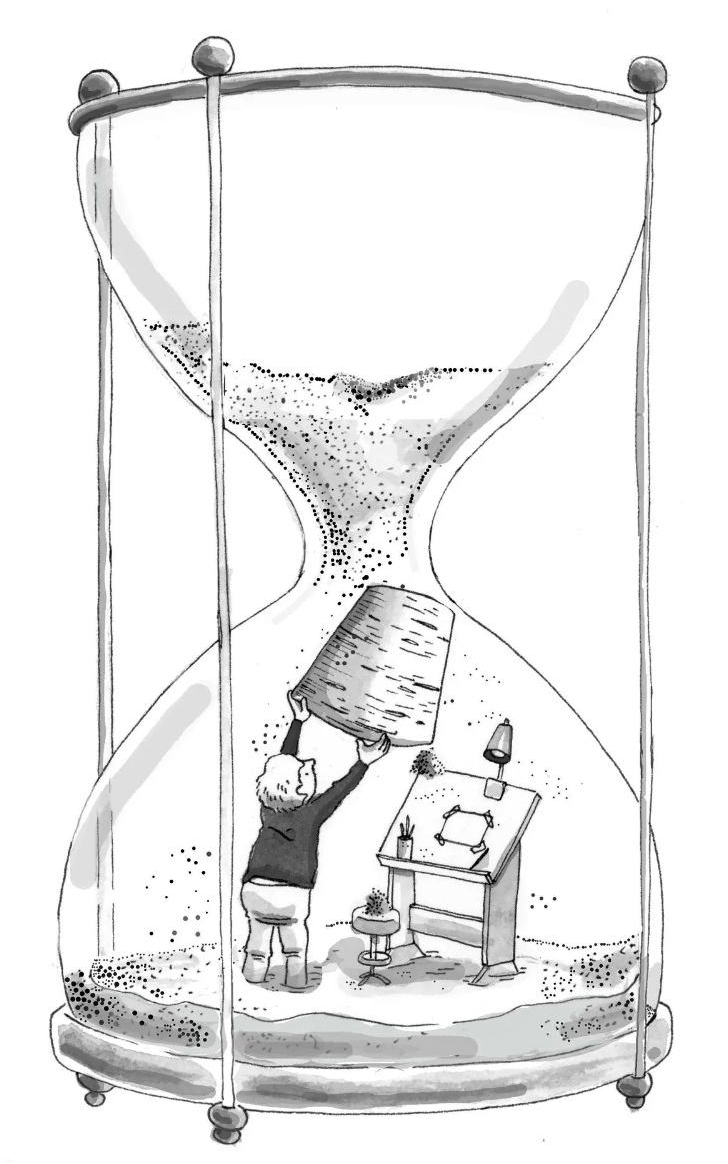 I wonder, however, whether the obvious utility of time management ideas has enabled them to creep into how we think about other areas of life.
Few would say that all our problems result from poor time management, but many proposed solutions are often more procedural than foundational. Afternoon sloth isn’t a moral failure but stems from a lack of structure. The wayward teenager is scolded that they need to get their priorities sorted. The stressed-out parent has to find more “me time.” The unemployed college grad who can’t get out of bed needs achievable daily goals. We might not be devotees of the 3-3-3 method, but we probably still think of our day in terms of ranked goals and segmented times. Life only moves forward and we must always be ranking our tasks to accomplish our goals in light of shifting circumstances.
Time management, in order words, may be a useful tool for optimizing the day to day, but it is a tool that shapes its user toward a way of thinking about life in general. Calling it a philosophy or religion might feel a tad too lofty, but the essential elements are there. Everyone will eventually die, so time is a finite commodity that only becomes more valuable each passing day. One is not subject to time, but free to use it as one wills. There are therefore good and bad ways to use the hours and minutes one has. If you use time well, it will bless you. If you use time poorly, it will curse you. Discern your priorities and schedule accordingly, making the most of what precious little time you have. Within an increasingly chaotic modern world, time management promises to be our savior, making life itself easier, more efficient, and more enjoyable.
The scarcity of time and the need to maximize productivity are so thoroughly baked in to how we think, to believe otherwise feels like sheer recklessness.
Christians — most of who tend to be Type-A personalities — are by no means immune to a time management philosophy of life. If anything, they fluently articulate a time management theology. God has given us only so much time on this earth, and it’s up to us to make good on what precious little he’s given. Take risks and make sacrifices for the sake of eternity. Find your all-embracing, all-transforming goal and do not waste your numbered days on this earth.

To live out their faith, the time management devotee tries to “put God first” in their life. While this slogan might be an analogy for the life of faith (to put God first rather than our natural impulse to put ourselves first), it is most often meant more literally as a kind of God-flavored time management. Amid the many possible tasks, goals, or obligations, God should reside at the top of one’s daily planner. Like a rigorous workout, having God time in some senses sanctifies the rest of the busy day. There are only so many hours in a day and so much to do. Put God first and make him the “top priority.” “Make time” in your schedule for God.
Whenever I read the Bible, I find myself not only asking what it might mean for me today, but I also become immersed in a world that is so very different from the one I inhabit. Comparing the world in which we live with its ancient counterpart isn’t a barrier to understanding so much as it questions so much of what might be taken as obvious today. I don’t ask what Jesus would make of our time management systems; I instead notice that he never owned a wristwatch. Did he not ever know what time it was? Sundials weren’t exactly portable devices. How did Jesus manage to make it through his day without a Pomodoro timer or a Google Calendar?
Surprised by this fairly obvious insight, I then read further to notice how little Jesus seemed to care about maximizing productivity, or how he actively preached against a scarcity mindset. He spoke of a kingdom that grew by itself and believed planning for the future was a fool’s errand. He deemed loss and suffering and poverty to be a blessing. He taught that the first will be last and the last will be first, and of a God who gives generously without regard for worth.
When Jesus said for his disciples to “seek ye first the kingdom of God and his righteousness” (Mt 6:33), he wasn’t talking about trying to fit God into your busy schedule or an itemized list of priorities. And he certainly wasn’t outlining a strategy for getting the most out of your day. If anything, it was the opposite.
Jesus commended to his disciples the birds of the air that don’t work for their food and the flowers of the field that don’t toil for their clothing. Don’t worry about food, clothing, tomorrow, or even death itself. Don’t worry about anything because God will give you everything. That might seem like sheer recklessness nowadays, but it also feels like sweet relief.








I always thought the marketing of Oliver Burkeman’s “4000 Weeks” as a ‘time management’ book – a choice no doubt made by his publisher, not the author himself – was kind of strange. It seemed like it was more about grappling with our finitude than anything else. Even so, this reminds me that there is definitely a practical component to it all.
Thank you for this. I will carry the thought that Jesus never owned a watch for days after this…perhaps for much, much longer.
I just listened to 4k weeks on Spotify, so good timing I guess 😉
I’ve heard it said that putting God first all the time is impossible and rather we should always put God at the center of what we do.
Maybe a tomato tomatoe sort of thing when really analyzed, but still interesting.