




The physical sensation was probably the worst feeling I ever experienced. The shock of pain was like electrocution. Every fiber of my being was resisting this decision toward what felt like certain death. My body felt like an entirely separate person from me as if it were someone I had betrayed. “How could you do this to us!?” my mind screamed. “Make it stop!” What felt like an eternity was a mere three seconds of being submerged in the icy Rivanna River in central Virginia on New Year’s Day. Despite my body’s state of panic, when I came up for air, I was laughing. I felt reborn. Such was my introduction to cold plunges.
The cold plunge phenomenon is the latest health craze where people voluntarily submerge themselves in freezing water anywhere between 30 seconds (or 3 seconds in my case) to 10 minutes at a time. Apparently, it’s very good for you. A long list of purported benefits includes enhanced immunity, reduced inflammation, and improved mood and focus. Businesses are turning to cold plunges as team-building exercises. While self-care therapy invites you to stay inside with some tea and a book, cold plunge culture is the equal and opposite reaction. It’s more akin to shock therapy.
Admittedly, part of me wants to scoff at the culture of extreme fitness. Is our day-to-day so insipid that we would willfully risk loss of limb to feel anything at all? Perhaps. What is the next popular craze we’ll force our bodies to do? Walk barefoot on coals or hang upside down until we pass out? And yet, something about the cold plunge concept is deeply resonating, if not downright Christian. Being submerged into death only to be raised in newness of life; suffering as a kind of cleansing agent. It sounds like baptismal imagery.

By all accounts, the sensation of a cold plunge is thoroughly spiritual. James Parker’s description in his essay “An Ode to Cold Showers” reads, “Your lovely, furry old brain goes glacier-blue with shock. Thought is abolished. Personality is abolished.” Roger Deakin’s book Waterlog says you plunge into the lake with all your raging devils and clamber out “a giggling idiot.” Perhaps Nick Cave said it best when describing his newfound love affair with cold water swimming soon after his son had tragically died several years ago:
I was walking along an empty beach in Brighton and had the sudden impulse to jump into the sea. I was shocked to find that, upon entering the freezing water, I experienced a sudden, violent, radical rearrangement of my relationship with almost everything. I discovered that it was simply impossible to grieve in icy water.
The craze for cold water swimming can partially be explained by our collective need for revelation. For those of us who live in the gray doldrums of the forty-hour work week, car payments, and children’s birthday parties, we depend on the power of God to shock our hearts back into beating properly. In an age that prioritizes mental health and our emotional needs, we have become rather detached from our bodies. As delighted as we are to experience things virtually, we often forget that the realm in which we live is the physical one. We may read self-help books and follow tips from influencers, but intellectual arguments and life hacks are no match for the adrenaline rush of an ice bath.
The physical sensation, however, cannot be described as pleasure. No one has ever done a cold plunge and said that it felt “good.” And yet, they will also tell you that they felt more alive than ever. Perhaps the value of a cold plunge is that it teaches us how to suffer. If what the Apostle Paul tells us is true — that affliction produces endurance, and endurance produces character, and character produces hope — pain is not something to avoid, but to endure. Nobody benefits from denying that a cold plunge is going to be excruciating. You simply accept that the next three to five minutes are going to be dreadful, take a deep breath and dive right in.
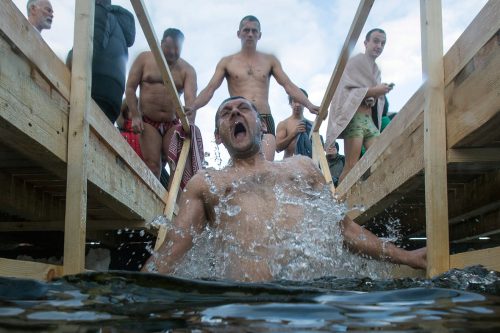
If we know anything about God, we know that he is an extremist. He is not indifferent or apathetic about all that much. He certainly isn’t one for half measures and halfhearted attempts. And yet, there is profound comfort in God’s extreme nature. The Dutch impressionist Vincent van Gogh once said, “It always strikes me, and it is very peculiar, that, whenever we see the image of indescribable and unutterable desolation — the end and extreme of things — the thought of God comes into one’s mind.” In our halfhearted, everyday virtual reality, we may easily convince ourselves that there is no need for God. That is, until our body is suddenly submerged in 32-degree water. In that case, the word “God!” comes to mind all too easily.
Experiencing the pain and exhilaration of a cold plunge isn’t the same as experiencing God, but the phenomenon points toward a universal need. God speaks in many ways, but the extremes of life are the most clarifying, the most revelatory. Walking through a flowering field may soothe the soul but it will likely fall short of making you feel alive — and, even more, to remind you that God is alive. The comfortable life might have its appeals, but a life without hardship can easily turn God into a comic butler who caters to our whims. As much as we may prefer the ease of our own cozy homes, it is suffering that clarifies our purpose, suffering that reveals a God who himself plunged to the depths of hell. Those whose bodies resurface from the icy depths of a cold plunge know far more than those who never risk themselves with anything. The writer Catherine Newman described a cold plunge this way: “It’s a kind of frigid baptism, but you’re not praying, not really, although if you were praying you would probably just pray for this.” In my case, on New Year’s Day, the prayer was short and sweet: “Oh, God!”








Thank you, Sam. Well said.
Love this. Thanks. I just started saunaboxing and taking 3 minute cold showers. Not quite a plunge, but similar.
Sam,
No. As a fellow Boomer said to me, “If you have no hardship at the moment, then that sucker is soon to be knocking on your door.” Doesn’t take a cold plunge, but thanks for the article. Love your writing!
I have to try a cold plunge now. Well . . . maybe I don’t. But it reminds me of the Russian and Turkish Baths on E. 10th St. in New York City, where you sit on concrete steps and steam and just about boil and and then take a bucket of the ice cold water running from the taps in the steps and pour it over your head. And then repeat. And repeat.
Cold plunge: nature’s most intense reset button.