




I chuckle sometimes when I hear people laud “the posthuman.” It reminds me of being in high school in the aughts and rolling my eyes when kids in Good Charlotte shirts would pontificate on what was and was not true punk. Because, similarly, the posthuman pundits do not grasp what humanity is as they gleefully call for its overcoming and obsolescence.
 Perhaps such ideas sound too hifalutin for you. What could the posthuman phenomenon have to do with you? You, working a job you don’t particularly like, raising kids that frequently frustrate you. You, awaiting your Dasher with the meal you know you shouldn’t have ordered, but you didn’t make time last night because you ended up cleaning the kitchen and washing dishes after the kids had a Thunderdome-style row, and you detonated with more anger than was really appropriate. What does the question “What is humanity?” have to do with you?
Everything, actually.
To be human is to be more than an element of a story: it is to be an active participant in it. It is both a gift and an accomplishment. It is given to each one of us as a possibility, but like most gifts, it can be ignored or unrecognized or refused. This is why it’s also an accomplishment, as all who are called to this dignity do not attain it.
Those who do stand out. They accept responsibility for their lives — not only their choices but also the conditions and persons and consequences they did not choose but inherited. They possess a wisdom that is not easily rattled and that helps you, in your station, to carry on. They embody a hope that makes you ashamed of your routine frustration, that makes you wish you could bear up under the weight of your life with more joy, more peace, more dignity.
This is an accomplishment because most of us default to desperation and bitterness.
“Touch grass!” is a common prompt these days. Yet it is usually more of an imperative to get out of something than an overture to get in to something else. Let me ask you: when was the last time you wandered a trail you’ve never trudged before? When was the last time you allowed yourself to linger in the woods? To be still and let the frantic metronome of your heart match the speed of the creation? To grab a handful of soil and feel your kinship with the dust of this world? To tune yourself, just for a few minutes, to the resonant frequency of a particular place and its testimony to the Maker of all?
I don’t do this nearly enough — I’m usually too worried about dirtying my hands and mucking up one of the books I have set aside to never read. I have been preoccupied with protecting the pristine thing that does not actually exist. Clean hands spare me from the burden of being someone who actually does something.
But it’s not just me. Too often, we who have the theological vocabulary to do so rationalize our passivity by decrying works. As if breathing were a breach of faith in the finished work of Christ. The accomplishment I referenced earlier is a derivative accomplishment, as it is only ever rooted in and made possible by his accomplishment.
Do we believe a story that Jesus delivers us from ever having to do anything? Do we resent being alive because of the burden of responding to and caring for things?
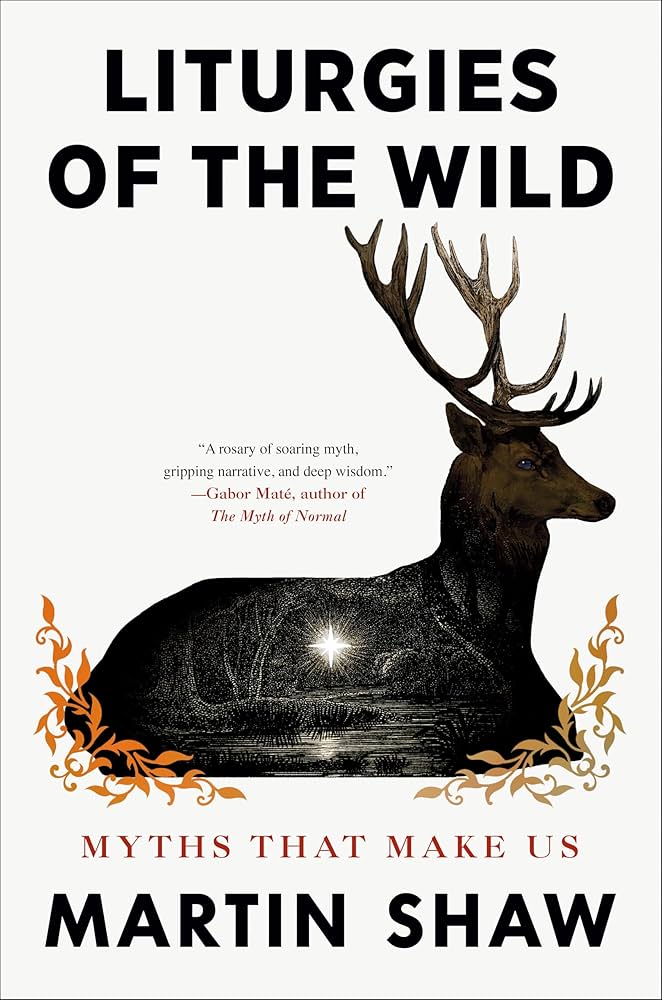 If we look a little further than the screens that fill our lives, we may find an old idea, Martin Shaw says in his new book, Liturgies of the Wild. “That if you aren’t wrapped in the cloak of story and the cloak of place you are liable to experience huge rushes of angst as you age.”
Do you recognize yourself in that sentence? Do you taste a familiar, poignant sting in this warning? I certainly do. Without being so wrapped, Shaw cautions, “You are in some grievous way, unprepared for what the world will likely hurl at you. You remain adolescent, you remain at risk, and that itself makes you dangerous and your decisions likely unwieldy. You’re not grown” (3–4).
We are more prone to take offense at such an assessment than we are to acknowledge how true we know this to be. This is our fundamental dividedness, the split in ourselves inherited from Adam, that knows a thing to be true but loathes that knowledge and conceals it from consciousness. We hide it from ourselves because it threatens our desire to be self-sufficient and beautiful and powerful and every other thing that we are not in our natural estate.
This is cut, really, from the same cloth as Jesus coming to strangers and telling them to repent, for the kingdom of God is at hand. We read this and think, “Well, yeah. Repent, you dummies,” and in the same nanosecond think that we justify ourselves. Thou art the dummy. The scandal that dumped cold water on them needs to jolt you awake too. Because Jesus loves you, he comes to you and tells you, You are not well.
You have probably heard this, probably even believed it. But have you been fooling yourself that you are something now because you know this? We are not justified by works — let me repeat it yet again — but we are not justified by not-works either. All too often, you and I are swept into tide pools of wonderless drudgery because we tell ourselves this is the same thing, and it most emphatically is not.
“I don’t need a rule of life, I have Jesus!” isn’t the flex you think it is, when as a rule you are forlorn and despondent and boastful of all you don’t do. It is all too easy to justify ourselves with theology and resign ourselves to crawling in the muck than to take the risk that God’s justification opens us up to a better story.
A good litmus test is wonder. When is the last time you felt it? Or, more pointedly, allowed yourself to feel it? Wonder is the stirring that wakes us up out of the sleep of our accommodation to the world.
Wonder is dangerous. It whispers of something more that threatens what we’re used to, even when we loathe or are exhausted by the things we’re used to. But that “more” frightens us because we fear the demand that will come with it. This is why we settle so often: we can scarcely live with how things are, but the prospect of change terrifies us and makes the norm a tad more acceptable. We are afraid of a love that would not leave us the way we already are.
Wonder illuminates our lives; it shows that the things of this world are more than mere furniture in the space of our self-actualization (praise God). These are the creatures of a good God. As are you. They testify to the Creator and thus to a purpose that exceeds your own. Wonder testifies to a story that gathers up all of our stories.
Stories show us the stuff of life, Shaw writes, as depicting them in narratives clarifies them and their holds over us. We live every day but do not necessarily recognize our lives. We rely on stories to do the work of recognition. But more than simply clarifying these things, “Christ then lifts this all up into higher ideals — ideals that don’t just work within the murk of the passions, telling us that to step beyond their negative aspects is to dwell in the biggest story of all” (95).
Do you allow yourself to dream of something better that God has for you? Of a you that you aren’t tired of? Because “Christianity is a dream in which the very best of us is encouraged to emerge,” Shaw urges us. “A dream that challenges and inspires us. A dream in which God speaks directly to us” (163).
The gospel is the impossible taking root in the muck of our lives at God’s behest, just like Joseph’s vision, like Daniel’s insight, like the guidance given to Joseph, the guardian of our Lord. Of course there are dreams that are only dreams. But we also know, from the fact that they happened, that there are dreams that open different vistas, that change us by showing us an alternative or by disclosing what our truest, most heartbreaking desire is.
That fear of a love which is not content to leave us with what we think we need is the fear that often leads us to dismiss dreams. That vivid intimation of more is too pungent there and in the stories that grip and shape our imaginations. What if we weren’t so swift to dismiss that? And what if we didn’t rationalize it with misappropriated theology?
Shaw speaks directly to such a person — let’s be honest, me for too long a stretch of time — on the book’s final page. “How do we find by will something we were once gifted by grace?” Listen to what he says:
We can’t. We simply can’t, and we’re heading to an existential crack-up if we think we can. But we can take heart from the fairy tales and note that certain opportunities of the soul come around more than once. And that we can ready ourselves, deepen ourselves, humble ourselves. We have Christ’s full attention — let’s not waste it. In the end, it’s surrender to that loving attention that will get us home. (230)
What story are you living out? Where does your story fit into the story God is telling in Christ? What strength and resolve can you derive from other stories to help you live yours? Because every good story draws its goodness from the Great Story of God’s redeeming love, we have an embarrassment of riches to draw upon. I pray we will recognize how wonderful this truly is and that we will be surprised to find the scales of cynicism falling from our eyes as we recognize it.








AMEN!!!