




This essay appears in Issue 28 of The Mockingbird magazine, now available to order.
I went on a dare. My friend Brett, an English professor and poet with a doctorate from Yale, had once visited the Precious Moments Chapel on a family road trip. He thought that I, who also boasted a fancy degree and who formally studied art history, might get some kicks out of visiting “America’s Sistine Chapel.” After all, we sophisticated Christians, the kind who bend over backwards to defend contemporary art and literature, often do so at the expense of the Christianity that reared us. In fact, so much time is devoted to making fun of lesser Christians (especially when they don’t vote as we wish they would) that the practice could qualify as a professional sport. Mockery can result in decent writing, whether an academic article calling out “baptized capitalism, where a religious sheen enhances the magic and greases the wheels of commerce,” or a more casual think piece dripping with sardonic disdain. Brett was planning to call his piece “Specious Moments.” The Precious Moments Chapel is in Carthage, Missouri, and like Cato the Elder we might have been tempted to say “Carthago delenda est” (Carthage must be destroyed).
As it happens, Brett never got to write that piece because he died at forty-two of colon cancer, a cancer which, incidentally, cured him of nearly all the cynicism that might have generated that kind of writing. So it fell to me. I was driving from Illinois, following what remains of the “Mother Road” of Route 66; I had secured the funds to do research on Native American art in Oklahoma. Realizing my schedule could afford a stop at the Precious Moments Chapel, I booked a cheap hotel in Carthage and planned to do an early-morning hit-and-run before moving on.
On the way to the Chapel, I saw signs for guns, and then more signs for guns. One massive yellow billboard just said in black writing, “GUNS, GUNS, GUNS.” I stopped at a gas station and saw a sign that read:
Lord, let my aim be true and my hand faster than those who would seek to destroy me. Let not my last thought be ‘If only I had my gun.’ And Lord, if today is truly the day that you call me home, let me die in a pile of empty brass.
Enemy-vanquishing violence contrasted perfectly with the orgy of cuteness that awaited me just up the road. I thought of Carl Jung’s quip in Psychology of the Unconscious that “sentimentality is repressed brutality.” My ability to summon this quote from memory filled me with something as pleasurable as the discharge of a handgun at a firing range: sweet condescension.

Photo courtesy of the Precious Moments Chapel.
For some reason, Google Maps told me the Chapel would open at 8. Google was wrong, though — it didn’t open until 10. So I wandered the grounds. I saw bronze statues of trumpet-blowing angels lining a path that led to what — at least from the outside — looked a lot like Giotto’s Arena Chapel in Padua, Italy. The grounds were impressive, but abandoned. Disappointed, I got back in my rental car and took some time to chart the next leg, seeing if I could find a substitute stop along the way. And then someone knocked on my car window.
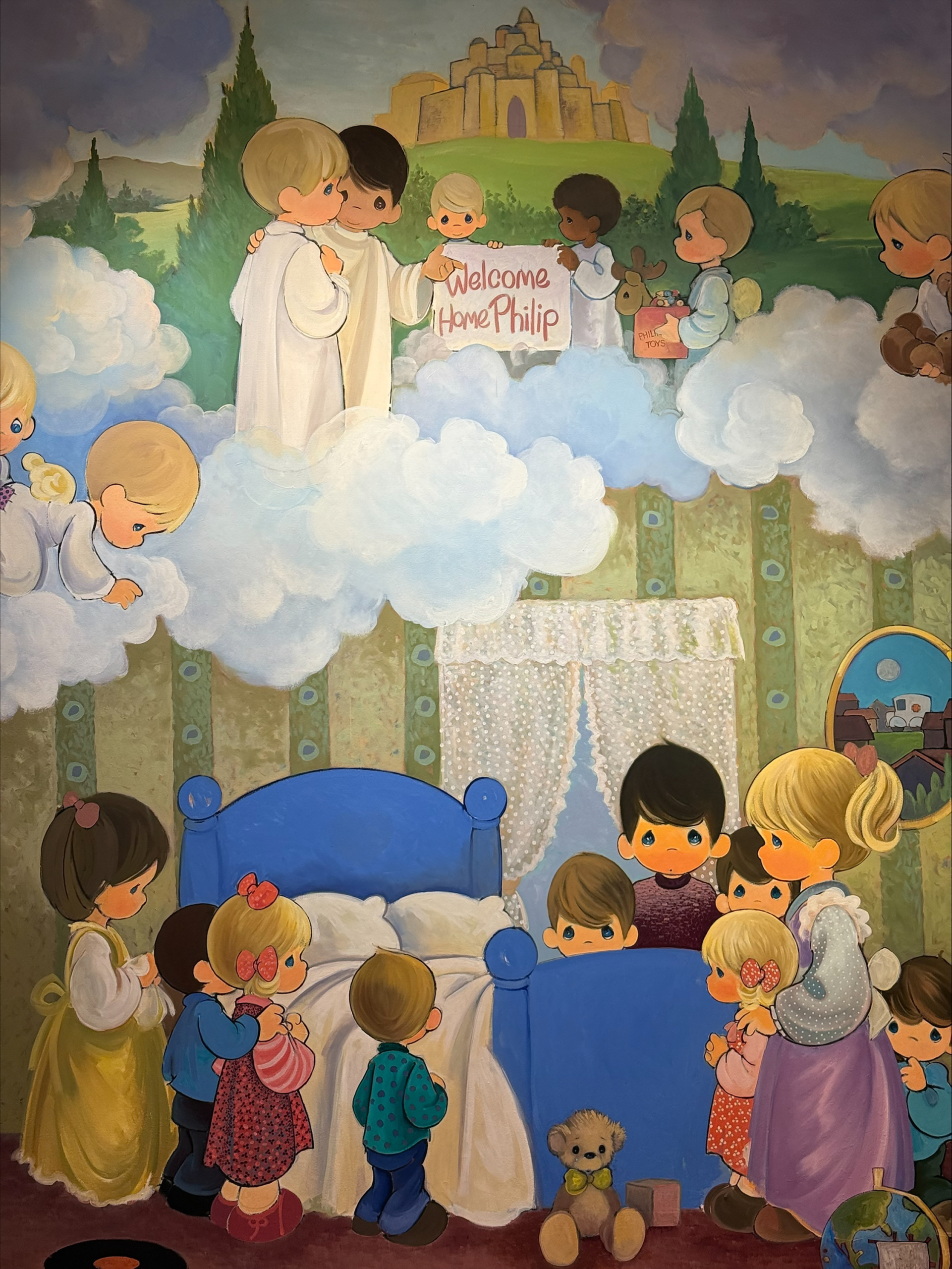
Samuel Butcher, “Welcome Home, Philip” and El Greco
She appeared to be in her late fifties, slim and commanding in appearance, dressed to the nines, with flashy pointed spectacles gracefully enhanced with sequins. I expected I was about to be yelled at for trespassing, or told the police were on their way. But when I rolled down the window, instead she asked with an elegant eagerness inflected with the slightest of southern accents, “Can I help you?”
I know the old canard that southern sweetness conceals hostility, but I sensed only sweetness from this woman. I explained that I was an art historian who had miscalculated the opening time, and would soon be on my way. She introduced herself as Terri, and asked me to wait a moment. After scurrying to the office to check with the groundskeeper, she rushed back to my car — high heels being no obstacle — and told me she had arranged a private tour. After all, a real live art historian needed to be accommodated.
As we waited for the groundskeeper to unlock the Chapel, I explained to Terri about my friend Brett. Terri in turn told me about her husband’s agonizing cancer treatment, which has been an ongoing trial. But if I came here in grief, she added, I had come to the right place. Samuel Butcher, the founder of Precious Moments, who built the Chapel in gratitude to God for his financial success, had lost an adult son in a car accident. In fact, the Chapel is a shrine of sorts to many who have lost loved ones. First Terri took me to the Chapel that honors Sam’s son. On the wall there was a mural of children surrounding an empty bed, with a “Welcome Home Philip” sign above. It reminded me of El Greco’s 1586 painting The Burial of the Count of Orgaz, which also shows heaven opening to welcome the departed. She showed me the “Book of Remembrance” signed by many who have made pilgrimages to this Chapel to grieve lost children. I found myself telling Terri about my son Clement, who my wife and I lost in a late miscarriage years ago. Although I could tell from the guest book that this was not the first time Terri had heard such a story, she listened to me as if it was.

El Greco, The Burial of the Count of Orgaz, 1586. Oil on canvas, 190 in × 140 in., Iglesia de Santo Tomé, Toledo.
It is not only that the Precious Moments Chapel was a shrine to those who had lost children, family and friends. That I suppose would have been uniquely poignant. But it was also the fact that all the moments in art history I had learned to celebrate were contained here as well. The blue ceiling echoed the interior of Giotto’s Arena Chapel, so what I had thought was an accident was in fact deliberate. There were appropriate depictions of Mary and her son Jesus, depictions which delicately anticipated the Passion as do classic Orthodox icons. In another painting, a bridge symbolized the union of humanity and God, just like Botticelli’s famous Cestello Annunciation or Jan van Eyck’s Madonna of Chancellor Rolin.
As if to imitate Tiepolo’s famous Baroque fresco at the Würzburg Residence in Germany, there were even sensitive evocations of the four corners of the earth in stained glass windows — Precious Moments style personifications of Africa, America, Asia, and Europe — but absent the arrogant colonialism that marks Tiepelo’s program, which is centered not on Christ but Apollo. Sam Butcher’s inclusion of many races was not groveling to political correctness, but simply illustrating Revelation’s vision of every tongue, tribe, and nation gathered in the New Jerusalem. (There were even signs of cooperation with the nearby Osage Indian nation in the Chapel museum.)
Then came the elements of unmerited grace. Lucas Cranach the Elder’s visualization of Martin Luther’s Law and Gospel theology was illustrated on the Chapel’s front doorway, reminding us of the impossibility of earning our salvation. The left door illustrates Law, with the decalogue firmly blocking the stairway to heaven. But on the right-hand portal, the stairway is opened by the cross. “The Law says ‘do this’ and it is never done,” said Luther in the Heidelberg Disputation. “Grace says ‘believe this’ and everything is already done.”
The notes of grace-beyond-earning did not stop there. At the heart of the Chapel, Samuel Butcher shows only children entering heaven. In the Spanish Chapel in Florence, a fourteenth-century depiction made that very same move: all of those on the way to heaven become diminutive children as they enter. How John Ruskin loved this scene: “Becoming as little children,” he gushed in Mornings in Florence. “There is, so far as I know, throughout all the schools of Christian art, no other so perfect statement of the noble policy and religion of men.” We adults may have our resumes, but in both Florence, Italy, and Carthage, Missouri, only children need apply.

Precious Moments Chapel (1989)
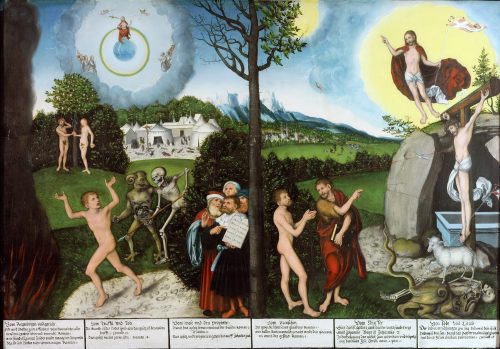
Lucas Cranach the Elder, Law and Gospel, 1529. 32.4 in × 46.5 in, Herzogliches Museum, Gotha, Germany.
It turns out that spiritual childhood was an especially popular theme in the Protestant Reformation as well. As William Halewood explains in his book Six Subjects of Reformation Art, it was used by the classical Reformers to find the middle ground between the Catholic hierarchy (which the Reformers claimed could prevent access to grace as the disciples prevented children’s access to Jesus), and the Anabaptists (who did not allow for infant baptism). Biblical accounts of Christ’s blessing the children showed that “the saintly disciples function not as intercessor for divine favor, but as obstacles to it.” Christ cuddling children therefore functioned as the ideal illustration of grace.
Lucas Cranach’s images of Jesus holding the little children luxuriated in this metaphor, but the motif was perfected by Rembrandt’s famous Hundred Guilder Print, where the righteous are obscured by light. Only the darkened sinners, acknowledging their failures, find themselves close to Christ, whose hand reaches out to touch the only one who seems to understand him: a baby. “Men and women transformed into children,” Halewood explains, “are visited in Rembrandt’s scenes from the New Testament by a Christ who expresses only compassion.” The Precious Moments Chapel, with its copious depictions of children embraced by Jesus, continues this great Reformation tradition.
Perhaps the reason children were drawn to Jesus is because Jesus, even while a man, nevertheless remained a child. He summoned his heavenly Father so frequently in the New Testament that many modern psychologists might conclude something was wrong with him. But the problem is with psychology. As Hans Urs von Balthasar puts it in Unless You Become Like This Child,
In the Son, the Spirit keeps alive the unshakable trust that the Father’s every ordinance (even abandonment – the Cross) will always be an ordinance of love… and so the Son can be obedient.
We adults may forget how to trust, but Jesus never did. Accordingly,
Christian childlikeness and Christian maturity are not in tension with one another. Even at an advanced age, the saints enjoy a marvelous youthfulness.
As one of those saints put it (Thérèse of Lisieux, who was drawn to near-Protestant understandings of meritless grace), “I want to love you like a little child, I want to battle like a warrior bold.”
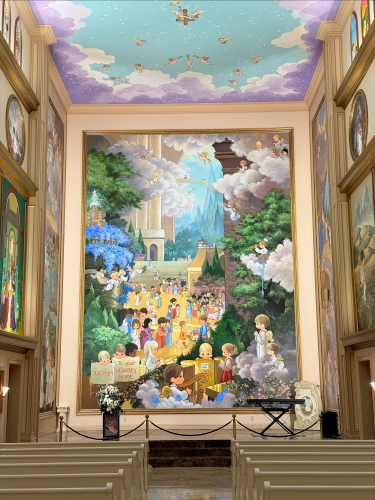
Photos courtesy of the Precious Moments Chapel.
I suppose it is fair to say that on my visit to the Precious Moments Chapel (and in my subsequent visits since), I grew not up but down. In my churlish delight at remembering Jung’s quote about sentimentality being repressed brutality, I had forgotten that right after that line, Jung — still then in his own youthful arrogance — mocked early Christianity’s ubiquitous shepherd-and-lamb motif as “infantilism.” His prognosis, however, is accurate. Infantilism is the sentinel that guards the gates of the kingdom, to which the ticket is trust. Only wide-eyed children are allowed. Who knew that those cutesy Precious Moments porcelain children, eyes dilated in total dependence, packed such theological punch?
If all of this sounds unsophisticated to those who prefer the studied complexities of contemporary art, I can only cite the founder of the most daringly deconstructive art movement in history, Dada. Hugo Ball, after he burned out on the artistic avant-garde he worked so hard to promote and returned to Christianity, said it this way in Flight Out of Time:
Childhood is a new world; all the directness of childhood, all its fantastic and symbolic aspects, against all senilities and the adult world, the Crucified One will be the Judge, the Resurrected One will dispense the pardons…. No art can exist without the application of the laws of childhood.
In sum, all the places I had visited in Europe, those great iconographical moments that sustain a visually intelligent faith — even Dada — are freshly encapsulated in Carthage, Missouri, safely concealed by kitsch to humble art snobs like me.
To the academics who claim this is all just “baptized capitalism,” I remind them that admission is free. If anything, Butcher’s painting of a child holding a “No More Tears” sign at the gate of heaven wrenches this trademarked slogan from Johnson & Johnson baby shampoo and puts it back in the Scriptural key where it belongs (Rev 21:14). I love a good art exhibition, but how sick I am of sham urbanity. More people could stand to flee from the laundered capitalism of New York and Los Angeles art galleries to be changed as I was along Route 66.
Even if what Martin Laird calls the “syrup of devotionalism” is to be avoided in the life of prayer, it remains true that “God chose the foolish things of the world to shame the wise; God chose the weak things of the world to shame the strong” (I Cor 1:27). I had imagined that verse to be aimed at the arrogant philosophies that posed themselves against the sophisticated, aesthetically superior Christianity I had chosen to embrace. Until my visit to Carthage, I had never stopped to consider that the verse was aimed directly at me.








Wow. What a turn. This was convicting and insightful. Thank you.
I have collected Precious Moments for years! I loved this article…how insightful and inspiring! Thank you!
Take me to Carthage! This article is fantastic and full of interesting history and points to the benefit of patience. And how kind of them to see you and offer an early private tour. I had no idea this place existed until now. Thank you.
A beautiful reminder to stay childlike, even as we grow in wisdom.
Very moving and true.
It is also aimed at me, a theological snob who needs to become like a little child through repentance and God’s grace.
Well said.
Thank you.
Well done. Lead me with the usual guns billboard as you enter town and then leave me with the simple truths of trust like a child. Like Lewis, my six month old grandchild who is presently asleep in my chest. He’s been asleep nearly an hour. He trusts me
To protect him. As I ought to totally trust Him who made me. He’s about to awake and I am about to trust.
Beautiful, unexpectedly emotional & so so interesting
Thank you. Beautiful and humbling indeed.
Dr. Matthew Milliner walked into St. George’s church more than ten years ago to take pictures of historic churches in NYC. It was the weekend of Mockingbird Conference and he came back to attend. A friend ever since, he spoke at the 2017 conference, Hearing Law and Seeing Gospel. Stunning, like this incredible piece; which has given this old man such peace and love for our dear Savior.
Dang. Boy can write.