




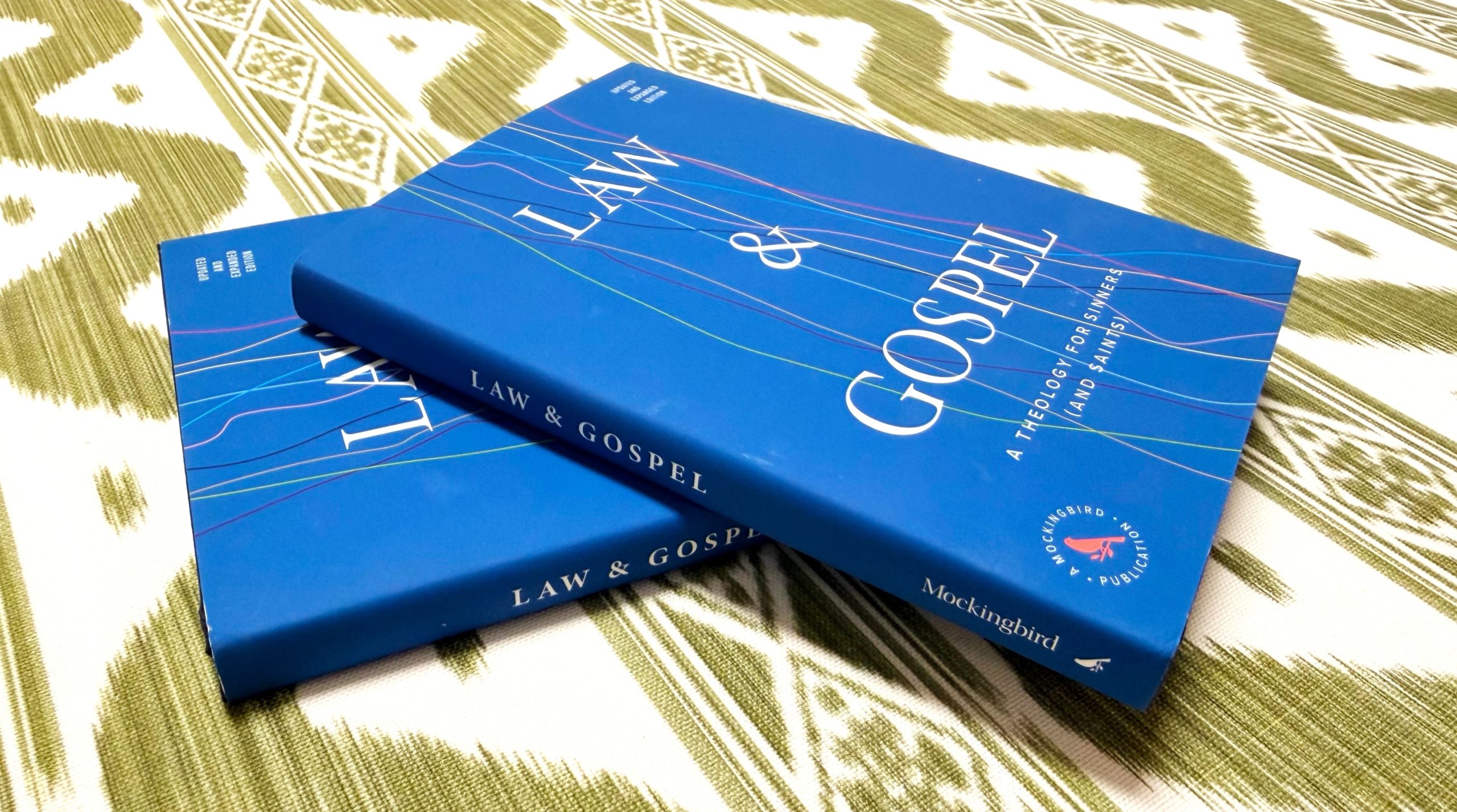
Big day, you guys. For the past year or so, we’ve been hard at work overhauling one of our most popular publications, Law & Gospel: A Theology for Sinners (and Saints) by Will McDavid, Ethan Richardson, and myself. We polished the prose, redesigned everything, added a discussion guide, and gave it the hardcover it deserves. I also penned a fresh preface which you can read below. It’s the same book that so many of you have taken to heart, but now it reads better, looks better, feels better. A substantial improvement in every way, and we cannot wait for you to hold it in your hands.
A paperback is on its way, but you can order your copy of the hardback now.
Here’s what author and theologian Chad Bird said about the original:
Here is an exquisite condensation of immense biblical wisdom. If pastors and congregations would read and study this book, we would experience a profound shift in the moralistic, anxiety-producing, hopelessness-generating direction that most of American Christianity has gone. I cannot recommend it highly enough.
Preface to the 10th Anniversary Edition
This short book was written in a fever. Mockingbird was a smaller operation at the time, only three full time employees and a part time bookkeeper. Our print journal had just launched, but we’d yet to record a single podcast. In January of 2015 one of the team, Will McDavid, broke the news that he’d be leaving staff to go, ironically enough, to law school. The announcement was bittersweet but not unexpected.
An avid writer and preternaturally gifted theologian, Will had been overseeing our book publishing projects for the preceding several years, working alongside myself and magazine editor Ethan Richardson. The three of us had chemistry—and a surplus of energy. It was a special time, and we knew it. How best to use Will’s remaining months with us? That was the question we sat down to discuss once the cards were on the table.
I forget who suggested it—possibly Will—but someone floated the idea of putting together a short book about ‘first principles’ that we could debut at our upcoming spring conference in New York City. The distinction between the Law and the Gospel had been part of the Mockingbird DNA since day one. It was the primary theological lens through which our writing and commentary peered and felt like the natural place to focus our efforts.
Up to that point we had resisted defining the categories at length on paper. This was in part a matter of self-confidence—we were all young, without advanced degrees. But it was a rhetorical decision, too. It was more effective, we believed, to show rather than tell when it came to such theologically loaded topics. Plus, there were scores of books to which we could point people if they were interested, most notably my father’s Grace in Practice (2007).
The time had come for the organization to go ‘on record’ and produce a short monograph, almost a manifesto, that made it clear to the wider world what we were about. I knew I didn’t want to do it without Will’s help and voice, though. Could we pull this off in three months? The writing and editing would have to be done in six weeks.
 There was no time to lose. The three of us sat down at a coffee shop on the downtown mall in Charlottesville to map out the content and divvy up the writing. I remember being taken aback by how swiftly the outline fell into our laps and how self-evident the individual assignments were. The rest was a blur, but we somehow hit the deadline. The first version we distributed had plenty of typos, but it was more or less complete. A few weeks later, we did one more proof, and that edition remained in print for a full ten years. It sold extraordinarily well (for a small self-published work) and has continued to do so. I think the lack of polish is part of its charm. The energy and passion made it onto the page.
That said, I always hoped we’d have a chance to go back and refine things a bit, make the book more reader-friendly without reducing the umph. The ten-year anniversary seemed like the perfect opportunity to do so. Each of us went through the text and did our best to iron out imprecisions and redundancies. We’ve added a few little bits here and there and expanded a section or two. I am so proud of this spruced-up version. I think it sings like a (mocking-)bird.
Of course, a decade is a long time, and things change. While the core message still resonates deeply in my own heart and soul—and the distinction itself feels just as urgent as it ever did—there is one element we did not foresee. As you’ll read in the introduction, we framed our message as an answer to the cruel optimism we perceived to be endemic to our society. People both inside and outside of the church suffered from a blind confidence about the future and themselves that was setting them up for deep disillusionment, as well as putting them at odds with the God of the Bible.
Spiritual conditions have shifted such that our opening diagnosis no longer applies in the same way. Today’s burden is much more one of despair and hopelessness. Young people feel like they’ve been failed by the institutions they were raised to trust. Many doubt they’ll ever be able to afford a house, let alone find a reliable spouse and raise a family. Purpose and meaning feel increasingly out of reach in the age of the algorithm.
The charge that you and I think too highly of ourselves may still pertain to those within the church—with its undiminished appeals to willpower and the human potential to partner meaningfully with God—but outside the church, that “high anthropology” takes a different form. These days our ironclad confidence has more to do with future doom than future success. Yet pessimism, it turns out, can be just as self-righteous as its inverse. To reclaim a sense of agency, we blame and scapegoat and divide the world into all sorts of categories. Or maybe we make ourselves feel better by striking a more nihilistic pose. Either way, humility remains lacking.
This means that the exigency of the Law-Gospel distinction no longer has to do with dismantling excessive optimism so much as leveling the playing field and spotlighting the one-way nature of the promises of God. Doubtless the sands will have shifted again in ten years’ time.
What a relief, then, that the Gospel does not fluctuate according to the cultural tides but continues to ring forth with timeless potency. A hope exists which transcends our ability to obstruct or avoid it. God’s love targets the undeserving, including you, forging a redemptive way forward where there appears not to be one.
Law school notwithstanding.
– David Zahl, 2025








I’m glad that God led me in finding this website. I pray that this will help me with my mental struggles & habital sins & just find peace within all of this. 🙏