




1. So glad to have locked in Jennifer Breheny Wallace for #MbirdNYC26 this year, another in a long line of prescient speaker picks for our annual gathering in New York City. (Speaking of the conference, did you see the pre-conference workshop titles and breakout sessions we announced this week?) Breheny Wallace’s star continues to rise after her appearances with Oprah and Good Morning America, making the case that “mattering” lies at the root of so many social ills. Not too long ago, over at The Up and Up Substack, JBW gets more explicit with her observations that Gen Z’s struggles are not just sociological but also spiritual. Henri Nouwen and the Jesuits lend a hand:
Mattering is defined by researchers as feeling valued by our family, our friends, our colleagues, our community, and having an opportunity to add value back to the world around us.
To go even further, mattering is a meta-need, which means it’s a need that sits above other core needs, like belonging, connection, purpose, meaning, agency, self-determination. Mattering goes deeper than these. So for example, you could belong to a workplace, or a class, or even a family and not feel like you matter to the people there. You can have a deep sense of purpose, but if no one is connecting you to your impact, if you don’t hear how your work is making a difference, you can burn out. […]
Gen Z is the first generation that grew up with parents who were not religious. And I am not saying that religion is a panacea. I am simply saying that as a society, we have replaced religion with capitalism. And who matters in a capitalistic system? The people who matter are the people who are contributing to the capitalistic system.
When it comes to mattering in our current society, that sense of mattering for Gen Z people feels very contingent on their grades, where they go to college, the job they get, the house. What religious values used to offer was an emphasis on intrinsic values, wanting to be social, good to our neighbors, good to the environment. All major religions talk about this unconditional inherent worth that we humans have.
When you are raised in a family where that sense of inherent worth is not a part of your conversations, you believe your worth just because of the signals that society is sending you. And I am not blaming parents, I am saying the wider culture is sending these signals that certain people matter more.
There’s great theologian Henri Nouwen who talks about the three great lies of our culture that I think Gen Z is hitting up against, and this is ‘we are what we do,’ ‘we are what we have,’ ‘we are what others say and think about us.’ So in the absence of some sort of spiritual tradition, we get sucked up into this vacuum, and I think Gen Z is right to be having an existential crisis.
2. Let’s keep the ball rolling with the idea of intrinsic values. At Aeon, Julian Baggini writes how the opposite of an intrinsic motivation is an instrumentalist mindset. Instead of human endeavors being directed toward an unchangeable good, they are directed towards some functional, utilitarian end. His example: a writer advocating for six-second-long hugs, not because they communicate love and draw people together but because six seconds is the minimum time length needed to release mood altering happy hormones into the brain. In this light, writes Baggini, hugs and relationships aren’t the ultimate good but are secondary to mood stability, stress relief, and biochemical serenity. In fact, Baggini continues, just about every human endeavor these days is justified by its ability to provide health, wealth, and psychological wellbeing.
Think about what instrumentalization serves: health, wealth and psychological wellbeing. These are all so obviously desirable that it’s easy to miss the fact that none have intrinsic value. That is clearly true of wealth, but it is equally true of mental and physical health.
Take bodily health first. We often talk about it as if it were the most important thing of all. That’s why Augusten Burroughs’s quote “When you have your health, you have everything” has a healthy life as an internet meme. But we don’t prize health for its own sake. We value it for two reasons. One is that the alternative usually involves pain and suffering, which are bad in themselves and so to be avoided. The other is that, with health, we are more able to do the things that bring meaning to our lives. But a healthy life devoid of love, meaningful activity or experiences would be empty. Indeed, many people with chronic illness surprise themselves and others when they discover that, actually, their health is not the most important thing after all. In sickness, they see more clearly what matters and find that it is better to be, say, ill and loved than in good health and loathed. As one wheelchair-using study participant told Elizabeth Lindsey, an associate professor of nursing: “I can live life to the fullest, even if I have no physical ability, I can still live life to the fullest because where I am living, life is from within.” Physical health is important only as a foundation to make it easier for us to appreciate the things that really matter. Indeed, Lindsey talks of “health within illness,” arguing that health in its fullest sense is not the absence of illness.
Even mental health is not important in itself. Mental illness is intrinsically bad, since it is suffering without gain. But being in good mental health, like being in good physical health, is just an enabler of what is more fundamentally valuable. Even some mental distress is not intrinsically bad. It is a good thing that we grieve as it shows that our emotions are functioning correctly when bad things happen to the people who matter to us.
Not even happiness, perhaps the most commonly claimed benefit of instrumentalization, is an intrinsic good. It is not good if someone feels happy to see people they prejudicially hate suffer. It would not be good to live life in a chemical cloud of bliss, content but disengaged from the real world. It is not good to live happily in the illusion of a strong relationship when your partner is cheating behind your back. Blissful ignorance may sometimes be better than painful knowledge, but that does not make it good.
Baggini trips in an otherwise thoughtful reflection when he goes on to argue against the philosophical idea of the summum bonum, the ultimate good. “Flourishing takes as many forms as human beings do,” he claims, suggesting that any intrinsic good can hold the weight of human purpose. “Seek ye first the kingdom of God, and his righteousness; and all these things shall be added unto you” is, of course, a statement of the summum bonum from Jesus of Nazareth, made all the more relevant here since it comes after his teachings about health, wealth, and anxiety. Or, to pair it with JBW’s observations, what good is health, wealth, and psychological stability when you don’t matter to anyone and nobody matters to you?
3. Emily Oster carries on the intrinsic vs. instrumentalist torch with her New York Times op-ed about the science of exercise and health. Oster’s helpful contribution to our public discourse is to wade through the morass of low-quality scientific research and highlight the principles and patterns that have been vigorously tested. Yours truly wrote about her helpful parenting book Cribsheet back in 2021, comparing her decluttering of parenting expectations to Jesus’ decluttering of the traditions of the scribes and elders. We’d all do well for less law in our lives. Now, it looks like Oster is turning that same critical eye toward the science of exercise and nutrition, arguing that an obsession with an instrumentalist approach to exercise is actually keeping people from exercising.
Unfortunately, a lot of research and media coverage is focused instead on asking what the best type of exercise or the optimal amount is. Is walking better than tennis? Is running better than swimming? Is it really important to do 80 percent of your workout at 60–70 percent of your max heart rate (known as Zone 2)? These questions serve an engaged population and promise that with a bit more knowledge, you can maximize your health. The trouble is, they are basically impossible to answer well, and most of the answers we get are misleading and wrong. […]
People love findings like these, but the reality is that when we see such claims we should assume that they don’t tell us much. They can even backfire — making people feel inadequate about exercise programs that are actually fine.
The limits of our knowledge are a tough pill to swallow (especially since it’s not just exercise; the research on nutrition is equally shaky). It can be frustrating to know there are some questions we’ll never answer. I also think it can be freeing, an invitation to let go of optimization and focus on what we do know. In the case of exercise, we can say with confidence that it’s good to regularly do something that raises your heart rate. […]
People are more likely to stick with an exercise program that is tailored to their preferences and lifestyle. When doctors are advising patients about exercise, they should be as open as possible to the variety of ways people might want to get moving.
The instrumentalist impulse — to organize life in the service of health, and not vice versa — backfires here. It creates less health instead of more health, and it doesn’t help the people who are actually sick. Something something “Those who are well have no need of a physician,” etc.
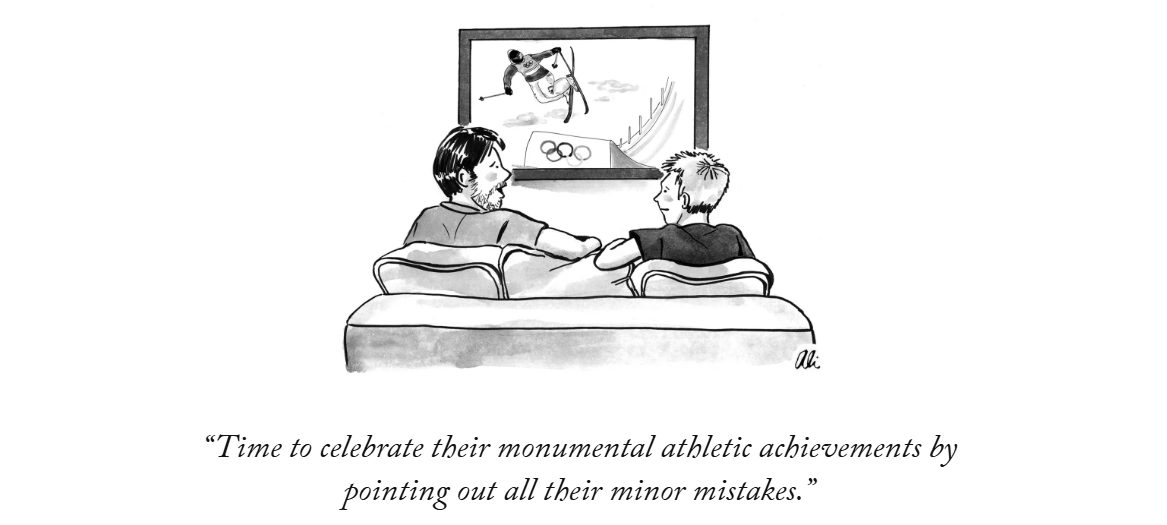
4. Keeping in line with the instrumental, the athletic, and mattering, the summum bonum of a human life cannot be a gold medal. The Olympics wrapped up this week, and the nightly dose of winter sports was an unexpected joy in my household during these past few weeks. A family-friendly break from the algorithmically generated content catering to our differing demographics. It seems like the Athletic’s reflection on sports success and personal fulfillment is the kind of article that pops up every two to four years, a reality check for those daydreaming of their own Olympic glory. But just because that article can be expected doesn’t mean it isn’t wrong.
One of the primary reasons people are bad at forecasting their emotions is something called “focalism,” a cognitive bias in which people tend to narrowly focus their attention on big events while ignoring all the smaller aspects of their lives. Kahneman, one of the giants of psychology, had once captured the idea in a simple line: “Nothing in life is as important as you think it is, while you are thinking about it.”
It was easy, for instance, to imagine the celebration, the podium, the pomp and circumstance of the Olympic Games, to blow up the experience into something beyond comprehension. It was harder for athletes to think about taking out the trash, or managing relationships, or what type of person they might be on the day they actually won.
“How is life going to be after the Olympics? That’s just hard to forecast,” said Thomas Gilovich, a psychology professor at Cornell University. “You don’t know what your life is going to be.”
5. I don’t need to prove to you that all these reflections about the joys of mattering and the dangers of instrumentation are true. Alysa Liu proves it for me. Surely you’ve watched her gold medal performance in the women’s free skate to (of all things?) Diana Ross’ disco cover of “MacArthur Park.” No, that isn’t the cake left out in the rain, it’s my tears of joy for the sixteen-year-old figure skating prodigy burnout who left the sport in frustration and came back at age twenty to win it all.
You can read about her early career success, her overbearing father, and her burnout and return to the sport here in the New York Times’ preview piece published before her gold medal skate. To win the gold, and to wow the world with a truly free performance, Liu needed to matter to her family outside of her athletic success. She needed to matter to her coaches beyond what her success would bring them. She needed to reorganize her relationship with her overbearing father. She needed to fall back in love with figure skating instead of viewing it as means to belonging and success. See for yourself what mattering, intrinsic value, and freedom from instrumentalism can look like:
6. Switching gears, McSweeney’s gives us “Is It a Red Flag? Wuthering Heights Edition.”
He hurls a tureen of boiling applesauce at the boy next door.
Not a red flag. A good reminder that commenting on another person’s hair is not without risk, and a testament to the dangers of serving applesauce unchilled.He leaves for three years without saying goodbye.
Not a red flag. If absence makes the heart grow fonder, yours should be positively enamored. Also — and please know it gives me no pleasure to ask this, but — DID YOU CHECK THE CALENDAR?He marries your sister-in-law.
Not a red flag, since he could just as well claim that you married his brother-in-law. Plus, it will make holiday gatherings more intimate. Between this and the shared parents, nobody should get stuck sleeping in the haunted bed closet.He tries to kill your sister-in-law’s springer spaniel by hanging it from a bridle hook.
LOOK. It’s not great. But is it the type of behavior that will definitely stop people from imagining him as a romantic lead? Something tells me we aren’t there yet.
Also fun reads this week: “Why Is No One Eating My Awful Potluck Dish?” and “Baby Not Sleeping? My Online Course Can Help!” from Points In Case.
And “Why Are We Cancelling School Today?” hit home for this dad this week with two burned PTO days for (IMO) less than optimal reasons. Then there’s this from Hard Times:
The hard truth is, self-worth isn’t tied to how good you look, or how smart you are, or how much money you make. You know that. But let me tell you something. It is 100% unequivocally tied to the number of Instagram friends you have who are connected to semi-well-known public figures.
7. Odds are good that you’re watching a Game of Thrones spinoff, reading the Fourth Wing novels, or playing Dungeons and Dragons. I’m personally enjoying a second watch of the first season of Friren, the beloved German fantasy anime. In the Guardian this week, author Francis Spufford asks why the fantasy genre is in a golden age and argues that the old explanations just don’t fit. Yes, we live in a supposedly disenchanted world, and so fantasy worlds become sandboxes for our personal and social escapism. Yes, fantasy worlds help illuminate the inner life, the invisible realities of our psychology that a strictly secular world has trouble expressing but everyone, especially kids and teens, acutely feels.
But what if, Spufford argues, the world isn’t as disenchanted as we think, and fantasy is one of the only realms that charitably explores the everyday mysticism of human existence? In this way, fantasy ceases to be escapist fiction and instead takes on some higher calling for the human project:
A lot of what we eliminated from the world by disenchanting it, we really don’t want back. At least, not seriously. There’s a compelling origin story for fantasy as a genre – you can find it brilliantly and subtly analysed in Adam Roberts’s recent Fantasy: A Short History – in which it works as a kind of regulated return of the repressed. A partial haunting. With its kings and quests and chosen ones and battles and powers of earth and air, it lets back all the things we miss in the world of science, contract, employment, regularity, but don’t want to return all the way. Roberts identifies the turning point as the first world war, giving a generation of young men such as Tolkien and CS Lewis an experience of modernity as utter mechanical savagery, and brewing in them the desire for a literature in which the old stories of myth – with the space in them for individual human agency – came back, remixed, in modern form. We like to dream of having enormous muscles like Conan, when office life makes seven-stone weaklings of us all; we like to think of ourselves as the singular and remarkable Chosen One, when really we form a pixel in a crowd. But having picked these dreams up, we want to put them safely down again, rather than deal with a world in which unaccountable kings and barbarians with zero impulse control really shape our fate. Hence (runs this argument) our packaging of the fantastic in trilogies that end, and books that close.
But there’s another story of fantasy that needs telling. In this one, it isn’t just the wonder-book of our impulses, or an organised nostalgia for a more romantic world. Here it exists because it is (paradoxically) a kind of necessary realism, arising in response to qualities of the contemporary world that we couldn’t properly attend to, couldn’t narrate, any other way. I’d argue that, as well as expressing our frustrations with the disenchanted world, it’s also our best means for capturing the ways in which the world remains enchanted, for all our strenuous buffering. I read and write fantasy because it’s the literature that sees the recurrent unearthliness in human experience. That knows we’re hopelessly metaphorical creatures, who find meaning by tying together patterns of resemblance that might as well be spells. That knows there are some struggles where the stakes really are overwhelming, and good and evil in something like their pure forms really do pivot on human choices. Fantasy understands that to undertake the risks of love is to venture beyond safety, into landscapes strange to you, on perilous and wonderful journeys.
8. My favorite Robert Duvall movie is his 2003 film with Michael Caine and Haley Joel Osment called Secondhand Lions. It’s not the critic’s choice, but it’s a sweet little movie about manhood, aging, grief, and family, and I watched it during impressionable years. You likely have your own favorite Duvall movie. His death on February 15th brings to mind a lot of fantastic movies over his 60+ year career in Hollywood. To close out this week, here’s Aaron Griffith at Christianity Today reflecting on his 1997 film The Apostle and the ways it highlights the best and worst of American Christianity.
What is most striking about the film is not the plot or even the rich character studies; instead, it’s Duvall’s depictions of Pentecostal worship and sophisticated explorations of Southern evangelical ministry and practice. Duvall not only acts well in the film, but he also cast and surrounded himself with actual Pentecostals.
This is clear in the film’s first few minutes, when Sonny and his mother (played by an elderly June Carter Cash) come upon a car wreck on the side of the road. Duvall runs to the crashed vehicle, Bible in hand, and prays with the seriously injured young driver. “I want you to know the Lord loves you,” he tells the man, before asking him to pray in his mind and ask Jesus into his heart so he might go to heaven. The man, in shock, barely able to speak and possibly on death’s door, nods in agreement with Sonny’s exhortations and whispers, “Thank you.”
On paper, this scene probably shouldn’t work. Indeed, it is fashionable to criticize American evangelicals for moments like these, where an individual’s simple moment of decision, offered as a kind of “get to heaven and out of hell” card, overlooks the much more expansive vision of the Christian life in its practical, communal, and complex fullness. Many evangelicals and ex-evangelicals alike have been burned by exactly this kind of exhortation, laser-focused on the afterlife, to get right with God by asking Jesus into your heart. But The Apostle shows in this moment the deep power of evangelical faith for confronting the most wrenching of horrors, even death itself. It doesn’t matter if you have never thought a wit about God; when the chips are down, Jesus stands ready to receive you still. […]
At the same time, The Apostle showcases evangelical violence and harm. This is true not only of Sonny’s deadly assault on a fellow minister but also of his relationships with others, especially women. Though he rages against his wife’s infidelity, Sonny admits he has been unfaithful himself. He also pursues a younger woman later in the film, trying (though never succeeding) to sleep with her. Sonny might be a skilled preacher with a remarkable church, but as my students have said to me when I show them the film, he is also a major creep. And given his own dishonesty and reluctance to disclose his past, it’s not a stretch to say his entire ministry is built on lies.
Sonny’s ongoing sinfulness, as well as the fact that he never takes responsibility for it, indicates that this is not a simple story of redemption, a term that comes up time and again in early reviews of the film. But I don’t think that is quite right. Duvall clearly understood something about the constant temptations evangelicals face in the realms of sex and worldly power — and in the flexibility of evangelical self-definition, of never having to say sorry. […]
Though some viewers may see the story as pro-Christian propaganda, and others as a takedown, The Apostle is a powerful film that holds up because it doesn’t try to escape these tensions. It offers a mirror: Evangelicals are Christians with spiritual gifts to offer a hurting world, and they are sinners with their own temptations and patterns of corruption. Duvall gave us a gift with The Apostle, not because it celebrates or bashes evangelicals but because it shows us as we are.
Strays:
- For more on Alysa Liu: a lovely review of her skate from a dance critic, Gia Kourlas.
- Pleasure in the pain: ‘Wuthering Heights’ and the fetishization of suffering. A review of the Emerald Fennell movie that is, apparently, all the suffering of the Brontë novel without any of the redemption.
- Lent Reminds Us That a Penitent Imagination Can Counter Evil. A reflection on how the Christian imagination isn’t just about working toward a positive view of the world but imagining the terrifying realities of total depravity.
- It’s movie trailer season. I don’t know much about the studio behind it, but an exploration of Ben Franklin and George Whitfield’s friendship? That’s a pretty fun way to celebrate the America 250 if you ask me! And also, if I can trust any media franchise to deal with the screen time controversies plaguing our generation, the Pixar and Toy Story team are as good as any.
- The more I live, the more Dostoevsky becomes relevant to everyday life. Lots to love in Elizabeth Stice’s reflection in Comment Magazine, “Laugh It Off,” exploring the leads in Notes from the Underground and The Idiot.