




Bill Burr’s latest stand-up special, “Drop Dead Years” finds the 56-year-old comedian describing himself as “too young to die of natural causes, but not too young to drop dead.” Watching the new Wes Anderson film, one gets the impression that the 56-year-old auteur has been having similar, late-middle-age thoughts.
The end may not be nigh, but it’s gaining on him.
The Phoenician Scheme, Anderson’s 12th full-length feature, finds the Master of Meticulation on his heels a bit, running down his most unlikely heist story yet. Bottle Rocket (1996), Rushmore (1998), The Life Aquatic with Steve Zissou (2004), Fantastic Mr. Fox (2009), Moonrise Kingdom, (2012), The French Dispatch (2021) — all contain elements of the classic cinema heist run through Anderson’s dollhouse aesthetic and lovable-loser protagonists. But this is the first time the writer-director has given us a character hellbent on outwitting the Lord God Almighty.
Zsa-Zsa Korda (Benicio Del Toro) is a disreputable tycoon with a problem: Other wealthy industrialists are trying to murder him — usually in mid-air, which makes for a whole lot of plane crashes and near-death visions of a foreboding afterlife. So he decides to appoint an heir he can trust (estranged daughter and novice nun Liesl) and get to raising enough capital to settle his nagging debts and shore up his failing businesses.
But no matter how much Korda can finagle from friends, rivals, and family, it’s not going to be enough. There is THE GAP — a “maybe bottomless, closer to an abyss” pit of debt that won’t be satiated by an influx of cash. And Korda knows this. Or maybe he doesn’t know it. Or maybe he does, but just tries not to think about it. Or maybe, just maybe … he can use this moment of crisis to win back the love of his estranged daughter (Mia Threapleton) and go out on a high note.
And then, maybe, God will forgive him for being the “break but don’t bend” jerk he’s been his whole life.
There are plenty of films about redemption. (Almost all of them are.) But in The Phoenician Scheme, Wes Anderson’s Zsa-Zsa Korda is looking for justification, too. And he’s looking to God to get it.

“Why am I up here being stalked by a fighter jet? I have a vocation!” – Liesl
***
When Wes Anderson enters the chat, laying down some God talk, it’s helpful to know what kind of deity he’s working with … his theistic assumptions. Ten minutes into the film, he lays it out for us. Anderson’s God is an Ingmar Bergman/Luis Buñuel arthouse Lord, with lightning-charged hair, Orthodox beard, and the sad face of Bill Murray. And, as you might imagine, this black-and-white God has had just about enough of the recalcitrant Korda.
Anderson’s God shares his dollhouse aesthetic, but struggles to unconditionally love all us losers. And so, with The Phoenecian Scheme, Anderson sets his protagonist, this bone-tired Howard Hughes with a frequently smashed up face (due to repeated acts of airborne sabotage) futilely chasing after a redemptive windfall that never comes. All the while, near-death experiences and afterlife encounters pile up, each more frightening than the last.
Korda’s best hope is reconciliation with his sullen daughter Liesl, who has locked in her own Phoenician scheme with The Man Upstairs: an infinitely gap-less life ordered by devout religious faith and pious practice. A salvation plan that may include bearing the weight of her father’s sins, too. But she’s pretty sure he murdered her mother. So, no. Or rather, upon learning that Korda didn’t kill her mother … or have her killed … but he did kinda-maybe-sorta provoke the mom’s murderer to murder her … Liesl listlessly offers her dad an “I forgive you.” Then slaps the living fool out of him. And again: “I forgive you.”
As father and daughter aviate Anderson’s sun-scorched, mid-century modern Land of Canaan, it is Liesl’s redemption story that becomes what may be the film’s most fascinating idea. Rather than leaning in to the work of personal improvement or self-sanctification, our would-be nun tip-toes away from her ivory tower by adopting some low-key vices: pipe smoking, beer drinking, rank materialism (that’s a Cartier rosary she clutches throughout). Indeed, Liesl’s salvation lies with a loosening of her grip on religious practice just as her father tries to broker his way into heaven. This makes for a wonderful dramatic tension, one so many of us can relate to as we veer back and forth between self-congratulation and shame.
Rest assured, Anderson does offer Korda and Liesl a Promised Land of sorts. See the movie to find out what that answer is, and if you think his math adds up. Still I wonder if, in Anderson’s accounting, we all just deserve to be slapped around a bit for our shortcomings. Which, if you think about it, may be your best-case plan of salvation if you’re not quite ready, willing, or able to …
Korda: (sighs heavily) “I know. Jesus.”
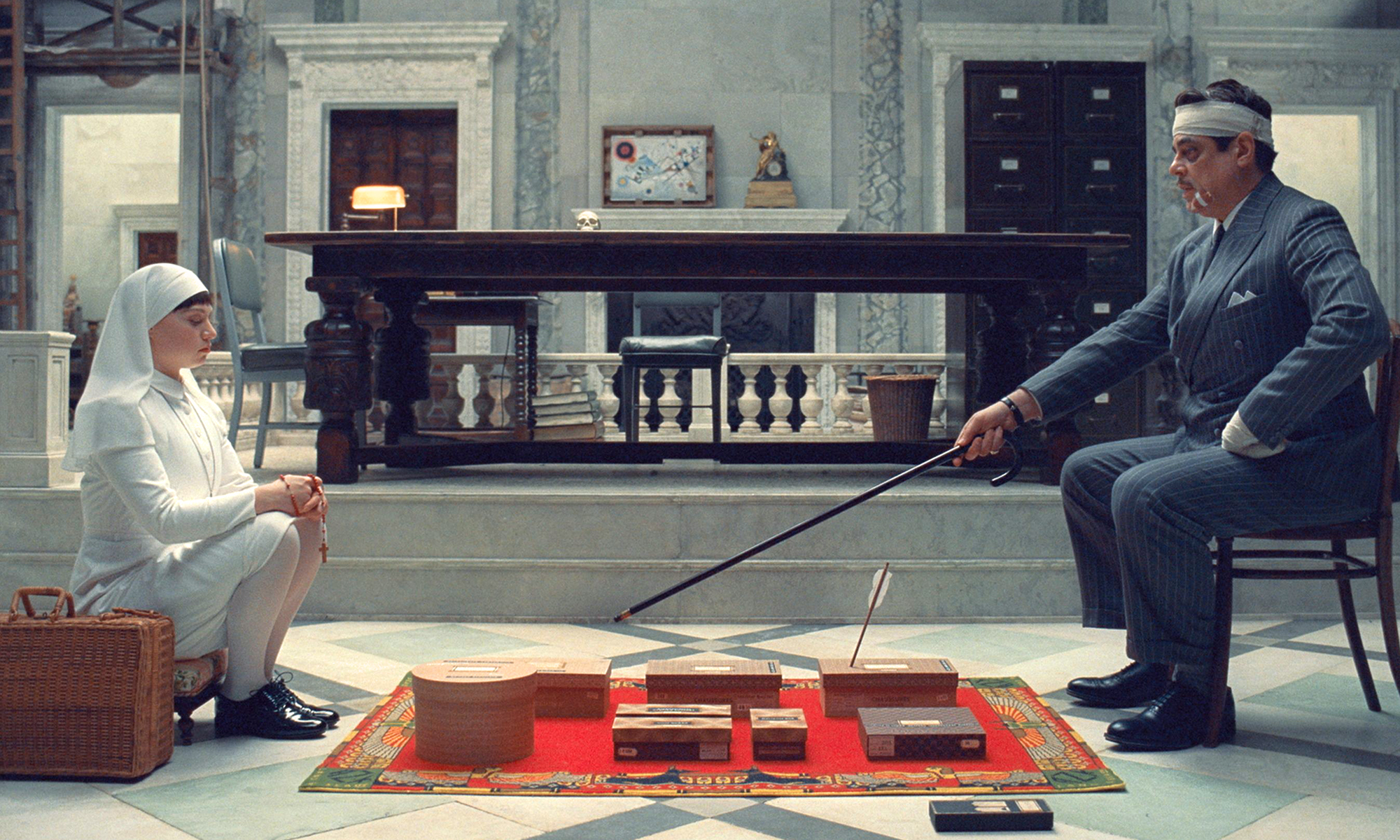
“Myself, I feel very safe.” – Zsa-Zsa Korda
***
Having just turned 55 myself, it’s been helpful thinking the moment through with artists like Wes Anderson and Bill Burr. Consider Tom Cruise’s Mission:Impossible: The Final Reckoning. A stunning film that ultimately reckons with its 62-year-old star’s aging out of action star usefulness. Fellow quinquagenarian Tina Fey’s The Four Seasons series is another GenX-penned story told from this strange new perspective: the end is nigh, and it’s gaining on us.
I’ve felt my own existential dread (first activated during a church basement screening of A Thief In the Night in 1975) settle into a kind of resigned rootlessness. Could be the post-pandemic, post-politics malaise we’re all feeling, but I suspect it’s age-related. Or aging related. My fifties feel like I finally know what I don’t know and have adjusted my expectations accordingly. And yet there is this space … this yawning gap of ugh! I can’t shake.
I don’t fret over Burr’s death drop (it actually seems like one of the better ways to go). More to Anderson’s point, my Phoenician scheme too often finds me trying to close the gap between my life as lived, and the story I want told at my funeral.
Facts are facts: I’m running out of time. Not going to make it. Oh God, what am I to do?
There is always a bit of an ironic detachment to the performances Wes Anderson wants from his actors … a kind of Bill Murray patina spread over his casts like a spell. In The Phoenician Scheme, Del Toro and Threapleton initially keep us at arms’ length, playing everything as it lays. But as the film unfolds, their deadpan performances invigorate. The characters begin to need each other, to actually love each other. Reminiscent of Ryan and Tatum O’Neal’s estranged father-daughter in Paper Moon (1973), the film’s most profound moments happen when Korda and Liesl graft on to each other’s weakness and begin to heal. They get real. Anderson’s frame becomes less formal, more playful. He even allows a little whisper of grace to sneak in via Bach’s ‘Jesu, Joy of Man’s Desiring’ late in the film … which, to that point, relies heavily on Stravinsky’s sturm und drang to drive its score. It’s so beautiful when that cue lands. Sure, you’ve heard that piece of music a million times, but here … ah, such sweet relief.
Chris White is a screenwriter and director living in Greenville, South Carolina. He never imagined Wes Anderson could make a better movie than Rushmore, but then he saw Moonrise Kingdom and now all bets are off.








So good and illuminating Chris. Needless to say I loved the film but you’ve brought out a bunch of stuff I didn’t see.
Thank you, Dave.
This is definitely on my list of summer movies. And now I’m looking forward to it even more.
I have yet to see the film, but appreciate the analysis Chris — and I am particularly intrigued by the idea that this may be Anderson’s most “religious” film yet.
I think there’s something to that opening credit sequence where we have a high angle shot (long take) in which we see Korda sitting in a bath, connoting cleansing, washing, etc., after having survived the assassination attempt. We see nurses entering and exiting from various directions as they minister to and restore Korda’s health. Once the title sequence is done, it is noteworthy, that he looks up right before we cut to the next shot…as though he is looking toward the heavens, toward God…indeed, seeking redemption.
Anderson’s cosmos is a strange one, indeed. I appreciate all of your insights, Chris!
My favorite point of similarity between Anderson’s conception of redemption and the Real, Actual, Biblical Scheme™ is that adoption happens before we can cover The Gap (and we never actually cover the gap, do we?).
[…] I’m getting old. Christopher Neil White, born Wednesday, 20 May 1970 at Knoxville’s Presbyterian Hospital to Joseph S. White Jr. and Linda Ann White (née Friel) of Chattanooga has run slap out of time to achieve the level of career success he craves, the financial standing he longs for, the immortality he’d come to believe was his due. […]