Two others, who were criminals, were led away to be put to death with him. . .One of the criminals who were hanged railed at him, saying, ‘Are you not the Christ? Save yourself and us!’ But the other rebuked him, saying, ‘Do you not fear God, since you are under the same sentence of condemnation? And we indeed justly, for we are receiving the due reward of our deeds; but this man has done nothing wrong.’ And he said, ‘Jesus, remember me when you come into your kingdom.’ And he said to him, ‘Truly, I say to you, today you will be with me in paradise.’ (Lk 23:32, 39–43)
It’s been five years since Martin Scorsese’s sprawling, unforgiving tale of loyalty, The Irishman, was released. The mobster epic scrutinizes the irony in which humanity seems confined to live. We’re moral people who commit immoral acts; we simultaneously perpetuate and escape death; we bless and curse with the same forked tongue. Frank Sheeran (played by Robert De Niro) is the vessel Scorsese uses to capture such paradoxes, another cinematic subject haunted by his vices.[1] Frank inhabits the liminal space between heinous evil and true confession, making progress toward — but never arriving at — a fully devoted Christian life. Despite the lack of outward change one may hope for from a murderous mobster who finally prays the confession, there’s something beautifully Scriptural about Frank’s final moments. Namely, that it’s never too late to ask God to remember you, and he’ll gladly reply, “You will be with me in paradise” (Lk 23:43).
The Irishman unfolds in three timelines: the young Frank’s rise through the ranks of the Philadelphia mob, the middle-aged Frank’s cross-country trip to the tense Bufalino wedding, and the elderly Frank’s recollection of every monumental occurrence in between. Time’s passing is marked by political events such as the Kennedy assassination and the Bay of Pigs Invasion, but one of the more profound ways to view The Irishman is as Martin Scorsese’s administration of the sacraments.[2] The timelines revolve around baptism, matrimony, and penance, respectively.
A low-angle shot studies Frank as he watches his second daughter, Dolores, get baptized into the Catholic Church. His brooding stature accentuates his near-constant expression of disapproval with the world — a hardened but somehow deeply burdened stare, the edges of his mouth perpetually downturned. His first daughter, Peggy (played as a child by Lucy Gallina and as an adult by Anna Paquin), is his primary moral compass, a watchful eye penetrating his callous exterior. Throughout the film, she embodies the conscience viewers find largely imperceptible in Frank’s character. She’s disturbed by his ironies: she finds his attack on the store clerk who shoved her reprehensible and wants nothing to do with Russell Bufalino’s blood-money-bought Christmas gifts. Her compass is only so due-North, however; she is enamored by Jimmy Hoffa, who is no more moral than Frank or Russ despite better presentation. “To her,” Frank recalls, “he was helping people. He was helping them make more money, live better lives. He wasn’t stomping on somebody’s hand.” She eventually cuts all ties with her father. For the entirety of the film, Frank’s daughter occupies a looming moral presence, the voice of the law’s accusation that Frank can never seem to shake.
As Bill Bufalino walks his daughter down the aisle of a packed church, members of the mob are caught in slow motion, turning toward the altar and standing upright in the house of God. The affair emphasizes the mobsters’ vision of the church as a tool for ulterior motives. “In this particular matter,” Frank remarks, “the whole thing was built around the wedding … the wedding was really a peace mission, and everybody kinda knew that.” Jimmy’s grip over the Teamsters Union had slipped; he began causing trouble for Russ and, by implication, Frank, who eventually served Jimmy the terrifying verdict, “It’s what it is.”
Jimmy never arrived at the wedding. In one of the most jarring moments of the film, Frank shot him to prove his fidelity to Russ. (“Look how strong I made you,” Russ firmly reminded Frank when he gifted him an insignia ring.) A harrowing theme of the film is the wages of loyalty, which came to fruition when Frank killed one of his closest companions. In a symbolic sense, Jimmy’s chances of redemption were cut short. Despite his constant strain after control, he was powerless in the end.
The most illustrative moments of Frank’s paradoxical life follow Jimmy’s death. After rumors of Jimmy’s disappearance make the news, Frank calls Jimmy’s wife, Jo (Welker White), to assure her that her husband is going to be alright.[3] Frank stutters and stumbles over his words as if he’s walking barefoot on gravel. Though they look the same as the rest of the film, his downturned face and sunken eyes finally convey the sense that he feels guilt for his wrongs. He simultaneously lies with ease and conveys deep concern. Another irony.
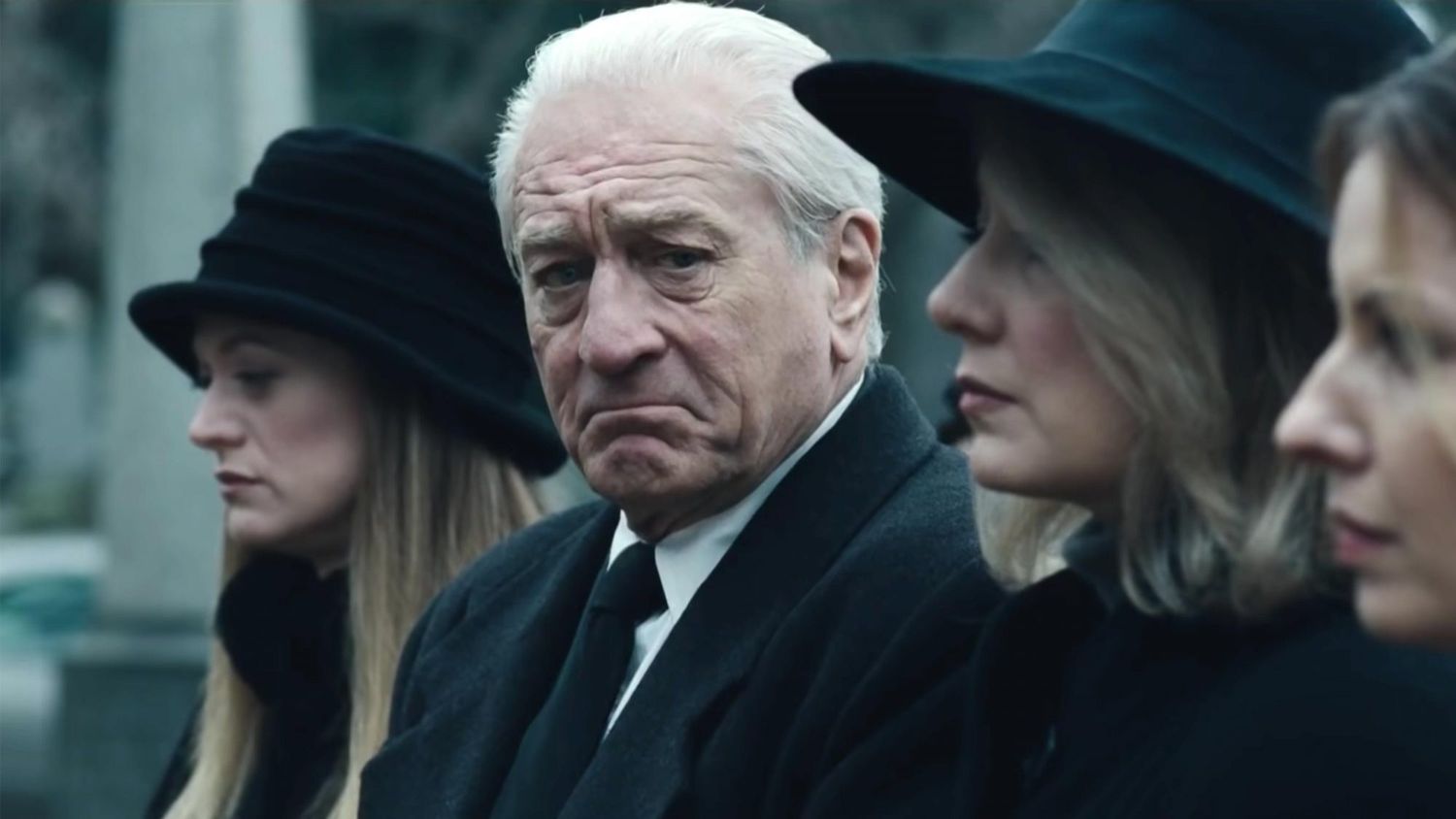
Frank’s story comes to a close during Advent; he’s a battered and alienated man in a nursing home. The assisted living priest grants him absolution after guiding him through a prayer of confession. As the priest leaves, Frank says, “Don’t shut the door all the way, I don’t like that.” With as much stubbornness and calculated precision as his mob tactics, Frank decries the thought that the proverbial door is closing on his chances of reconciliation, both with God and his family.
Perhaps the priest was a bit unorthodox in granting absolution almost immediately after Frank said he felt no guilt for the things he’d done and didn’t show repentance — or was he onto something? He replies to Frank’s conflicted answers (“I didn’t know the families,” then, “What kind of man makes a phone call like that?”) by speculating, “I think we can be sorry even if we don’t feel sorry.” Frank gains new perspective after his second wife, Irene, dies, and he finds himself completely cut off from his remaining family. Though he doesn’t admit it throughout the film, we see Frank begin to feel burdened by the harm he caused his family over decades in the mob.
Frank is forgiven without repentance, offered absolution before he gets his act together. It’s when we’re unwilling to come to Christ that he comes to us. This is the wonder of the gospel, that “while we were yet sinners,” not seeking Christ but callous to our own sinfulness, “Christ died for us” (Rom. 5:8). It may seem tertiary to Martin Scorsese’s three-and-a-half-hour epic, but the search for God is in fact the focus of his career.[4]
In The Irishman, Scorsese delivers a sermon on the Good Thief. Frank is a twentieth-century St. Dismas. Coming to Christ is responding to the lifelong call God has placed on one’s life, whether they are attuned to his voice or not.
Though the film is riddled with violence and pain typical of Scorsese, it may be one of his most hopeful works to date, an epic journey to the realization that redemption is only one prayer away. The beauty of the gospel Scorsese reveals is that no one is too far gone for God. After a long trend of doors closing on men with vices, Martin Scorsese leaves one open.[5] Frank, a death dealer encroaching upon his own expiration, doesn’t know how to address his past, but he does softly repeat the confessional prayer. In the end, he progresses from negative to neutral vis-à-vis religion. I used to think this conclusion was heartbreaking, but I now see that it’s hopeful. A good redemption story is heartwarming, but one about a man’s continued journey to renewal — even if there is no apparent arrival — speaks profoundly to the human state. We’re all works in progress. Though everyone else dies or abandons him, Frank learns in the end that God is there, ready to welcome him home.
[1] My favorites of Scorsese’s prior subjects include Travis Bickle in Taxi Driver (1976), Jake LaMotta in Raging Bull (1980), and Ernest Burkhart in Killers of the Flower Moon (2023).
[2] How fitting that, as we approach the presidential election, I contemplate whether it is best to view this film through a political or religious lens. Such a multifaceted film balances the personal interplay of politics and religion well.
[3] Jimmy’s story in this film and the book from which it was adapted is speculative and largely uncorroborated, though for Scorsese’s narrative purposes this is inconsequential, perhaps even advantageous for the construction of the intimate relationship between the three main characters. See Wilson, Michael. “The True Story of ‘The Irishman’: I Heard You Paint Tangled Tales.” The New York Times, November 27, 2019.
[4] Clear examples are The Last Temptation of Christ (1988) and Silence (2016), but this search is riddled throughout Scorsese’s filmography. See Wilkinson, Alissa. “Martin Scorsese has spent his entire career searching for God.” Vox, November 26, 2019.
[5] Scorsese breaks from trends in films like The Godfather: Part II and Goodfellas to make a stark claim, while marking the end of a distinct mob-movie era. See Chaney, Jen. “‘Don’t Shut the Door All the Way’: On the Ending of The Irishman.” Vulture, January 22, 2020.