This essay appears in Issue 28 of The Mockingbird magazine, now available to order.
When Pope Leo XIV first came onto the balcony to wave at the cheering crowds in St. Peter’s Square, one writer described him as “dressed like Benedict but sounding like Francis.” He wore the red mozzetta Francis eschewed, as well as the traditional red and gold stole. Vatican commentators immediately took note. For many, papal aesthetics signals ecclesiastical politics and theological commitments.
Pope Benedict famously dressed in gorgeous vestments. The press at various points noted a red velvet cap, a fur-lined mozzetta, a watered silk chasuble, his jewel-encrusted pectoral cross, and his red Prada shoes. Pope Francis dressed more simply. He made his first appearance in a white woolen cassock and ordinary black loafers, which were widely contrasted with Benedict’s footwear. His pectoral cross was made of iron, his papal ring silver. But he was no less invested in the symbolism of his vestments than was Pope Benedict.
Pope Benedict meant his splendid dress to arouse desire for God by rendering visible the beauty of the Lord. Beauty, Benedict once proclaimed, can pierce our hearts with longing, discontenting us with our quotidian lives, and preparing us to suffer for Christ’s sake. Pope Francis chose less ostentatious garments because, as he put it, the shepherd should smell like the sheep. He was the heir in many ways to the mid-20th-century Pact of the Catacombs, when 40 bishops from around the world gathered in the Catacombs of Domitilla to pledge themselves to a life of poverty in solidarity with the poor. “We renounce forever the appearance and the substance of wealth, especially in clothing … and symbols made of precious metals,” they wrote. The beautiful things of the church, they thought, had become alloyed with social hierarchy. Instead of challenging the gaping inequalities of the day, liturgical splendors, they feared, reinforced them, sacralized them, even.
Sometimes we like to pit Benedict and Francis against one another and then side with our preferred pope. But on this issue, at least, they both speak to theological trajectories deep in Christian thought: Beauty can accommodate us to the worldly power of the status quo, but it can also call to us, inciting our souls to seek God.
***
It sounds like the start to a song or poem: Kallos kalei. Beauty bids. According to Plato, Socrates proposed that “the beautiful” (to kalon) derives from “to call” (kalein) or perhaps from “the one who calls” (kaloun). So then: Beauty is the one who calls.
I first encountered this idea — of beauty calling — in The Life of Moses by Gregory of Nyssa, a fourth-century bishop who swam in the waters of Platonism. Meditating on the story of Moses’s life, Gregory imagines Moses hearing a divine voice and climbing a mountain to see beauty face to face. At one point, Moses despairs of receiving the encounter he longs for, but he continues to ascend, receiving more beauty, longing for even more. The love of beauty, Gregory surmises, draws the soul ever on, from beauty seen to beauty unseen. The divine voice calls through beauty.
And not just through beauty. Beauty is for Gregory a divine name; God calls as Beauty. Though Gregory never uses kallos kalei, the locution animates his description of the soul’s ascent to the God who is Beauty and bids through beauty.
In the story Gregory tells, Moses does not find the God who is light. Or the God he finds is not like any light he knows. Moses discovers that not even our concept of “light” can contain God, because there is no boundary that marks the limit of One who is infinite. God is the light beyond light, confounding the opposition between light and darkness. God is dazzling darkness, surpassing every boundary and transcending every limit, the light who cannot be contained by light, the Holy Other who is also wholly here. God is the Beauty who outstrips our concepts and casts all creaturely perception into shadow.
Donna Tartt has one way of describing encounters like Moses’s: “Beauty is terror,” she writes in The Secret History. “[W]e quiver before it.” In the presence of the beautiful, we lose control; we are unmastered. Consider the words we pair or synonymize with beauty: striking, stunning, captivating, ravishing, breathtaking, spellbinding, enchanting. Beauty does things to us, violent things even. Gazing at the beautiful requires the strength to be made weak, to be, as Tartt puts it in a vivid string of verbs, consumed, devoured, unstrung — and reborn. She is thinking of the Greeks for whom the powerful attractiveness of beauty, what we might describe as its call, is mixed with aversion. In answering the call of beauty, we make ourselves vulnerable. Perhaps we will be destroyed; perhaps reborn.
***
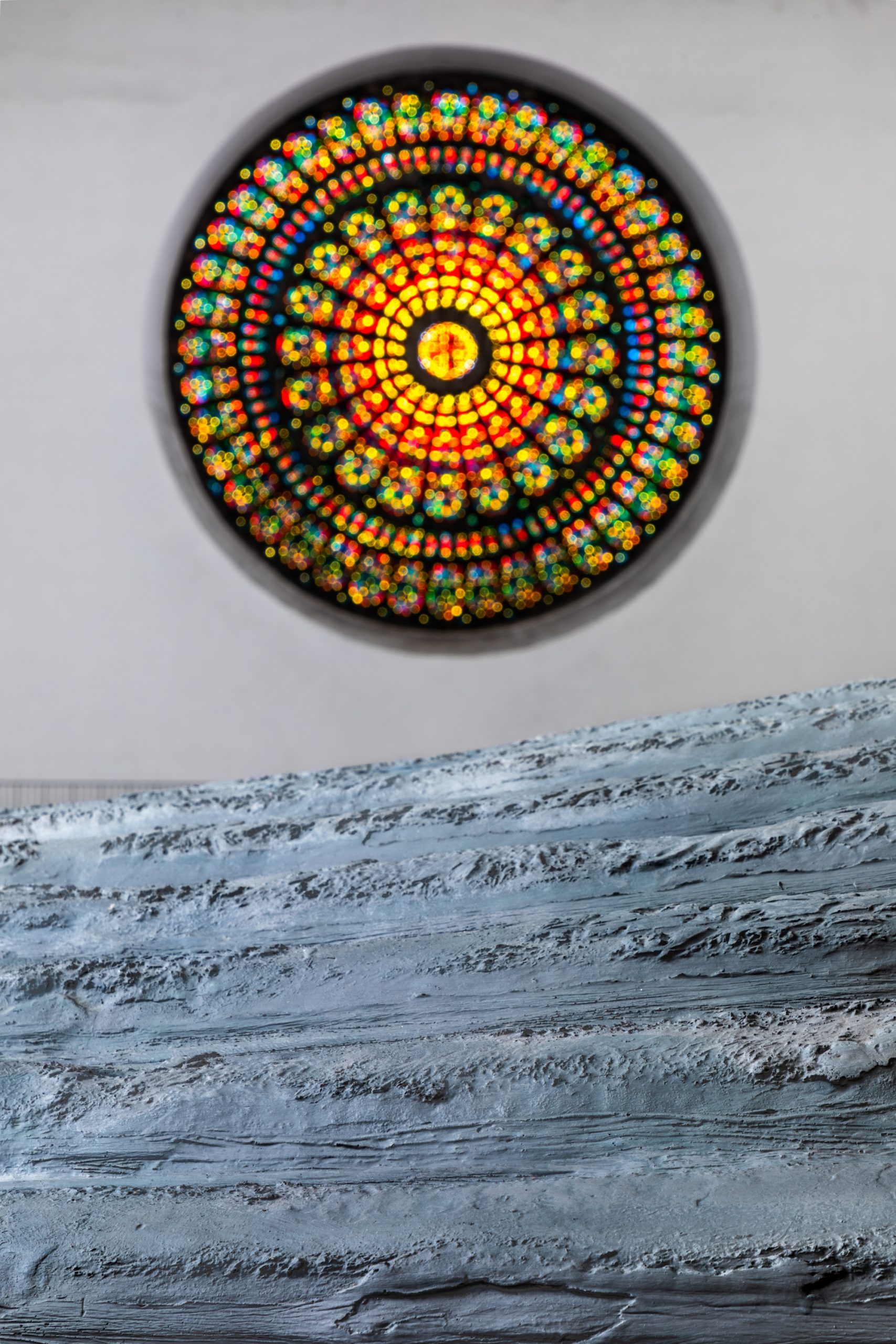
Dietmar Rabich, The Cast Whale Project, 2022. Wikimedia Project.
The fashion writer Arabelle Sicardi also says beauty is terror, but means something different by it. Sicardi means that we are driven by terror to make ourselves beautiful, and that the beauty industry feeds on this terror. Beauty, after all, is a form of power — historically one of the few open to women — and in the pursuit of it and the profits associated with it, we do terrifying things to one another and ourselves. The history of beauty, Sicardi points out, is the history of eugenics, fascism, exploitation of refugees, and violence against persons with disabilities. We perpetrate this violence because we are terrified of not belonging. We fear the diminishment of our agency, social status, desirability, and power. Beauty is a way of securing ourselves in an insecure world, and we pursue it to make ourselves less vulnerable.
Beauty is vulnerability; it is invulnerability. What has happened here? How does beauty inspire such opposite ends?
It is tempting to say that divine beauty beckons us toward vulnerability, while the pursuit of personal beauty is the pursuit of invulnerability. But that’s too easy, too laced with centuries of misogyny in which women were judged for cultivating their beauty, their access to power, even as they were also judged when they failed to embody social standards of beauty. And it’s imprecise. The beauty of one’s person, after all, also has played an important role in Christian culture and history. Think of Dante’s Beatrice, whose beauty bid Dante to the new life, or the countless images and statues of Mary, whose beautiful appearance hails her fullness of grace. Or think of Pope Benedict, who sought to reflect God’s beauty through personal appearance, who even thought such beauty could prepare a person to become more vulnerable. So why, so often, doesn’t it?
***
The Life of Moses is not the only text in which Gregory of Nyssa writes about beauty. In his first homily on the Beatitudes, he takes up the issue of personal beauty, addressing someone he imagines glorying in his youthfulness, in his curls blowing in the wind, in his clothes bright with purple dye and embroidery. “Yes,” he writes, “perhaps you look even to your shoes, carefully polished with blacking and smart with extravagantly stitched lines.”
Gregory speaks of the vain and prosperous youth in the same breath as he imagines the occupant of an imperial office strutting around, his ego puffed by shouts of acclamation. These characters confuse their roles with their persons. They think their status or beauty speak to who they fundamentally are, but for Gregory, a person’s identity is not found in gorgeous clothes or an impressive job. It is found on the burial grounds, in the grinning skulls stripped of flesh. We see our death, and we see our equality. None of us is sovereign over life and death.
Most fundamentally for Gregory, we are creatures who cannot sustain our own existence, and that utter dependence on God for our life speaks to an egalitarianism. The power we wear through our personal beauty or occupation is just a costume we don while performing our part on the stage of life. Our call is to perform these roles in such a way that they reflect the true equality of creatures. Then, at the end of the day, we hang up our costumes. If beauty is power, what do we do with symbols of power? We remember our death, our life, our equality; we use them to enact rather than deny our vulnerability.
Beauty is terror. To face it is to face our inability to master death or life or even our own belonging. To face it is to live in a way that honors our death and life and our longing to belong.
After his official introduction and first performance of duties on the balcony, Pope Leo XIV switched out of his splendid vestments to a simple white cassock and moved among the people.
***
If beauty is a form of power, when does its power insulate us from its call? Gregory worried about that. He worried especially about words. Beautiful rhetoric can call a person to wisdom, and it can also deceive.
For Gregory, beautiful words should call you up the mountain, where you will be dispossessed, vulnerable in your encounter with the One who is Beauty. And also: beautiful words should call you down the mountain, where you are dispossessed and vulnerable in your meeting with the dispossessed and vulnerable. Some of Gregory’s most powerful invocations of beauty occur in the sermons he gave during a time of famine and disease, as he supported his brother St. Basil the Great’s project of building the world’s first hospital. After speaking to them harshly, after pleading with his congregants to attend to the realities of suffering with the eyes of God, he says, “For it is beautiful [kalon] for the soul to provide mercy for those who are in need.”
As with other forms of beauty, there is an aversive quality to mercy. For in the mercy Gregory commends, both the hungry and the greedy are dispossessed of their habits of negotiating the world. Vulnerable and exposed, they come together in a meeting dark and dazzling to worldly logic.
This is what Gregory wants his own beautiful words to do: to call us to Beauty, to the one who calls. And in speaking words that call, Gregory focuses not only on the aversive aspects of beauty but also the diverse sites of its call — the way the afflicted, for all their bodily suffering, bear the face of Christ, and the way both the well-fed and the hungry bear the image of God. His beautiful words call us to that personal beauty, which calls to Beauty Itself, which calls us to the beauty of mercy. Kallos kalei.
***
Beauty can enchant us to serve the status quo. It can distract us from the cries of injustice. Pursuing beauty can be a way of pursuing invulnerability. But to actually listen to beauty’s call is to make ourselves available to the terror of beauty, the way it undoes our categories, our habits, ourselves. It arrives apart from our own merits or efforts, unbidden but bidding, and does something new.
How do we know when we are answering beauty’s call and when we are only using beauty to make ourselves more powerful? The question cannot be entirely answered in the abstract. Popes may legitimately disagree about what shoes they should wear, and Christians may have radically different but still faithful liturgical styles and levels of ornament. But one way we can attempt to answer the question in our particular context is to ask another: Are we responding to a given instance of beauty by ascending to the Lord and drawing near the dazzling darkness where we lay aside our concepts to receive divine presence? And are we responding to this beauty by descending to the Lord, drawing near others in spiritual and corporeal need through acts of mercy that upend worldly habits of negotiating our life?
When Beauty calls, it asks us to surrender our categories, our consolations, our ego. It demands our very life. But it asks so much of us so that it can give us more than we could conceive. The surrender is not the condition for the gift but simply the other side of what it means to receive it. For what is beauty but a mode of the grace of the God who is Beauty, arriving in our lives unbidden and bidding? The arrival can be terrifying, and we may respond to our terror by attempting to claim it for ourselves, to secure our position in the world and so make ourselves invulnerable to the forces that would undo us. Or we can face the terror that is beauty, and enter the dazzling dark where we may be consumed, devoured, unstrung, and reborn.