In 2007 the Pilgrim Press published a book by Paul Nixon with the great title I Refuse to Lead a Dying Church. Not only a great title, an attention-grabbing one in a time when so many churches are dying. A second revised, post-pandemic edition came out recently.
I love the verve and chutzpah of the title. The defiance as well. I get the idea. Too often, churches and clergy roll over to forces of stagnation and entropy. Decline is rationalized, demise deemed inevitable. Many mainline denominations now offer an ecclesial version of MAiD (Medical Assistance in Dying), standing ready with “legacy programs” designed to capture a church’s remaining assets and experience “death with dignity.” Perhaps that’s the best that can be done in some situations.
But Nixon’s book was a call to resistance, to not go gently into the night but to rage against the darkness, against death, to rise up in defiance. I get it. I applaud it.
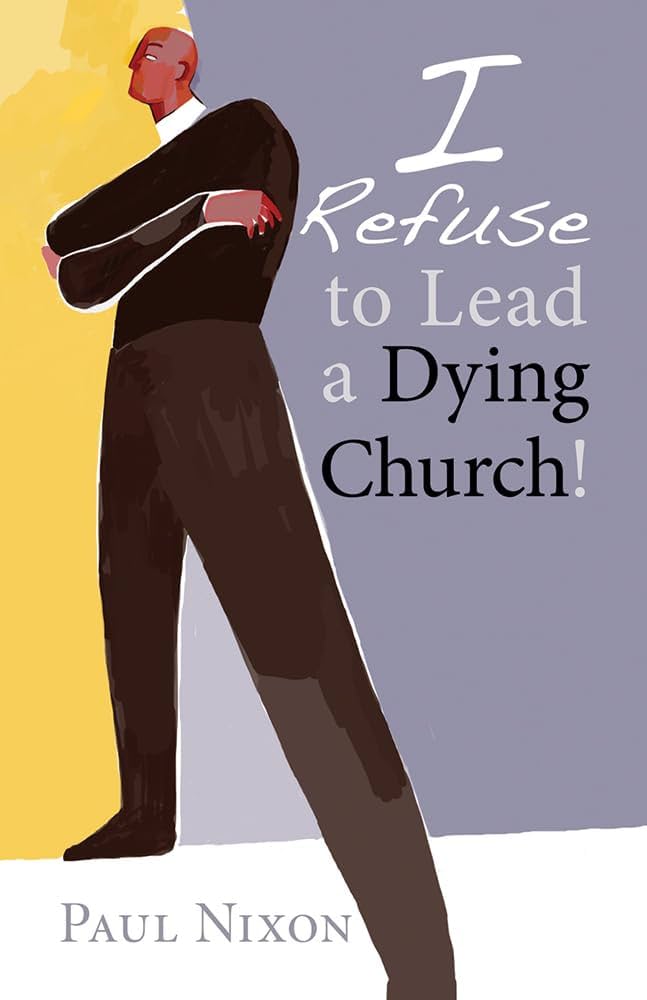 And yet … and yet, we are all, our churches are all, dying. Moreover, it is only as dying churches that we can truly live. For in dying, we are raised to new life. “It is no longer I live, but Christ who lives in me,” wrote Paul to the Galatians. “And the life I now live in the flesh I live by faith in the Son of God, who loved me and gave himself for me” (Gal 2:20).
It is only in dying to the self-centered self that we live.
So, the defiant word, I Refuse to Lead a Dying Church, may invite a holding on, an assertion of our human will and resolve when life is found in dying to that very grasping, to such clinging, to the willful assertion of ourselves. I respect the impulse, the drive behind Nixon’s book, but I also suspect that the title has the subject wrong.
That subject is “I.” “I refuse to lead a dying church.” The subject there is us, we ourselves, our self, our ego and institutional self-image. What if it is all this to which we need die, to be crucified with Christ, that we may truly live? “Remember not the former things, behold I am doing a new thing.” This is the word of the Lord, said the prophet Isaiah (Isa 43:18). There is dying there. A dying to what has been, which may once have served us well, which once worked just fine. But no more. Not now.
The other problem with Nixon’s title and the first person pronoun is that it’s apt to cause some clergy to put too much pressure on themselves, to think that if the church grows it’s their doing, or if it declines it is their fault. A lot of clergy are already staggering under that load and don’t need more burdens.
Resurrection is God’s work. It only takes place when we are at the end of our own resources, schemes, dreams, and pretensions. “At the end of our rope” as the saying goes, “is where God’s office is located.” New life occurs not because we assert ourselves with renewed determination and new vigor, not because we have finally found “the right minister” or the right plan, hack, or technique, but because we surrender ourselves to the God for whom “all things are possible.”
While I doubt it was Nixon’s intention or counsel, I Refuse to Lead a Dying Church, or as the title of companion volume puts it, We Refused to Lead a Dying Church, the idea is conveyed that it is really on us. If we are dying, it is because we have not worked hard enough or have not discovered effective strategies for growth.
But what if we are dying not for lack of self-assertion but because of it? What if life is found not in resistance to death but in letting go? Letting go and letting God, to borrow a phrase from AA?
Sometimes churches do simply die or close. It happens daily now. There’s some sort of bittersweet celebration of their life and a disposition of their remaining resources to a denominational fund or for a low-income housing project on what was once the site of a church.
But there’s another way to die. We can die in the Lord, unto the Lord. We can die to our self-centered, self-focused, survival-focused self and rise to utter and complete reliance upon God in Christ who sets the captive free, who gives sight to the blind, and who raises the dead.
We do not proclaim a new strategy or technique for renewal or growth. We proclaim Christ and him crucified. We proclaim God who chose what is foolish in the world to shame the wise; God who chose what is weak in the world to shame the strong; God who chose what is low and despised in the world, things that are not, to reduce to nothing things that are, so that no one may boast in the presence of God (I Cor 1:27–29).
The church that declares such faith is a dying church. Ours is not a human potential movement. We are aware of our own fragility, our own mortality. Such a church is dying to the powers of this world and to its boasting — from which churches are hardly exempt — to be raised to a new life proclaiming “the power of God who gives life to the dead, and calls into existence the things that do not exist” (Rom 4:17).
Only a “dying church,” that is, a church that knows its utter dependence upon this God and not upon its own reputation, past greatness, resources, endowed funds or programs, can truly live.
I have visited and counseled with more than one dying church in my time. Most understood themselves to be dying because they lacked sufficient resources — members, money, programs. “If we can just get twenty-five new members or fifteen new pledging units, we will be okay” is the kind of thing you are apt to hear.
One near-death church I visited was, however, reviving, newly alive. When I asked the pastor about what they had done, she spoke not of what she or they had done but of what God had done and was doing. It wasn’t about “what we are doing.” It wasn’t about the pastor’s determination to not lead a dying church. It wasn’t about “our strategic plan” or our mission statement or our great preacher. It was “Come and see what God is doing.”
Why would I want to serve a dying church? Because at least some dying churches may discover in their weakness God’s power. Because some dying churches may discover in their need God’s help. Because a dying church may discover that “my grace is sufficient for you, my power is made perfect in weakness” (2 Cor 12:9).
“For it is in dying, that we are born to eternal life,” prayed St. Francis. We are born to eternal life, which isn’t a quantity but a quality of life, not by our striving, our fevered efforts, our achievements, or our splendid resources but by dying. In death, life.
I want to serve a dying church.