




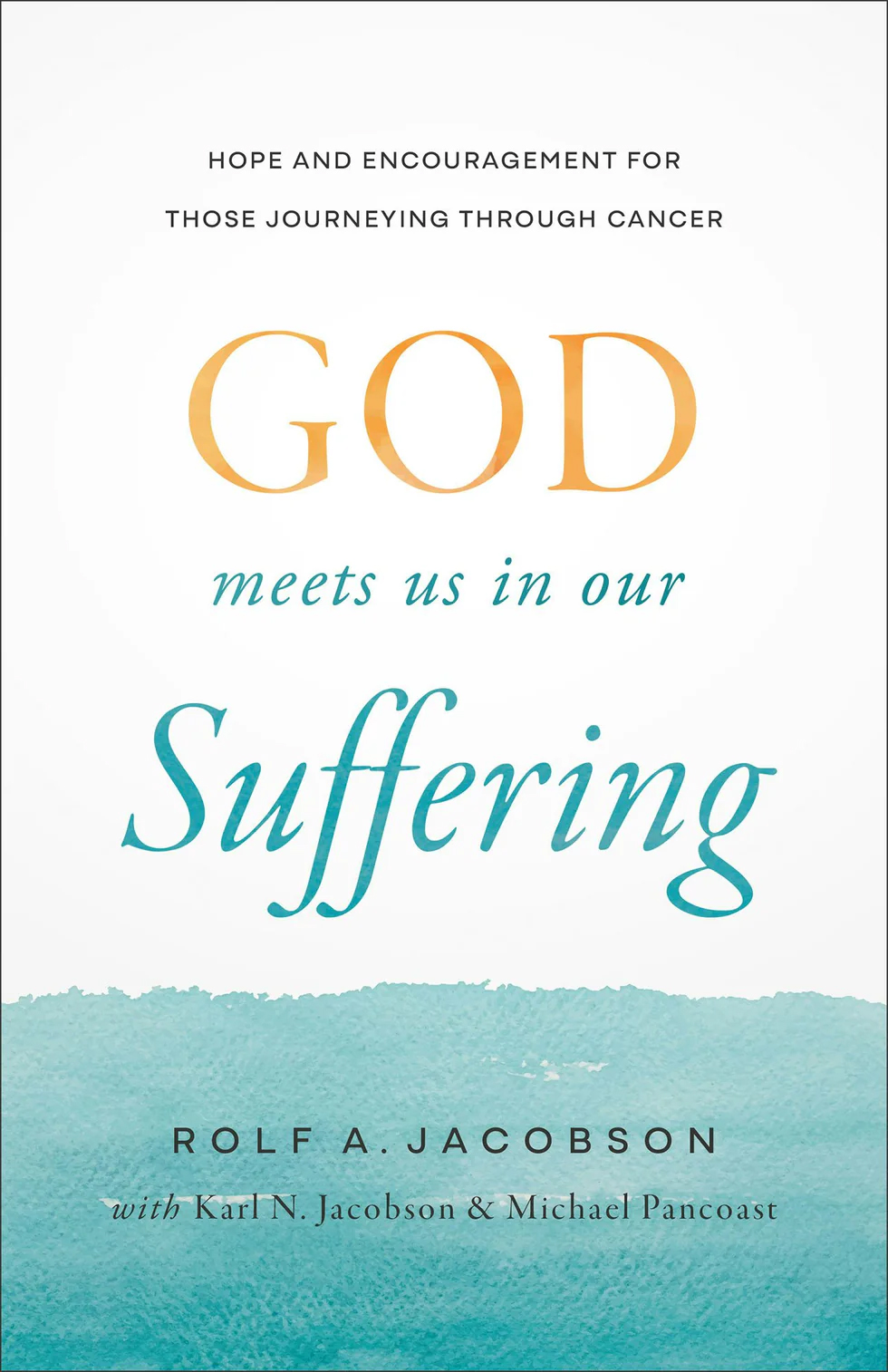
When someone we love is going through something hard: a scary diagnosis, a death, a divorce, a job loss, we want to fix it. But in reality, we know we can’t. That helplessness makes us even more nervous about showing up. We don’t want to make things worse. So what is there left to do? “Admit that you may not want to go, go anyway, and bring Cheetos.” This nugget (chip? puff?) of wisdom comes from Luther Seminary professor Rolf Jacobson, who along with his brother Karl and their mutual friend Michael Pancoast (all three Lutheran pastors with firsthand cancer experience) recently wrote a wonderful book called God Meets Us in Our Suffering.
Rolf lost both of his legs to cancer as a teen, and before this book was finished also lost his brother and co-author Karl to meningitis. When he says God meets us in our suffering, he’s not making theoretical arguments. This personal and pastoral book comes out of real pain and finding God in the midst of it.
 The Cheetos idea comes from a time when a pastor from Northern Minnesota brought his confirmation class on a field trip to the Twin Cities, including a stop at Luther Seminary. Rolf was talking to these kids who were respectful but largely uninterested (they were fourteen and fifteen years old, after all). He noticed one girl sneaking Cheetos from a bag she had hidden under the table, and this gave him an idea.
“How many of you are fifteen years old … or hope to be fifteen years old someday?” Rolf asked. They all raised their hands. He told them that when he was fifteen, he developed cancer and had to have his right leg amputated. Then the cancer spread, and he eventually lost the left leg too and had over twenty surgeries in high school alone. He told them he had a wonderful, close group of friends. Then he asked, “During those years, how many times do you think that my closest group of friends came to see me in the hospital after surgery?”
The girl with the Cheetos looked up, smiled, and said “Every day!” Many of the others nodded. Rolf went on: “Almost never.” The quiet turned to shocked silence. “Do you know why?” he asked. “Because they loved me and didn’t want to see me in pain.” Now he had their attention. He continued:
“Understand why,” I said. “If you are a normal human being, the intense, psychic pain of another person will repel you — it will push you away. It pushes me away. None of us want to be around those who are in pain — we don’t know what to do, and we don’t know what to say. So here is what I want you to do when one of your friends is in deep pain. When one of your friends has a grandparent die, or has parents get divorced, or gets cancer, or is injured in a car accident, this is what I want you to do. First, admit to yourself that you may not want to go. There is nothing wrong with you if you feel that. Second, go anyway. Go anyway.
Then, looking at the girl with the Cheetos, I added, “And bring Cheetos. Say to your friend, I’m here because I love you. And I brought you some Cheetos. Can you do that?”
They looked around the room at each other … and they nodded.
People deal with tragedies in different ways. Some try to fix as many things as they can. They want to contribute. They want to be helpful. Something bad has happened, and they scramble to soften the blow. Others are overwhelmed and can’t think of a single way they can be helpful. They are paralyzed, shrinking back and withdrawing altogether. Everything is too big to handle, too sad to be helpful. However different their responses, they are both responding to the same law: “Thou Shalt Be Helpful.” One feels accused and wilts, the other fulfills all righteousness.
But our showing up isn’t meant to be the thing that makes everything better. This applies to both the person who is anxious to the point of paralysis about how to help and to the person who rushes into this kind of situation at full force and quickly burns out trying to save their loved one. Those in a crisis don’t need flowers to cheer them up; they need a hand to hold. They certainly don’t need someone else trying to fix them. They just need you. No pressure, just presence. We show up, and from there, trust that God meets us there too.
In the book, Karl calls it a kind of “sacrament of showing up.” We don’t need to rectify anything or redeem anything. But when we show up, we carry the grace of God into the room with us. We tend to the sufferer rather than to their affliction, remembering their humanity rather than their diagnosis. It’s a grace to be seen as a person, not just a condition.
When Jesus felt the woman with the bleeding problem touch the hem of his garment in a crowd, he stopped. Even though he had other places to be, he didn’t just heal her and move on. After the miracle came the gospel: he asked who touched him, found her, saw her, spoke with her at length. This is the good news in microcosm: God showing up, taking on flesh, and entering into our suffering to the point of death. We’re not being asked to go that far. We’re just being asked to show up and tend to the sufferer and attend to their humanity — with nothing in our hands but a big bag of Cheetos.








Thank you for breaking it down to a manageable action. Just go, and bring Cheetos and the grace of God comes into the room…
Wow, what a great post. So true about the Cheetos. As a hospice nurse I was always struck by the quantity and quality of friends who came to the funeral: soooo many people, “his friend of 50 years,” “their neighbor,” “his longtime boss,” “his workout buddy,” but they were people I had never seen or heard about in the last 6 months of his life. Because, as you said, it’s just so hard and a little scary.
And in fact, the Cheeto thing is actually the best to show up with , or just some silly something, because if you show up with the ginormous gift basket or a showy floral bouquet, it’s sort of like saying welp, this might be it, so I wanted to get you something AMAZING because you probably won’t be seeing many more flowers or baskets of gourmet goodies… and it’s formal and precious, when really all that’s needed is some Cheetos and a funny story.
When Jesus asked “who touched me?” It’s similar to when God asked Adam “where are you?” He is inviting a response, he’s drawing people to himself. During grief it’s an invitation to just be present.
Wow, this is beautiful! I needed to see this.
Soooooo Incredibly Good!!
“Go”…without the “d”!
Touching! Like the incarnation and the miracles and the sacraments. Thanks Joey.
This story reminds me of a night in ICU that I spent as a heart patient whose procedure landed me where I did not think I would end up. A good friend I had been mentoring came by to see me and brought me what really helped- not cheetos, but information about my beloved 69 Pontiac GTO, which was my project he was working on for me. In the midst of tubes and IVs and questions that had no answers right then, he told me of what was next on the car list. We didn’t talk about the hospital at all. Because when I got (not if), this was next. And I loved him for it. So, no cheetos, but “Geetoes”, I guess. It worked. I’m still here, as is my GTO!
This is terrific. When our daughter died a young friend brought over TP and Kleenex because he thought we would have lots of food but perhaps a shortage of these supplies. We all got a laugh out of it…and a few tears in response to his thoughtfulness.
So very helpful. Thank you. My husband recently experienced a health crisis that led to a hospitalization and in-patient physical therapy stay that lasted a full month. As his caregiver, I was bombarded by friends asking “What can I do? How can I help?” Common questions, yes, but so unhelpful. They can feel like demands, like one more thing I’m expected to do when I am already overwhelmed and extremely anxious. The friends who were helpful, powerfully so, simply got in touch and said things like “I’m bringing you lunch at the hospital today,” or “Can I bring you a quiche when you get home tomorrow evening,” or “I’m coming to see you at the rehab facility tomorrow. What’s a good time and what’s R’s favorite treat.” “I’m setting up a meal schedule for when y’all get home from the rehab stay.” They took the initiative and offered not only presence, but some gift of care for the caregiver as well as the one suffering ill health. In addition to Rolf’s superb counsel to “Go. Just go,” I add this plea. If you sincerely want to show you care, PLEASE don’t ask those in crisis what you can do; just do something! Offer something that requires nothing of me, as a stressed-out and exhausted caregiver, other than a sigh of relief and a thankful “yes” — or an equally thankful “today’s not good; can I have a rain check on that.” Extend yourself rather than asking those in duress to expend energy we don’t have.
I’m grateful to report that my husband is recovering well now and I’m catching up on thank you notes to my thoughtful and generous friends. To all here, I say “GO now and DO likewise.” Peace and blessing….