




1. First up this week, Andi Zeisler’s reflections on purchasing a planner uncover a surprising amount of human pathology — and also hope. It started when a woman named Kara had to buy a new planner after her old one got wet in January. She thought about simply replacing it but then decided she might need a bigger one. So she explored her options:
Two weeks later, she hadn’t found a replacement. “I got stuck in the rabbit hole. I started watching comparison videos and setup videos and all this planner stuff I didn’t know existed.” The choice was overwhelming, she found, but also alluring: “I never thought about needing a planner system, but then it occurred to me: Maybe it was exactly what I needed.”
Consumer culture sometimes feels Kafka-esque, where a simple buying decision suddenly becomes a high-stakes avenue of self-expression, self-discovery, even self-reformation. Among the billions of choices, maybe The Perfect One will solve everything. Turns out these dynamics are intensified in the planner subculture of the internet, where systems of organization become bizarre proxies for self-optimization across every domain of life:
Plannerworld comprises everything having to do with planners on every form of social media. “Plan with me” videos on YouTube let you watch, from the creator’s POV, the “setup” of a new weekly spread, a meticulous process that involves blocking out parts of days with washi tape, filling out weekly habit trackers, writing reminders of people to call and things to remember […]
If you spend a little time in Plannerworld, you’ll know your A5s from your B6s. You’ll develop strong opinions on paper weight, vertical vs. horizontal alignment and whether the week begins on Sunday or Monday … You might be convinced there’s a planner that can change your life, one that is perfect — that will make you perfect. You just have to find it.
It’s easy to laugh at the excesses here — or would be, if I hadn’t brought this same attitude to mechanical pencils, socks, coffee-brewing systems, mindfulness practice, sanctification paradigms, and the Grand Northern Conspiracy, among others I’m too embarrassed to confess. On the one hand, these represent yet another example of corporate marketers and influencers manipulating us by promising that control of our uncontrollable lives lies with a product or “system” available for purchase. But other angles offer more pathos: Women especially are often being asked to handle an astonishing amount of life administration for work, playdates, medical appointments, travel, etc. If we desperately need tools to help manage those demands, that need is earned. And there is something more, too, a sense that there must be more to life, that if we could only control the mundane, we might find a certain beauty in it.
The feminization of planners is, like so many other consumer products marketed to women, a series of mirages. They join the cosmetics and hair products and workouts and meal plans whose siren songs constantly beckon: This is the thing you’ve been looking for. A friend of mine remembers a specific moment of clarity: “I was agonizing over trying to identify the perfect planner. And the person I was with said maybe the perfect can be found in the consistency of always using the same one, never wasting the time to see if there’s a better one out there. She was right.”
I share this bit of wisdom with Kara, who receives it with a slight grimace. “I just started buying two and returning one. I know it’s not about the planner.” And yet, there will always be that mirage, the planner that shimmers on the horizon, always out of reach.

2. Freddie deBoer this week tackled the question “Why are so many people who have checked so many boxes of late-capitalist meritocratic success such wrecks?” He focuses on millennials, but the dynamics he charts end up casting a wider demographic net, and they have a lot to do with judgment and love:
Success in elite educational and professional milieus increasingly depends on an almost obsessive attunement to other people’s judgments, shifting norms, and invisible rules, so the habit of self-surveillance never switches off […]
The oversocialized person does not merely follow rules; they experience rules as moral absolutes and violations of those rules as deep personal failure. They feel guilt, shame, and anxiety not only when they hurt others but when they imagine (often incorrectly) that they might have violated some invisible, constantly shifting social code … The oversocialized become slaves to the rules themselves rather than to the ultimate intent of the rules, which is the human beings on the other side of those rules […]
[Millennials are] a generation of people who apologize when someone else bumps into us, a generation that compulsively rereads sent emails for unintended tone crimes … Educated creative class Millennials do not experience social life as a series of shared rituals and negotiated expectations; we experience it as a minefield.
Those problems, it turns out, are supercharged by social media, which “collapses context, audience, and time into a single, ever-present tribunal,” with the resulting “psychological posture [of] permanent self-monitoring.” Normally one might expect such anxiety to resolve into simple conformity to a set of social norms: Move back home, get involved at the church or Rotary, take up golf or pick-up basketball, get into smoking meats or building things with wood. But the very range of options for self-expression destabilizes such refuges:
Be anything, says the motivational Instagram account! Define success for yourself, says the best-selling self-help book! Chart your own path, says your mother in a text message! That all might sound liberating, but it’s actually exhausting; when nothing is prescribed, everything is a choice, and every choice is a referendum on your worth. At the same time, while the big questions of life are radically underspecified, the small questions of behavior are overregulated. We have endless rules about language, tone, sensitivity, and symbolic alignment, many of them implicit and contested, all of them morally freighted […]
A generation can be both norm-starved and rule-saturated at the same time, and that this combination produces endless anxiety, not virtue, certainly not compassion […]
If Millennials are to escape this trap, it won’t be by discovering the perfect set of rules or the correct posture toward every conceivable social interaction; you can’t overthink your way out of the pain of overthinking. If we escape, it will be by relearning things that oversocialization erodes: the ability to tolerate disapproval, ambiguity, and the ordinary friction of human life… the social world, despite everything the internet tells you, is messier, looser, and more forgiving than your anxiety allows you to believe.
That’s a pretty good diagnosis; “every choice is a referendum on your worth” is an inflection on the paradox of choice that highlights our need to find meaning and value independently of the choices we make — perhaps even despite them.
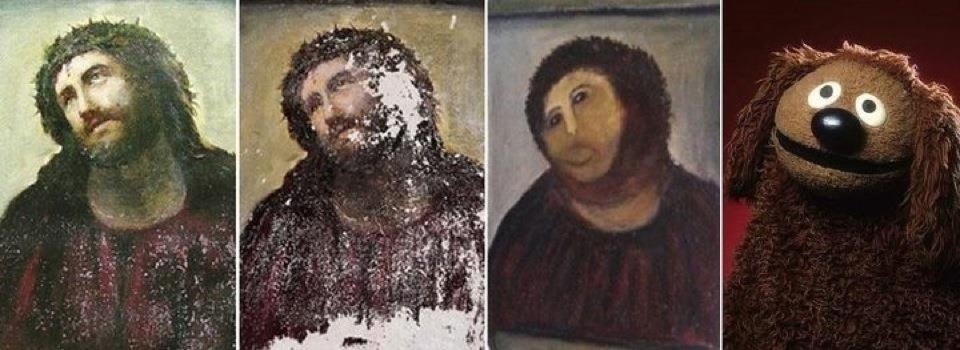
3. When our best-intentioned choices take us off the rails, we are likely to find a place of encounter with the God who brings life from the dead. The winding and unpredictable ways of the Holy Spirit were highlighted by the life of Cecilia Giménez, a woman from Borja in Aragon and the subject of an obituary from the Economist this past week.
An octogenarian widow and full-time caregiver for her adult son, Giménez worked at a local bar and was devoted to her local parish. In particular, she adored a deteriorating fresco of Jesus called “Ecce Homo” that had been painted by a Zaragoza art professor around 1930. As an amateur, she undertook to touch up the fresco from time to time, seemingly with the tacit approval of her parish priest.
Around 2012, she decided the fresco needed a more complete restoration and set to her task in earnest, repainting the tunic and the broad outlines of Jesus’s “sad lovely face.” She then paused for a two-week vacation, but before she could return to finish it, people saw it, concluded she had botched it, and barred her from further work. The moral outrage spread, and around the world, newspapers, network news, and Internet commenters derided her mercilessly. Wags redubbed the work “Ecce Mono”—behold the monkey. Beaten down by judgment and shame, she took to bed and started losing weight.
Providence had other plans:
Not so long afterwards, a wonder occurred … It was simply some flowers, and a card with a nice message. More came. Then visitors began to stream into Borja, not to torment her but to see her painting for themselves. In the first year 40,000 came, and in the years following the figure still settled at 15,000-20,000. (In earlier years 5,000 had been the norm.) The church charged one euro for entry at the start, soon raising it to three, and set up a shop selling “Ecce Homo” t-shirts, mugs, pencils, fridge magnets, flash drives and wine. The revenue helped both the Santuario and the Sancti Spiritus Hospital for impoverished elderly folk. Although the immediate talk in 2012 had been of restoration or plain painting over, even the artist’s family came at last to accept that Cecilia’s version should stay. It was such a boon to Borja that it could not possibly disappear […]
Cecilia Giménez imagined her portrait was suffering Jesus, so it was; and the miracles it wrought in Borja were surely firm evidence of that.
Giménez’s Jesus “had no form or majesty that we should look at him”; he “was despised and rejected by others” (Isa. 53), and she was despised and rejected with him. Her Jesus, arrested mid-restoration and held up to the world for mockery, was not what she had planned or attempted herself but something given fortuitously — and gratuitously. Perhaps “Ecce Mono’s” (and Giménez’s) metaphorical resurrection in public opinion shouldn’t have come as such a surprise.
4. The reception of Ecce Homo/Mono may be a case of reason (judging by classical standards of artistic beauty) getting too far ahead of the emotions, which were captivated by the work despite its despisers. Over at the New York Times, David Brooks proposes a more positive role for emotion, rather than pure reason, in thinking about human decision making. Brooks cautions against the “charioteer fallacy,” which holds that reason is like a wise charioteer trying to govern the wayward, unreliable stallions of emotion and desire. Drawing on neuroscience, Brooks proposes an alternative view of the parts of our brain as a “swirl of starlings”:
This chariot metaphor rests on an overly positive estimation of the power of pure reason and an overly negative view of the passions. The fact is that your emotions are not primitive and dumb. Positive emotions encourage risk-taking. Awe encourages you to broaden your focus beyond your narrow self. Sadness encourages you to change your way of thinking.
Your desires are not dumb, either. They tell you what is worth valuing and where you should go […]
Some people are so misled by the charioteer fable that they don’t cultivate or use all their faculties. They are so smitten with their own high intelligence that they don’t pay attention to their own emotions and desires, or to the signals their guts are sending them […]
The conscious mind writes the autobiography of our species and assigns itself the leading role. But the view of humans as swirls of starlings shines proper attention on all those deeper processes we should rely on every second, even though they may emerge from underneath the waterline of conscious awareness.
With a few disclaimers about low anthropology and mice riding elephants, Brooks’ more holistic view of the person, which neuroscience seems to support, is a helpful corrective. That we aren’t as governed by reason as we often assume is fundamental to any Christian anthropology; although those of us who follow Luther often read the role of desire in primarily negative terms (i.e., as a bent toward self-justification), there’s perhaps something more positive to glean there, too. A person, like a flock murmuration of starlings, is a mystery, and from that can emerge both inexplicable evil and uncoaxed beauty. In a world seemingly ever-more governed by organization, regulation, explanation, engineering, and technique, the uncharted depths of the human person and the strange promptings of intuition are potent sources of bewilderment, surprise, and delight.
5. When Christianity loses sight of those depths and becomes yet another instrument for producing individual or social good, it declines. At 1517, Russ Lackey and Mark Mattes chart this dynamic in modern American Christianity and propose an alternative:
Over the course of the twentieth century, American religion came to be understood primarily as a source of moral guidance and personal support. Religion was good insofar as it helped people be ethical, cope with life, raise decent children, and stabilize society. Prayer, worship, doctrine, and tradition mattered mainly as means to those ends.
Once framed this way, religion entered a crowded marketplace. Families, schools, therapists, coaches, and social institutions could offer similar goods — often with fewer demands and greater flexibility. […]
When religion is judged primarily by usefulness it places itself on a curve of performance. And anything on a curve can be surpassed.
The gospel, however, does not belong on that curve.
The gospel does not exist to make people happier, nicer, or more functional. It announces something far stranger: that God justifies the ungodly. It declares forgiveness not as therapeutic reassurance but as a verdict spoken over people who cannot secure it for themselves.
The gospel is that rarest of things: a word from beyond and external to ourselves. Perhaps it’s not the worst thing that, when we domesticate Christianity to just another technique or worldly religion, it withers — almost like a self-destruct mechanism when a precious artifact is misused.
Turns out that many of the New Age attempts to seek transcendence or re-enchantment founder in the same way, by becoming vehicles for self-actualization. Eventually, the moral standards that seems to promise life bring frustration and disappointment:
What kind of transcendence is being offered and at what cost?
Many contemporary forms of re-enchantment share a common structure. They promise depth, healing, or purpose, but only on the condition of effort, alignment, authenticity, or progress. One must choose wisely, practice faithfully, optimize consistently, or live sincerely enough. The path may be therapeutic, spiritual, political, or technological, but the logic is the same. It is the logic of the law.
In Christian theology, the law is not merely a set of rules. It is any framework that tells us what must be done in order to be whole, worthy, or at peace. The law can inspire and motivate. It can even console for a time. But it cannot forgive. It condemns.
The gospel speaks a different word. It announces not a path of ascent, but a way of mercy. God meets us not at the height of our striving, but in the depths of our failure. […]
The future of Christianity will not depend on reclaiming relevance or rebuilding cultural dominance. It will depend on the church’s willingness to gather people, speak ancient words, and proclaim grace to a world exhausted by the endless work of trying to be enough.
Amen.
Re-enchantment, anyone?
6. A lighter week for humor, but Reductress’ “How to Keep Your Home Guest-Ready By Never Hosting Anyone” strikes a chord, perhaps especially in the young families cohort; as does the Haven’s boasts that “I talk to myself and, honestly, I give great advice”:
By 10 a.m., I have a full debate session with myself about whether coffee counts as a meal, if I should do laundry now or later, and why binge-watching one more episode is technically productive.
Sometimes I nod and say, “ Wow, that’s actually a good point.” Then I ignore it completely. I’ve noticed that I give the kind of advice I’d never take from anyone else. “Go outside, breathe fresh air, do something creative.” Sure, past me, sure. Present me is still scrolling TikTok and eating snacks…
For the gap between ideals and reality, it’s worth revisiting the Onion classic, “Explanation Of Board Game Rules Peppered With Reassurances That It Will Be Fun.” If only I had a nickel for every time I’ve used that line in Here I Stand: Wars of the Reformation 1517–1555.
7. Finally, at ARC, NYC school director Todd Shy takes aim at an overemphasis on “student-centered” learning, which, he suggests, can produce students too absorbed in themselves — with all the attendant burdens and anxieties the self brings with it (Des – “What if ‘thine own self’ is not so good?”).
Rather than dismiss modern education’s sensitivity to students’ self-expression and self-discovery altogether, Shy proposes a curricular model he calls “You and Not You”: The principle is (you guessed it) that while “you” are important, lots of things that are “not you” also matter, and it’s healthy to be tuned into them from time to time:
We do a disservice to our students to suggest that school is only or even mainly about acquiring the tools with which to craft whatever life story they can imagine. Part of what you are doing in your life, we should suggest to them, is not figuring out what is inside you already but listening for possibilities and adapting yourself to what is outside you—picking up the various frequencies of the world, and tuning yourself to them, not mechanically, not by rote, but still tuning yourself to things outside yourself. It’s in the process of tuning to what is not you that you make your life unique. The way you adapt and move can be a life on Emersonian terms, for sure, a life of felt inspiration. It’s just that it doesn’t simply come from inside you […]
The language seems helpful in not merely rejecting individualism outright, but affirming that the individual’s greatest possibilities for self-expression and self-discovery lie in connecting to something bigger. To show our need for such connection, Shy turns to — of all places —Thoreau:
The penultimate chapter of Walden is full of this larger apprehension: “We can never have enough of Nature. We must be refreshed by the sight of inexhaustible vigor, vast and Titanic features — the sea-coast with its wrecks, the wilderness with its living and its decaying trees, the thunder-cloud, and the rain which lasts three weeks and produces freshets. We need to witness our own limits transgressed, and some life pasturing freely where we never wander.” Note that our own limits are transgressed by nature. In Thoreau’s celebration, we are part of something vast, but we are limited inside it. We don’t encompass it. This doesn’t diminish us; it plots the coordinates of our dignity […]
I read Thoreau as modeling humility before the conditions inside which we have our larger apprehensions, and a recognition that what we come to love and value and embrace comes to us from outside of us — what Thoreau in his journal describes as “the theme that seeks me, not I it.”
Something is certainly lost by being so little in nature; some of the things that nature teaches automatically — “When I look at your heavens, the work of your fingers, the moon and the stars that you have established / what are human beings that you are mindful of them, mortals that you care for them?” (Ps. 8:3–4) — we have to try to teach ourselves by technique. Structurally, Christians are not immune from losing touch with “the theme that seeks me”; maybe “disciple-centered discipleship” should be viewed with the same skepticism as “student-centered learning.”[1]
Herzog tackles Bultmannian Ghost Elephants
Of course, the theme that seeks you in nature might well take the form of a hungry bear,[2] which is why I think we need some sense of the supernatural, too. But it is undeniable that nature immediately connects us to our own smallness; the world that humans have made, by contrast, puts us continually in the cockpit, or at least gives us the illusion that is where we are.
Strays:
- Also at ARC, Henry Michaelson traces his journey from deleting TikTok through Martin Buber to becoming religious:
The very architecture of social media platforms trained me to surveil others’ lives, without placing any burden on myself for reciprocal vulnerability or presence.
I can’t say with certainty if my generation’s turn to religion will last. What I do know is deleting my accounts and learning how to relate to God has taught me how to relate to the people I love. And in a world that trained me to be a god of my own curated universe, that feels revolutionary enough.
- Meanwhile, James Wood at Mere Orthodoxy takes a deep dive on the role of suffering in spiritual formation.
- Rod Dreher tackles AppleTV’s Pluribus for The Free Press.
- And at Christianity Today, David Zahl is interviewed on The Bulletin (from 34:40) about James Talarico, Christianity in the political sphere, and 1 Peter 3:15.
[1] A friend reported doing this passage in Bible study, and the “application” was everyone talking about how they needed to do a better job of making themselves remember they are small — certainly a project where the method and the goal were not aligned. The more direct “applications” — lying in the grass in a rural area and looking up, heading over to the local observatory, finding a planetarium, or finally getting around to bingeing “Cosmos: A Spacetime Odyssey” — were never aired.
[2] Werner Herzog’s work in this area holds up.








Re Student Centered Learning – I recently learned about the Integrated Humanities Program at Kansas in the 1970s. Apparently it was a Great Books/Philosophy/Stargazing/Poetry/Walzing program that was about the pursuit of truth and beauty. The university shut down the program because all the students in it eventually became Catholic, even though none of the program leaders ever did any explicit evangelism. That mix of “you and not you” can have a big impact.
https://en.wikipedia.org/wiki/Integrated_Humanities_Program