




I don’t have the kind of testimony anyone in their right mind would ever let me share on a church stage. But I have one nonetheless, a living testimony. And it starts with … well, agreeing to live.
I endured decades of affliction with a super severe version of Major Depressive Disorder (MDD) — and when I say “severe,” I mean I’m rollin’ in here with some legit psych-unit street cred. I had a biological disorder that basically turned my brain into a distressed zombie that tried to kill me and, on more than one occasion, earned me psychiatric hospitalization (one time I was even upgraded to padded room accommodations!). Lemme break down for you what we’re really talking about here.
MDD manifests differently in different people, and there’s a giant grab bag of symptoms that appear to varying degrees and in assorted combinations. My particular flavor of the illness was most strongly seasoned with suicidality, but I also experienced constant, unyielding despair. I literally had no other emotions, no breaks; even my dreams were all nightmares. It was relentless. I did not feel pleasure, I was not interested in anything, I did not enjoy anything, and I did not have any motivation to do anything at all (except fear that things could be worse). I didn’t even feel anxiety or anger. My thoughts were slow, and social interaction was difficult and tedious. I woke at 3 a.m. every morning to fatigue-filled days stuffed with events that my brain cognitively distorted into an endless stream of proof of my repulsive, subhuman nature. I never came up for air. For 23 years.
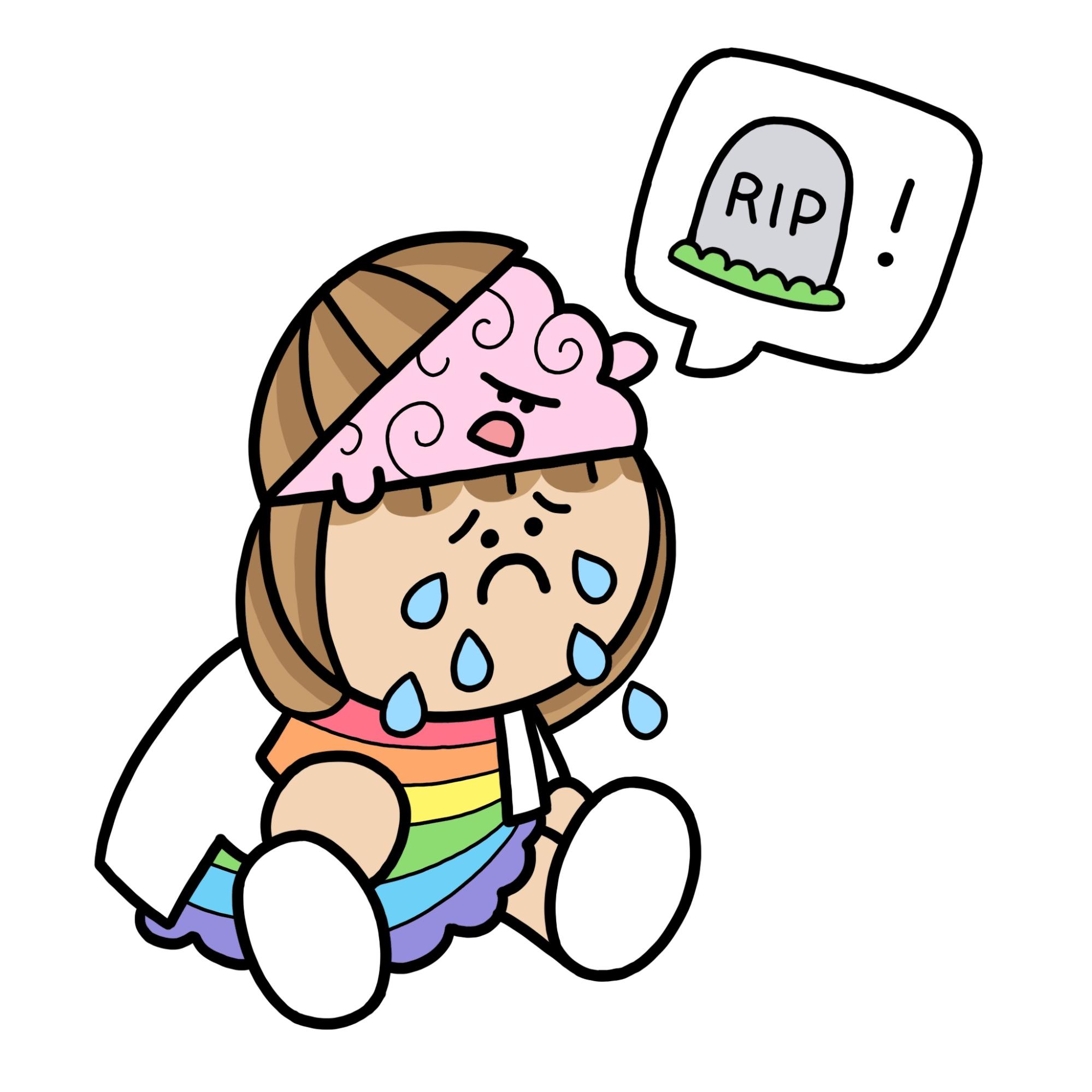
Illustration by Amanda Geisinger
But let’s come back to the suicidality, because that was the hardest piece. I know you think you know what I mean; I also know that you probably don’t know what I mean. The world tells us a simplistic story about suicide — that it’s a personal failure, “giving up,” refusing to use your fully controllable cognitive capabilities to stop a freely made choice to act on a shortsighted impulse. Perhaps there is a small population out there for which this is true. I was not one of those people, nor have I met one.
The formal study of what leads to suicide is in its infancy, and there is still a lot we don’t know about why people come to this state. Loads of potential risk factors can converge in a seemingly endless number of ways, with or without mental illness, and so the experience is different for everyone. I share my version of it not to represent the whole population of people who have faced this monster, but to make the point that many of us are facing monsters you probably haven’t met and would likely be surprised to know existed.
My suicidality had three aspects:
- One was intensely physical — my mental illness produced a literal bodily craving for fatal self-harm. If you didn’t drink anything for two days, your body would want water in the same way that my body wanted death. What I thought or wanted had absolutely no influence over this physical compulsion. You can’t talk yourself out of dehydration, and I couldn’t talk myself out of feeling biological urges for self-directed fatal violence.
- Another was a kind of mental autopilot. All day long, intrusive thoughts of “I wish I was dead” looped through my head, and there was nothing I could do to prevent or stop them. Over and over and over and over … Fortunately, I could still also intentionally think alongside them, but that involved fighting to manage my willful cognition at the same time the intense suicidal thoughts were still unceasingly droning on.
- And on top of that was the desire — the anguish from my deeply torturous illness was so incredibly intense and unyielding that I, logically, wanted it all to be over. Desperately, more desperately than I’ve ever wanted anything else. Pardon my bold challenge to your pride, kind stranger, but if you’re a rational being and were in my shoes, you would too.
I will spare you all of the terrible things Christians said to me as I struggled to stay alive. (Hint: if you can think of a terrible thing, I’ve heard it!) The pious cruelty from Jesus followers was distinct in that they had custom weaponry — sure, tell a mentally ill person they’re going to hell, that their broken emotions are sinful, that they’re not praying enough, that … whoops, not getting into that. But the cruelty was not otherwise remarkable. Christians, generally, buy into the same worldly stigma that everyone else does about suicide. They’ve succumbed to popular folklore and used their assumptions to demean the sufferer Jesus loves instead of honoring the image of God in the tortured soul desperately fighting for their life.
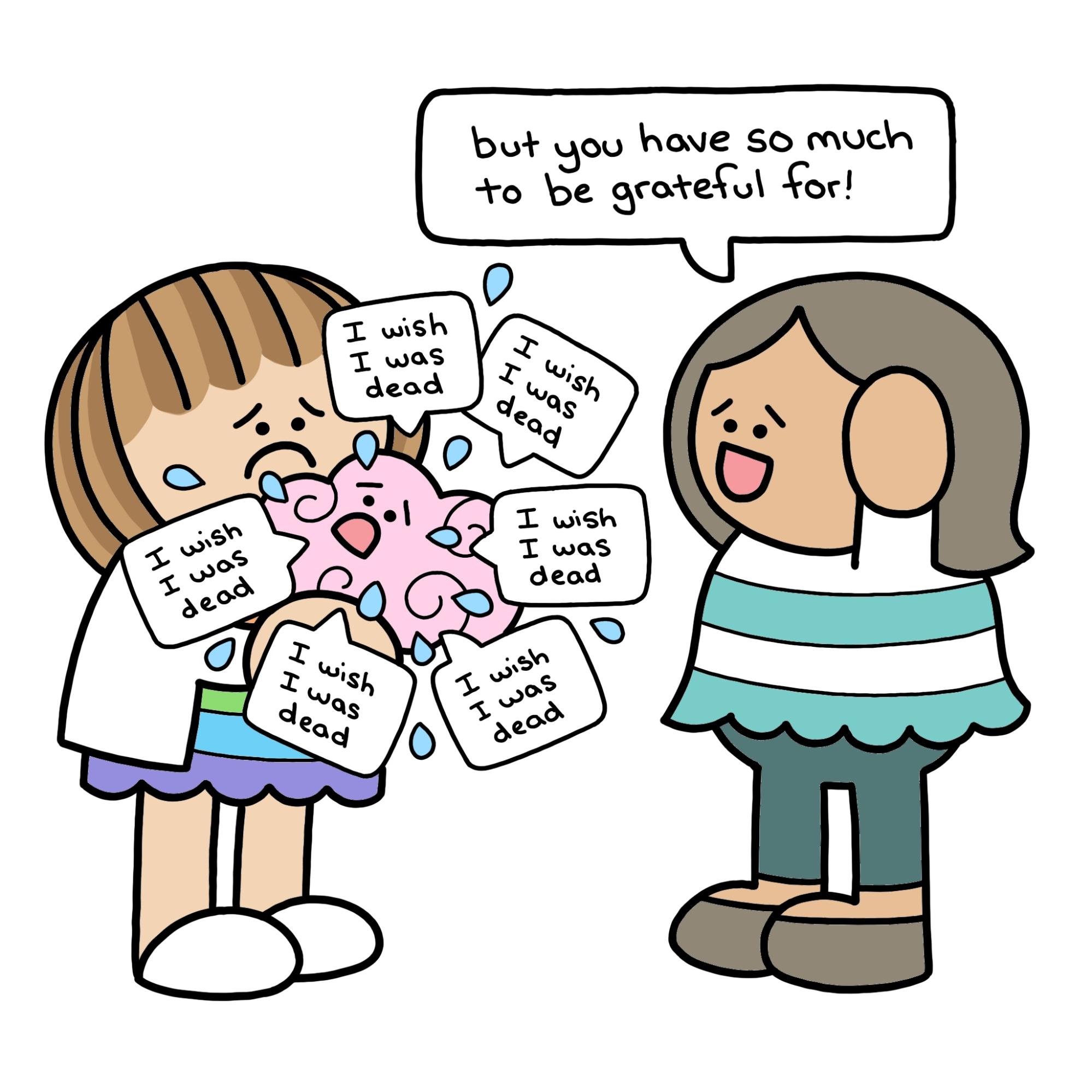
Illustration by Amanda Geisinger
Maybe there are communities out there that aren’t so abysmal at this, but I got extensive judgment on my condition from almost everyone, associated with the church or not. The condemnation was disguised with varying degrees of niceness and political correctness, but the message under the words was always the same: You’re not trying hard enough.
This is not to say that I did not receive care, that I was not pulled along by love more amazing than I had ever seen before. Despite the church, I was fortunate to wander into the warmth of a few friends who walked with me through the darkness they didn’t understand and helped me move forward when I couldn’t move myself. But even they, to some extent, bought into the popular stigma about suicide. Surely I could just have hope and keep trying?
And, believe me, I was top-notch trying. Despite basic functioning feeling like attempting to play chess in a warzone, I held down a full-time job and built a successful career. I cultivated a rigorous practice of gratitude, I exercised, I ate healthy, and I spent time in service and community. I worked on my attitude, I convincingly faked cheerfulness in most social circumstances, and I considered all of the ill-informed pop mental health advice polluting my Instagram feed (no, dance classes and some sunshine don’t fix real mental illness). I also did 15 years of therapy and tried 21 different antidepressants, 72 rounds of transcranial magnetic stimulation, 2 years of regular ketamine infusions, and 40 rounds of electroconvulsive therapy. I had healing prayer from church elders. I prayed myself. My friends prayed; dude, even my cat probably prayed. There was prayer, guys. We had it covered, I swear. Repented, confessed, tithed, read the Bible, accepted all the patronizing “biblical” advice, did the devotionals, checked ALL. THE. BOXES.
All of that seemed to lead nowhere. Eventually, I exhausted every treatment that was legal in the United States and then watched myself succumb to my own desperate suicide attempt. Maybe there was a part of me that chose to die an excruciating death alone in deep shame, but it certainly didn’t feel at all like “giving up.” It felt like being overtaken by a force much more powerful than I was, something bigger and stronger and callously indifferent to the decades I had fought to beat back that moment. I was swallowed up by the darkness.
Except I wasn’t fully digested; later that day, I found myself yet again in the hospital. It would be a long, long time before I’d get out, and when I did, I faced even deeper stigma and shame. I could not find medical or psychological care; I was now “marked,” a liability. Practitioners refused to see me. My church didn’t seem to notice that I, an active member that served faithfully on the Communion team and regularly attended Bible study despite living in the shadow of death itself for decades, had vanished. I went back to work and back to professionally pretending I was fine. I was far from fine.
Mercifully, God eventually relented. I stumbled upon a wildly innovative clinical trial being run out of a research hospital nearby, and the team of scientists, doctors, and analysts there received me with the grace and compassion that most of the rest of society had failed to muster. Suddenly, I was a full human being with dignity who just happened to have a disease. Five days after they surgically installed an experimental brain implant, that disease was entirely gone. After 23 years in the grasp of soul-crushing severe mental illness, I was suddenly in complete remission. I cannot even begin to describe the overwhelming relief to you. I hope that you get to feel even some of that in heaven; there’s no earthly experience like it.

Illustration by Amanda Geisinger
But there is a difference between relief and healing. I now exist in the murky in-between; I’m no longer plagued by biological disease but am still working my way toward a fuller wellness. I no longer desperately want to die, but … I haven’t figured out how to want to be alive. For most of my life, there was no future. And now there is one, and I really don’t quite know what to do with that. I feel like I’m 10,000 years old, that the batteries in my soul are dead, that the happiness I see in other people is still incongruent with my entire experience of life and likely a fraud. I am beyond grateful to at last be let out of the cage of mental illness. I am also beyond weary.
So if it were up to me, I’d still die. Sorry, but … not really sorry. Because even my weariness, my grieved agreement to persist in living (now that I’m capable of doing so), my willingness to obey even if my attitude about it isn’t sparkly and cheerful — speaks to God’s greatness.
Most of the incredible people I know who have suffered really severe mental illness keep death on the table, even if they’ve been privileged enough to be granted relief. The idea of suicide, after you’ve grown acclimated to it, becomes a profound comfort, a refuge, a place to hide from the darkness all around you that frequently still somehow seems overwhelming. If you have to live fully present, faced with the terror of the truly unfathomable misery that is possible in the world — suffering that you could very well return to — you reach for comfort that is up to the gravity of the task.
But death is no longer on my table. Every time it reappears, I grit my teeth and push it off. I sacrifice, over and over, day by day, my only reliable source of comfort. God is not my comfort; God is my reason to persist without comfort. I am now able (at least for the time being) to choose life. God has given me this life, and so I assume it’s rational to deduce that he thinks it’s worth having (even if I wish I’d gotten the gift receipt so I could take this busted garbage back to the store). I don’t see the point, but I see that God thinks there is a point.
There will never be anything in this life that will make up for the harsh reality that life has long been, there is nothing on this side of heaven that will ever be “worth it,” and there is no earthly joy that will ever balance out decades of carrying around death in my spirit. I don’t feel connected to Jesus, I have never sensed his presence, and I don’t find him enjoyable. In fact, I don’t find him useful in any way. I don’t feel all the fluffy butterflies-in-my-soul grateful feelings I’m “supposed” to be feeling, and pretending to be cheerful every Sunday at church is still really freaking annoying. I don’t appreciate God’s version of the world and my life. I don’t want it and sometimes — most times, even — I wish he didn’t exist.
But I do find him beautiful. Not useful, but beautiful nonetheless. And, guys, it’s true. That’s enough — he himself is enough without me having the positive feelings, correct attitude, or manageable circumstances. Even if I personally get nothing out of this whole “being alive” nonsense, he’s enough. He is worth honoring because he is good, goodness itself. He is worth whatever pitiful offering I can squeeze out of my battered, sin-soaked soul which, at this point, is assenting to live. I expect that I will not remain in this sorry state forever. I surely will continue to grow into the person he wants me to be.
“I will yet praise him, my savior and my God.”
But for now, I will live. And my life itself will be that praise.
Practical help if you or someone you love is wrestling with suicide:
If you’re in a pinch and things seem desperate, in my own experience, the most likely places to find effective urgent assistance are:
Your local emergency room, even before any attempts are made. If you suspect that you can’t keep yourself safe, this is the place to go. They see this stuff all the time and are absolutely going to protect your life for you and connect you with comprehensive services and professionals to seriously address your suffering.
Or
The national suicide crisis line (in the US, dial 988). I’ve not used it, but I know folks who have, and their assessments of it are universally positive.
I personally think the name doesn’t clearly communicate the full range of reasons you can call. The caring people who greet you will also be glad to speak with you if you’re suicidal but not in crisis, in emotional crisis but not suicidal, or if you just need a compassionate, non-judgmental ear during a tough time.
Thoughts and desires without actual intent may not be a crisis, but it’s still important to seek professional help in a timely fashion. Almost all suicidality is treatable with perfectly reasonable protocols, and most people will never need something nearly as extreme as my brain implant to vanquish it.
For non-crisis support, the American Foundation for Suicide Prevention has resources targeted to an assortment of circumstances: https://afsp.org/get-help/








Loved this. Loved talking about it on the podcast. And I’m now following your incredible instagram art! Grateful!
Thank you thank you thank you for having the courage to share your story. “I know you think you know what I mean; I also know that you probably don’t know what I mean.” I do know, and while I wouldn’t wish it on anyone, it helps to know I’m not alone.
Thank you for being real. You are also beautiful. The communion with a God who seems good-for-nothing and you – when you feel you’re good-for-nothing is love.
Is it okay for me to say I regret finding yet another playing “fake it till you make it?” This tired advice stems from the first “AA-type” meeting I attended and I practiced it mentally until I realized it succinctly described my remembered life. My regret is that yet another suffers with MDD. I applaud your success and will share a truth I’ve found: Despite my life differing greatly from those framed within my personal observations of those voicing their faith in Christ (maybe not so different?) I found myself to be “known” by Jesus. Accepted, loved, “rescued” and still struggling, my story now contains His Spirit and mine forever mingled. My struggles of acting normal are mercifully being transformed into walking (stumbling) in His Spirit. Every “rabbit hole” I think I’ve escaped reveals their depths, but God helps me to see me as He sees me, so very valuable to Him already judged in His favor. Thank you for your words.
Really grateful for this (unfinished) living testimony as someone who has struggled with depression before, albeit not to this extent. Praising God for the miracle of this device and praying (although it sounds like you’ve got that covered) for continued life improvement and connection to Him and others.
Amanda’s going public with her intensely personal story is beyond courage. I can only imagine some of the “advice” she’s heard through her young life. Much like folks seeing Jesus hanging on the cross were to have told him, “Just have faith and all will be okay.” Thank you for sharing.
I have personally known Amanda for many years, and have watched her walk this path. I want to testify that I have never seen another person endure suffering and persist in pursuing and holding to truth, even when really not wanting it to be true, as she has. We’ve all heard the stories of Christians refusing to recant their faith when faced with the threat of torture and death, and I hold Amanda amongst this group of witnesses. Indeed, not only did she endure the suffering, but she repeatedly refused the death offered to her to end it. I am grateful to God for restoring her to us when the weight became too great and for forgiving me for the countless times I spoke words to her that, while meant for her good, came from a lack of true understanding and empathy. I can’t wait to be kickin’ it on the other side of glory with Amanda, both of us set free of suffering and ignorance. Praise Jesus.
Thank you for bravely sharing your testimony. I am a mom to a young adult son with treatment resistant/refractory MDD and suicidality. Seeing him suffer has been unbearably painful, especially when he tells me that the most merciful thing I can do for him is to let him die. I don’t have the words to express how grateful I am for your vulnerability. Your story gives us a glimpse into the lives of many who are suffering in silence and are misunderstood. Thank you again.
I loved this piece. I just could not let go of its raw honestly. I have no first-hand experience with the dangerous and heart wrenching ordeal you’ve so vividly described, but I’ve lived long enough to know that if human pain were water, it would flood the world. May God bless you for this magnificent testimony.
This essay is a blessing. A few months ago, as part of a workshop/dialogue, I had to answer the question, “What does it mean to die a good death?” I said that, for me, the main thing was that I die however God wants me to die. Thank you so much for putting into words some things that I have chewed on for a while, especially: “I don’t see the point, but I see that God thinks there is a point.” Your words are a blessing, and you are a blessing (please forgive the saccharine language).