Preserved in an illuminated Psalter from early fourteenth-century England, made for the private devotion of the abbot at Peterborough, is an unusual battle scene. The castle against which it’s staged is standard enough. So too the metal-clad, sword-wielding knights seeking to breach it. But look at who’s warding off the invaders.
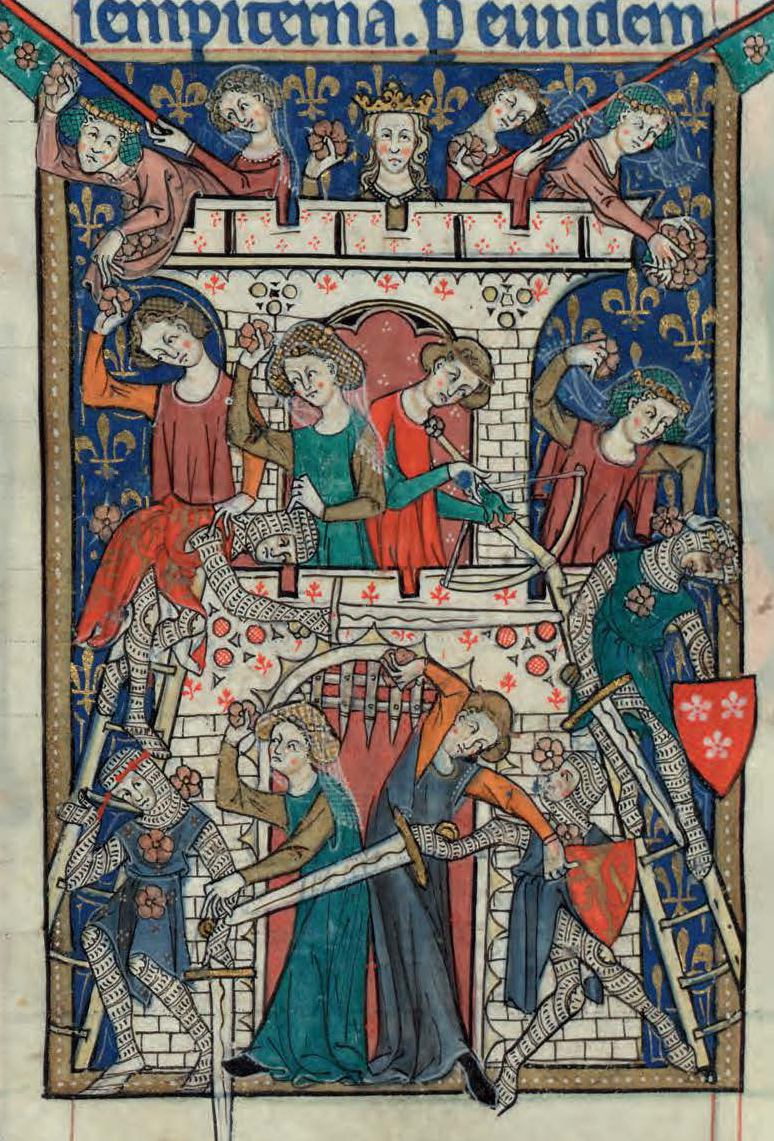
The Castle of Perseverance, miniature from the Peterborough Psalter, England, 1300–1325. Brussels, KBR Ms. 9961-62, fol. 91v.
It’s a group of unarmored women.
And the “weapons” they use to defend their fortress? Flowers! One loads her crossbow with such, while others vigorously launch them by hand.
This is a sacred variation on the secular allegory of the Castle of Love, sometimes called the Castle of Perseverance after a morality play of that name from around 1425. (Imagine medieval folk enacting such a scene in the town square!) The women represent the virtues; the soldiers, vices. The castle is the human soul. It’s a picture of the spiritual battle that rages within each of us when bad habits try to overtake the good. It’s aspirational: the virtues are winning. And they win not with stones or arrows or rotten fruit but with soft, lovely, fragrant blooms.
This is one of the many medieval images of the virtues and vices that medievalist Grace Hamman introduced me to in her book Ask of Old Paths: Medieval Virtues and Vices for a Whole and Holy Life, published September 9 by Zondervan Reflective. The book is her attempt to texturize or restore flavor to Christian virtue language for our day and age — to “re-fang something a little wild and beautiful,” as she puts it (195) — so that she, and we too, might increase in our love of virtue. It examines the seven capital vices and their remedies, drawing on poetry, dramas, devotionals, contemplative literature, preaching handbooks, penitential manuals, and visual art from the Middle Ages to discern what wisdom our spiritual forebears gleaned for us through their experiences of temptations and their learning ways to combat them.
Some of the saints Hamman engages include Augustine, Gregory the Great, John of Damascus, Herrad of Landsberg, Julian of Norwich, Thomas Aquinas, Mechthild of Hackeborn, Catherine of Siena, Giotto, Geoffrey Chaucer, Bernard of Clairvaux, Bonaventure, Hugh of Saint Victor, the anonymous Pearl poet, William of Auvergne, and Hieronymus Bosch. What a delight to meet them in the texts Hamman brings to the fore!
The list of seven vices and their opposite virtues — pride/humility, envy/love, wrath/meekness, sloth/fortitude, avarice/mercy, gluttony/abstinence, and lust/chastity — emerged with the desert mothers and fathers in the fourth century and was further developed over the next millennium. Medieval people literally fleshed out these words, personifying them in art and literature. Envy, for example, is a decrepit woman who gnaws on her own heart. Lady Fortitude stands on a winepress with an anvil on her head, holding a model castle from which she pulls a dragon, surrounded by her companions Perseverance, Constancy, and Patience.
Where our moral vocabulary has become insipid, full-bodied characterizations like these can vitalize our understanding of what it means to live in the Spirit and help us refine our language around that, leading to the cultivation of fruitful ways of being in the world.
Definitions are important. “A vice,” Hamman writes,
is a practice that corrodes and obscures our identities as images of God, a practice in which our love is misdirected, excessive, or deficient, generally out of joint. Vices corrupt our humanity and twist our natural loves. A virtue, on the other hand, is a habit that makes us more human, more conformed to the image of God that is our deepest identity. … It is significant that the virtues are not rules, laws, or even guidelines, but habits of creatures oriented toward love of God and neighbor (p. 13).
Many would rather avoid talk of the virtues, seeing them as boring or repressive, placing burdens and inducing guilt. Indeed, many books on moral formation take a self-help approach, providing work-based strategies to achieve a better you. But Hamman’s approach is thoroughly rooted in grace and framed by the question Jesus asks one of the infirm men at the pool of Bethesda: “Wolt thou be maad hool?,” as Wycliffe’s Middle English translation of John 5:6 puts it — that is, “Do you will to be made whole,” hale, hallowed, holy? (All these words, Hamman points out, share the root hal.) Sanctification is the theological term for the Spirit-powered process that begins for those who answer yes to Christ.
 Perhaps you’re wary of “asking of old paths” when it comes to virtue. Didn’t medieval Christians have some pretty warped ideas of what constitutes holiness? Can we really regard them as trustworthy voices when it comes to living well? Hamman never presumes that older is better, never advocates an uncritical embrace of all medieval works. Just as modern Christian writers and practitioners can go wrong, so too could medieval ones. Her book addresses a few of the more prevalent errors of the medieval church, like taking humility to the extreme of self-loathing and so considering it virtuous to abuse oneself verbally or physically; or ignoring natural human limitations or the goodness of the body.
She also tackles controversial terms like meekness and chastity, teasing them out with nuance while addressing the concerns they elicit, sometimes based on misconceptions. Abstinence (from food), the virtue that opposes gluttony, is another loaded concept; temperance or restraint are perhaps better terms to use.
One thing I always appreciate about Hamman’s work is how it connects me to Christian works from the past that were popular in their day but now fly under the radar of the average Christian. Ask of Old Paths references texts like the Hortus deliciarum (Garden of Delights), a pictorial encyclopedia compiled by a nun as a teaching tool for novices; the Ancrene Wisse (Guide for Anchoresses); the Summa virtutum de remediis anime (Sum of the Virtues on the Remedies of the Soul); the Somme le Roi, a French moral treatise translated into English as The Book of Vices and Virtues; the Middle English poems The Prick of Conscience and The Assembly of Gods; the Fasciculus Morum (Small Bundle of Morals); and Jacob’s Well, a confessional aid.
Rather than automatically assuming that their age and context make them irrelevant, Hamman sifts them for nuggets, uncovering substance and shine. There are some curious discoveries too, and Hamman relishes the weird, but not for weirdness’s sake. Some of the weird can be rejected, some of it merely chuckled at (e.g., “He [Glutton] pissed a puddle the length of a pater-noster” — thank you, William Langland); but some of it, if we give it a chance, can reveal and edify.
I’ll be taking with me, for instance, the visual mnemonic the English called the trewe-love, a four-petaled or four-leafed plant whose petals or leaves each represent love aimed at a different recipient: God, yourself, your friend, and your foe. The integrity of the quatrefoil is dependent on the unity of the four.
I opened this article with an allegorical image of battle: the vices laying siege to the soul but being thwarted by the virtues, who pelt them with blossoms (trewe-loves?). In The Castle of Perseverance, a play written in Middle English, Wrath laments his defeat:
I, Wrath, now sing “Wail-a-woe.”
Patience gave me a painful blow.
I am all beaten black and blue,
With a rose that from the Cross was torn.
Trans. Grace Hamman
The virtue of Christ avails!
Subversive though this one is, perhaps combat metaphors don’t sit well with you. Imagine, instead, a garden. That’s another way in which medieval thinkers conceptualized the life of virtue, drawing on the Song of Songs. Holy Scripture, writes the anonymous author of The Prick of Conscience,
likens a person’s soul to a fair garden full of green trees and good fruit. … This garden is planted by the Great Gardener, by God the Father, who softens the hard ground of the heart. He makes it treatable as wax well-tempered to take the print of the seal, as good black earth, well-arrayed, waiting for the good grafts for which it is worthy. These grafts are the good virtues that the Holy Ghost bedews with generous grace.
I finished reading Ask of Old Paths while in Germany last month on a self-led art tour. My last stop was the Sprengel Museum Hannover in Lower Saxony, featuring modern and contemporary art. A temporary exhibition boasted a room of large lewd sculptures, which docents lingered over and amused visitors took selfies with. But then, in one of the less-trafficked galleries of the permanent collection, I landed upon this unassuming oil painting:
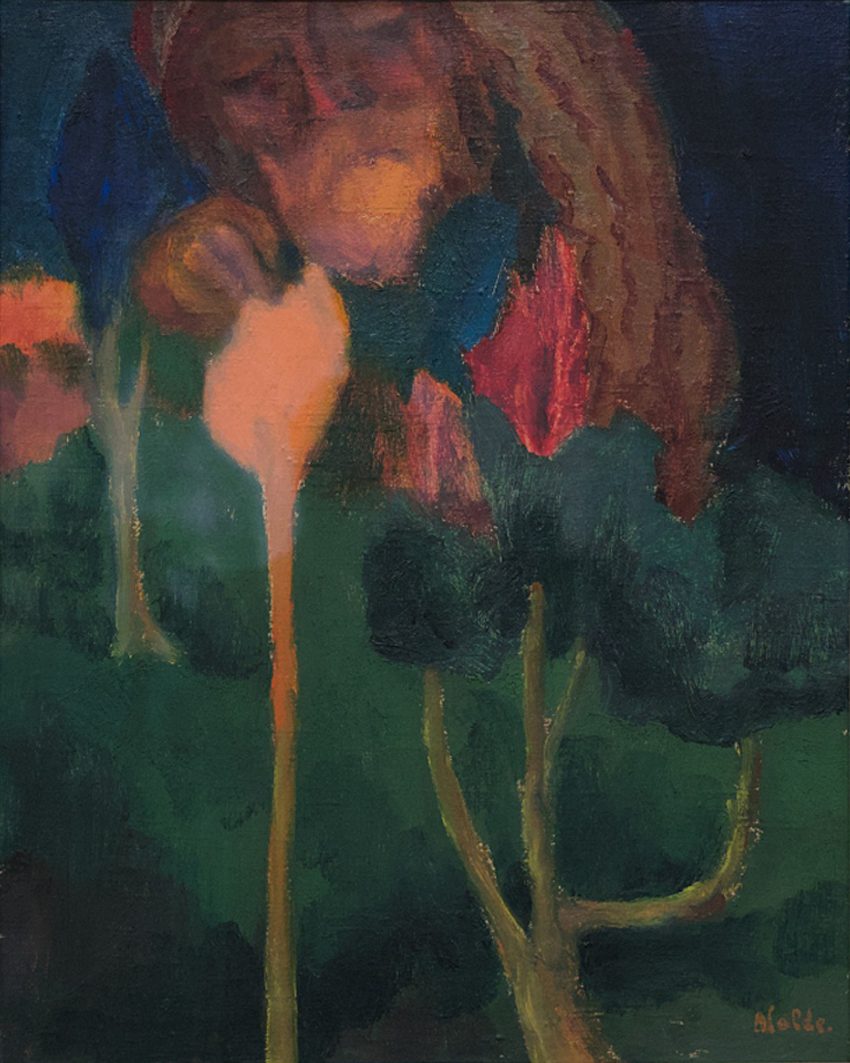
Emil Nolde, The Great Gardener, 1940, Sprengel Museum, Hanover, Germany
Titled The Great Gardener, it shows a grove of multicolored trees, and in the top third, an oversize figure tending it with care. In part because of his scale, I read this figure as God, stooping down to make our gardens grow.
It seems the German expressionist artist was drawing on a favorite medieval trope.