




Continuing in the series of Things You Won’t Hear Anywhere Else (But Church), an in-person version of which I presented as a class at Christ Church Charlottesville on Sunday mornings this fall. Click here to read the intro and many caveats.

Who are the most acceptable cultural villains these days? I’m not talking about archetypal bad guys like Nazis or Klan members. I’m talking about people we universally despise — and don’t feel bad for doing so. An individual example would be Dan Snyder, the erstwhile owner of the Washington Commanders football team, about whom I’ve never heard a kind word. Which is saying something; it’s not easy to garner genuine bi-partisan disdain in the DC metro area, but that guy seems to have pulled it off.
But what are the groups that function this way today? ‘Stage parents’ strike me as a demographic that’s pretty hard to love. Maybe that’s more of a personal peeve, though. A generous soul might say their only crime is loving their kid too much. Same goes, I guess, for those awful guys that get in fistfights on the sidelines of their kid’s little league games.
A couple years ago the Internet decided that Karens and Kyles were the worst. Yet there’s a generational element to those resentments that keeps them from being universal. Plus, I know some wonderful ladies named Karen.
Then it hit me: Telemarketers. No one is more casually hate-able.
To be clear, I’m not talking about folks who volunteer their time to make calls for a cause they believe in. Nor really, those who want us to switch our insurance companies (in the middle of dinner). I’m talking about a specific type of tele- or e-marketer. Call them spammers or catfishers or gift-card-grifters. They make a living by preying upon the elderly, and they’re who I picture when I need to picture someone irredeemable.
[Spend much time in an eldercare facility, btw, and the stories you’ll hear will make your skin crawl. I heard one just last week, of a nonagenarian almost giving $30,000 of their savings to a perfect stranger who had called them up under false pretenses. A special circle of hell, my friends.]
What I’m trying to conjure up is a sense of acceptable contempt. I’m probably making it harder than it has to be. We live, after all, in what some commentators have termed a “culture of contempt.” As a refresher, if anger is an evaluation of someone’s actions, contempt is an evaluation of someone’s value. It is anger plus disgust. “While anger says, ‘I care about this,’ … contempt says, ‘You are beneath caring about,’” writes Arthur Brooks in his book Love Your Enemies. He diagnoses Americans as addicted to political contempt in particular.
Enemy may feel like an antiquated term, but no word better describes those we hold in contempt. We are awash in enemies.
If that’s too bold, think about someone you consider to be ‘toxic.’ Last year on the Atlantic, Kaitlyn Tiffany explored the phenomenon of toxicity as it relates to people, asking if this suddenly ubiquitous term had something to do with the ‘estrangement epidemic’ we are witnessing more broadly. What she found sheds light on the current cultural wisdom on how to deal with one’s enemies. She writes:
The internet is wallpapered with advice, much of it delivered in a cut-and-dried, cut-’em-loose tone. Frankly worded listicles abound. For instance: “7 Tips for Eliminating Toxic People From Your Life,” or “7 Ways to Cut a Toxic Friend Out of Your Life.” On Instagram and Pinterest, the mantras are ruthless: “There is no better self-care than cutting off people who are toxic for you”; “If I cut you off, chances are, you handed me the scissors.” The signature smugness and sass of Twitter are particularly well suited to dispensing these tidbits of advice. I don’t know who needs to hear this, a tweet will begin, suggesting that almost anyone might need to hear it, but if someone hurts your feelings, you are allowed to get rid of them.
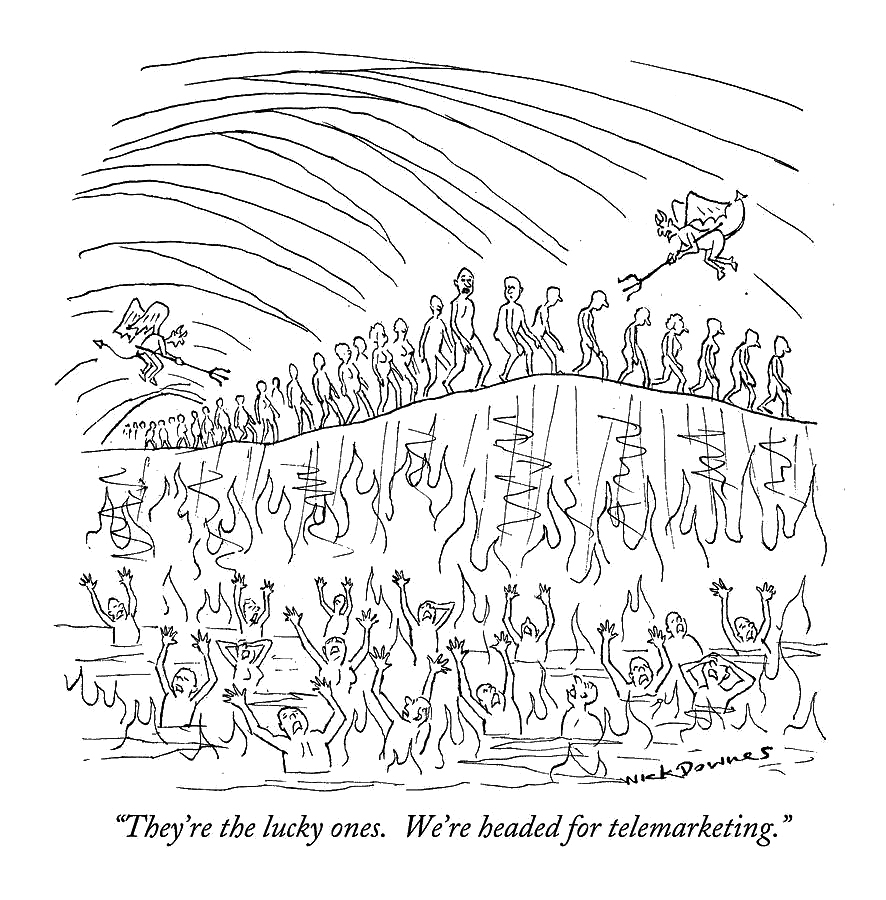
Enemies should not be coddled, in other words. They should be eliminated. Which brings me to this week’s aphorism that you won’t hear anywhere else but church. Hug a Telemarketer Today!
Ugh. Really? Much as I wish it weren’t the case, Jesus is not on board with the ghosting of one’s enemies. In fact, he suggests doing the opposite. In Luke 6, he says:
‘But I say to you that listen, Love your enemies, do good to those who hate you, bless those who curse you, pray for those who abuse you. If anyone strikes you on the cheek, offer the other also; and from anyone who takes away your coat do not withhold even your shirt.
‘If you love those who love you, what credit is that to you? For even sinners love those who love them. If you do good to those who do good to you, what credit is that to you? For even sinners do the same. If you lend to those from whom you hope to receive, what credit is that to you? Even sinners lend to sinners, to receive as much again. But love your enemies, do good, and lend, expecting nothing in return. Your reward will be great, and you will be children of the Most High; for he is kind to the ungrateful and the wicked. Be merciful, just as your Father is merciful.
Now, clearly the loving of one’s enemies is not the equivalent of enabling them. The usual caveats about abuse apply here. But we must also acknowledge that Jesus does not say, “tolerate your enemies” or “gently correct your ideological opponents” or even “be nice to bullies in the hopes of them becoming friends.” He exhorts us to lovingly seek their good and not to expect anything in return. Not reward, not thanks, not repentance, not ‘amendment of life.’
This is because Jesus is interested in love that exceeds the bounds of affinity. Your enemy, by definition, exists beyond the limits of reason or sympathy. Love, for it to be the type that Jesus endorses, must extend to your worst nightmare.
The world may cast such a view as another invitation to doormat city, but I wonder if it’s actually an invitation to hope. After all, no parent ever won their estranged child back through criticism. Consequences (of our own devising) do not engender reconciliation. Love is the only thing that can do the trick.
At the annual Mbird Conference this past year, we had the privilege of watching the short film Beneath the Ink, which provided a powerful illustration (pun intended) of what it looks like to Hug a Telemarketer. If you haven’t had the opportunity to watch it yet, be sure you have Kleenex ready:
For a slightly less charged example of what this looks like, take a gander at the college football story that Todd highlighted in this past Friday’s weekender, “We Can All Learn from Travis Hunter.” Heisman hopeful Travis Hunter suffered a debilitating injury a couple of weeks ago at the hands of his opponent, Colorado Rams defensive back Henry Blackburn. Mr. Blackburn drew a penalty for the hit, and Mr. Hunter went to the hospital with a lacerated liver. The article tells what happens next:
While recuperating, Mr. Hunter expressed no bitterness over the hit, acknowledging that injuries are a part of the game. He accepted the basic fairness of his misfortune, saying of Mr. Blackburn: “He did what he was supposed to do. It’s football.” This is rare equanimity from a young man. It’s doing justice when it is hardest: on your own nickel.
Nor did he stop there. Perhaps to take pressure off Mr. Blackburn, who had received death threats over the hit, Mr. Hunter did something radical. He went bowling with Mr. Blackburn. They rolled some frames, put the incident behind them and moved forward. The implication was that others should, too. This is loving mercy.
I dare say that this is what it looks like to hug, rather than rebuff, a telemarketer. By refusing to engage in the cycle of recrimination that comes so naturally to us — and forbidding the escalation that can only ever result in more harm — a future takes shape where there was none before. Where revenge shrivels, hope takes root.
Alas, easier said than done, right? Like the injunction toward boundless forgiveness we looked at last time, this commandment of Jesus’s isn’t just unfashionable or difficult. It is impossible.
Fortunately, ‘love your enemies’ is also Jesus’s own ethic. He does not and did not dole out love in accordance with who is good or enemy-less. He takes his cue instead from “the Most High,” who “is kind to the ungrateful and the wicked.” That is, Jesus doles out kindness to the enemies of God, repaying scorn with mercy, contempt with amnesty, and toxicity with redemption.
Hang up if you must — I know dinner’s getting cold — but I guarantee it’s the best offer you’ll get all year. Don’t worry if you can’t talk now, though, I expect you’ll get a callback when it’s more convenient.








This is an enlightening, uplifting, thought provoking article which was fun to read and to share with others.
Damn it, Dave, I’m teary all the way through. This is just amazing. It’s the absolute heart of things. Thank you for the gift – love you!
Thank you, thank you … I’m in constant need of this kind of creative expression of love.