




Quick now, here, now, always —
A condition of complete simplicity
(Costing not less than everything)
-T. S. Eliot, Four Quartets
In the beginning of the story of our house, there were two couples. Young with ambition and a we-can-do-anything spirit, these four friends set their minds and bodies to renovate a house over the course of two years. They had checks with both names on the upper left corner, getting double takes from the cashier at the local hardware store. They merged dishes and dreams, sorrows and hopes. This was a time in life when they didn’t care much how many extra friends lived with them, as long as they were down for loud noises, late nights and early mornings, the occasional water or electricity outage, and sawdust on their feet and in their noses at all times.
These two couples had dreams of a simple life. They felt the pull of the ladder of excess leading them further away from themselves and the God they loved. The pie in the sky was always just one more step. They felt the pinch of economic insecurity and climate anxiety. So they dreamed of jumping off and trying something else — a life shared.
Perhaps naivety is our best teacher.
***

Queens House, Greenwich II, 1978. Ben Johnson.
It’s been fourteen years since that fever dream. Did it really happen? What happened? My husband and I are still here, now with two kids, and up until now, someone has always lived in our basement. Renovations of the soul usually accompany renovations of a house, especially when it is shared. In the early years of tearing down and remaking, everything was affected. How we related to each other, our communication styles, our attachment styles, our relationship with God — like I said, everything. After those first two years of tearing down and remaking, the other couple went their own way, and we stayed, continuing to provide space for others. Whether it be friends, a sibling, or someone needing a space to call their own for a while, every decision that’s been made around our downstairs revolved around how we provide space and care for the souls living down there.
It is now empty. All the life that was, inhaled and exhaled, in bedrooms and bathrooms, a couch in front of the fireplace, and a tiny kitchenette; now breathe within a new set of walls and new soil.
I recently sat in the fresh emptiness, the thick July air creeping through our basement walls. Walls — once painted black because our old housemate was inspired by the chic seriousness of the Ace Hotel in downtown Portland, then painted brick red by another tenant. Or was it salmon? Now, most of the walls are gray – neutral. I sit on the bare hardwood floor and think how funny it is to remember all these colors and the people that went along with them. They all remain under my attempt to remain gray, neutral.
I got up and reached to open the window above the couch, letting in more of the outside. The breeze carried in more memories of the voices from the beginning.
There was a family who used to run a hostel in Tibet. Another young family with dreams of loving the people of Thailand and making beautiful films from their stories. And yet another young family who wanted to live among the nomadic people of Chad. And there were other beloved souls who just needed the fire going in the fireplace with a choice of blankets to choose from, or a set of bare bedroom walls to imagine what could be.
I pray to God all were seen and loved in some way, partly by me, but certainly by the One who sees — El Roi. I know a little deeper in my bones now what it’s like to be the one who stays. What it’s like to welcome all as Christ and let them move on when they want. It’s a bittersweet cup to drink. I inhale the emptiness and wonder what will be. I am okay with this emptiness, surprisingly. There is life eager to breathe again in the deep places. There is life eager to exhale a long held breath in wider spaces.
I am afraid it is my own.
When Everyone Is Gone and You’re Only Left with Yourself
My dad used to tell me I was too much of a people pleaser. And I’d think, well of course. What’s wrong with pleasing people? Don’t you want to be liked? As the firstborn child out of four, I was the trailblazer for pleasing everyone and setting the best example. Ever. In the early stages of renovating our house with our friends, I was so good at pleasing everyone that by the end of the remodel, I lost my sense of self, along with my friend. Boundary lines were thin, if there at all.
We had a boundless imagination, and our friends praised us for it. We were praised for our skill and tenacity, this thing we were remaking and rebuilding. All the while, there was no center. There was no order or cloisters. The ordering of our days revolved around efficiency and fun. There was no soul. We lived and worked on the periphery of God.
When we feel far from God, we like to speak of him as if he’s on the outer edges of our lives. Maybe it’s the other way around. Maybe we are on the outer edges of him.
As Richard Foster puts it this way in his book Freedom of Simplicity:
“It is one thing for God to come into us (and a very necessary thing), but it is quite another for us to come into God. In the first instance we are still the center of attention; in the second God is the focal point. When God comes into us we still have a certain autonomy; when we come into God we have come in. He is in all and through all and above all. This is no infantile pantheism, as if God could be captured in his creation; it is a marvelous, majestic monotheism — one God from whom all life is sustained. It is life out of the divine Center.”
In all of our own little we ways, we were dancing on the periphery of God. We were working really hard. With recorded time cards to prove it. We were also asking a lot of questions about God and his Church at the time. Which meant we were asking a lot of questions about ourselves. There were fresh wounds that we didn’t really want to go digging around in, so making concrete countertops, knocking down walls, and growing gardens seemed like a better way.
But we never really asked God what he thought about it all. Of course he was paying attention to our dancing on the edges. And those edges started to give, and cave in.
***
The people in our lives now joke that we must feel like empty nesters. I smile and nod, feeling a little of that perceived freedom. It’s odd. I feel so vulnerable now. Life is smaller and clearer, and I feel relieved and terrified. There is no one left to please. My therapist suggests marking this moment in time, and so I sit on our bare hardwood floors breathing in the emptiness and letting myself feel small with everything cleared out. I know I am a person who needs more than the average amount of solitude and silence to find my voice, and so I yield, letting God see me in this stripped down, empty state. The edges have caved in, and I realize there’s a part of me I’ve been protecting, a part who wants to be made whole, but there’s been something in the way.
When we dance on the outer edges of God, people pleasing seems like the norm. It’s a grace when our lives cave in and we realize that underneath the people pleasing is a desire to care, and under that desire is something that looks a lot like hospitality, or at least something offered from ourselves in the way of help. The intention is to lighten the load, but disordered or skewed, it lands heavy and controlling.
I sit in my basement and laugh. The part of me that is yearning to be seen is cautiousness or tentativeness. It’s a part of myself that I judge harshly, swiftly with a sharp blade, yet she continues to grow back. I feel guilty, almost … sinful.
The anonymous author of The Cloud of Unknowing refers to sin as being “a lump.” Something that is made up of inert matter. On its own, it’s stubborn and cannot be moved. But when looked at alongside the loving and gentle gaze of Christ, and perhaps with the help of a friend, it starts to soften. We see it for what it is. As I come in from the outer edges and situate myself closer to the feet of Jesus, I see this tentativeness as being a part of something larger — Self-Contempt.
Margaret Guenther, in her book Holy Listening, calls self-contempt “the eighth deadly sin for women.” That is a hard pill to swallow. But if the nature of sin is hurt — hurt inflicted upon ourselves, each other, and upon the One who bears it all — and if healing is being asked “Where do you hurt?” or “Do you want to be made whole?” then self-contempt could indeed be a sin that leaves a wake of hurt in our lives. And in a very spiritually real way, it can also be undone. Particularly for women, whether it be because of society/culture/family/religion, we bear a unique and heavy load when we are unwilling to take the risk that growth asks of us. Grace abounds, yes. And so does courage.
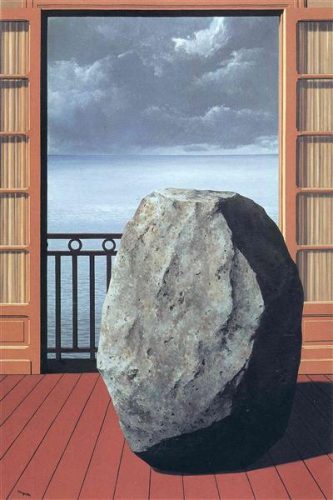
Invisible World, 1954. René Magritte.
Metanoia
I am tempted to use that same swift blade on myself I sit in the sacred emptiness of what will be in the downstairs of my house. I am no longer thinking about paint and which kid can have the extra bedroom, but I am staring at that lump square in the face. This time, for some mysterious reason, I do not swiftly judge myself. I let myself be, and speak to this lump of Self-Contempt.
Hello, old friend. I thought you were gone, but my knee-jerk reactions proved me wrong. Gosh, you’re overzealous. You’re so hyperaware of others’ needs. So much so, I forget who I am. You’re so stingy, possessive and confining. I thought you’d love me, but it’s hard to breathe with you in here.
The overzealousness is gone now, and I wait in the emptiness. I inhale a deeper breath.
Tentativeness makes herself known. This hesitancy that plagues my nerves and my steps. Margaret Guenther tends to the wound here:
Women’s tentativeness is another manifestation of self-contempt, as is an apparent absorption in triviality. Both are a noisy kind of silence, a screen erected — perhaps unconsciously — against clarity. By hesitating to take firm stands or express herself in decisive language, she sends a strong message that she does not deserve to be heard. By letting herself become immersed in trivialities, she sends a message that she does not deserve to be seen, at least not as an aware adult. Furthermore, absorption in trivialities deadens pain, for the woman is too preoccupied to face herself, her human relationships, and — of course — God.
On the outer edges of God, we feast on the trivialities of those we intend to care for. We become consumed and never satisfied.
This tentative wasteland is barren, dear ones, and it begs to be treaded on gently. I’m reminded of how I’ve made myself small and allowed others to believe I have nothing to say. Or I’ve done the opposite, flailing around like a three-year-old child needing to be noticed.
I sit in the emptiness, and it’s getting thicker in here now. What has grown within me in the fertile soil of the Kingdom now reaches its fresh roots into this vacant space ripe with new birth. At times I feel something is wrong with me because I’m either angry, crying, or laughing all the time. Being so alive can feel dangerous and exhausting when you’ve lived most your life being generally unaffected.
Yet, nothing is wrong with me. Like grapes waiting on the vine to be made into wine — grief, joy, anger, curiosity, love, hope, vulnerability, playfulness, astonishment, trepidation, courage — in time, I am being made new. The Gardener is always at work.
I stand up and walk around to the other side of this lump of Self-Contempt. There’s another angle to tentativeness. I stare at it as the warm breeze blows in through the gauze curtain.
You again. With your teeth grinding and sweet rage. How long I held you down. Smiling and being courteous and good on the outside while lying to myself and those around me. You told me I couldn’t be angry. You kept me closed and passive. You told me I needed to be perfect in order to be loved and safe. You told me I needed please others in order to be loved.
I laugh as sweet rage dissipates with another whip of wind.
Joyful sorrow arrives, and the inertia is starting to give way. The vine continues to grow and pulls with it, a deeply seeded plant — pride. Pride’s roots are laid bare, while its dust is shaken off, and the lump of self-contempt appears as broken shale at my feet.
Pride manifested itself in the part of me that wanted to fix everything. I’ll always have that temptation, but now I see it for just that — temptation. When I give in to its false promise and quick fix, I lose what I’m yearning for all along — connection at a deeper level. The Fix-It part of me is friends with the Cautious part who believes she won’t be able to stand in the hard deeper places with those she loves. These parts also believe they are not deserving of love and care, therefore they tiptoe and hum and haw as a way to keep themselves at arm’s length, licking their own wounds.
I know these wounds well, and I’m tired of licking them.
My toes sink into what had a hold on me but is now so frail. So … fragile. By now, I’ve forgotten to close the window, beads of sweat appearing on my skin. I welcome the warm breeze as the fragility of what I’m standing in still cuts.
Ouch. I whisper. I reach down to look at my foot. Tiny beads of blood escape, but I cannot. The blood calls out. Beloved, it whispers. Do you deny what I am calling good?
Again, from Margaret Guenther:
Pride plays a part after all, for the woman discounts herself as part of creation and assumes that the rules of divine love do not apply to her. That love is there for everyone else, but not for her. Like all sin, this cannot be private, hurting the sinner alone; instead its ramifications touch others, in the woman’s immediate circle and beyond. There is the waste of gifts that have not been used, frequently not even acknowledged, coupled with the inability to receive the gifts of others. Self-contempt is a loveless field that offers prime growing conditions to other sins, among them false humility, envy, manipulativeness, and sloth. Sloth is an especially sneaky sin, since it can disguise itself in busy-ness. Here again, absorption in trivialities is a symptom.
My feet are now steeped into the same soil as the vine. Grapes fall and are crushed beneath my feet. It is soft and juicy and warm, no longer cutting. Blood transforms to wine and I am offered a drink. What has grown is my own life, and I suddenly realize my outer life is making room for me.
***

In the emptiness, I am faced with myself. There is nowhere to hide. There is no one to care for. There is no false pride or duty or obligation to hide behind. I knew this lump of self-contempt was still there, I just needed to be free to look at it. I needed to know it wouldn’t devour me, and I needed the dignity to confess to God that I was sorry I saw myself and talked about myself with words he would never choose to describe me. There is pain here. The kind of hurt that comes when you realize you’ve unknowingly inflicted pain on yourself, and thereby to others as well.
I’m not interested in the “wellness-tinged versions of embodiment that equate wholeness with ‘taking up space,'” as Sara Billups confesses in her latest book, Nervous Systems: Spiritual Practices to Calm Anxiety in Your Body, the Church, and Politics. What I am interested in, along with Sara and so many other weary Christians, is how Jesus stood fully present in a suffering body with suffering people. As we know, he was tempted to fix people more than once. I want to come alongside people like he did, knowing and trusting that death always leads to life. That all of our problems and hurts, our joys and sorrows, can be seen as gifts. That people are gifts, not problems to be solved. For “all the details of our lives are gifts from God,” St. Ignatius says.
None of us are islands, but I wonder if sometimes we need to be on an island. Just for a little bit. To let the sun and rain beat down on our weary souls. To rest in the shade of a lone tree. To listen to the sounds of the earth crashing against our small habitat, and discover for ourselves where our true peace and belonging lies.
What would I build if I truly believed God was making all things new, including myself?
***
The old way of passivity and contempt lies dead, limp on the floor. I exhale, and look around. Not sure how much time has passed. I no longer feel guilty for leaving the rooms empty in this lower part of our house. Who knows how long they will remain, waiting to hold someone new. My mind is buzzing, and my skin is tingling. My eyes are clear. No longer will I make excuses. No longer will I hide. My own life is invited to breathe in the deeper clearer air. God is always inviting our lives deeper and further in, away from dancing on the peripheries and into dancing with the Trinity.
Our stairs are painted different shades of blue and green, ascending to the top main floor of our house, where we’ve lived for the last fourteen years. My husband really wanted to paint Moby Dick on our stairs when we were painting them all those shades of ocean, and I laughed at him. But alas, “I know not all that may be coming, but be it what it will, I’ll go to it laughing.“
I laugh at myself now as I ascend from the sweet mystery of what will grow in these emptied spaces.








Thank you for sharing the fruit of your silence and emptiness. I’m discovering also that the fallow field is a place of grace.
Janell, my wife and I were beneficiaries of your warm and creative hospitality. You and Ben left a memorable mark even though we haven’t seen you in ~13 years-ish. There are not many living out their Christian life in such thoughtful ways.
Also, wow, what well written reflections!
Dustin
Janell, my wife and I were beneficiaries of your warm and creative hospitality. You and Ben left a memorable mark even though we haven’t seen you in ~13 years-ish. There are not many living out their Christian life in such thoughtful ways.
Also, wow, what well written reflections!
Dustin
Dustin! We still remember you and Brandee, and what a gift it was to have our paths cross. Thank you for your kind words. Hopefully one day, our paths will cross again.